Grammar / B2 Grammar lessons and exercises / Verbs of the senses
Stative or Dynamic Uses of Sense Verbs
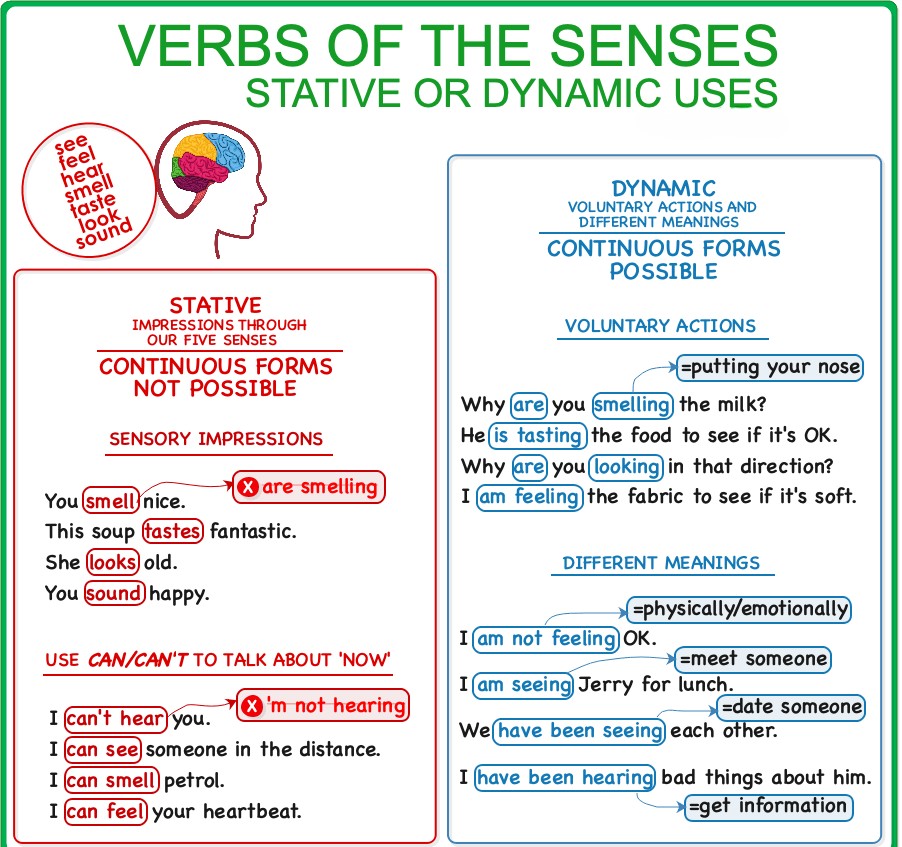
Verbs like feel, hear, see, smell, taste, look, and sound can be used as stative (non-action) or dynamic (action) verbs — and the meaning changes depending on the form. This guide explains when to use simple vs. continuous tenses, and how to use these verbs with adjectives, nouns, infinitives, and gerunds.
🔵 Stative Uses (Non-Action)
When describing **sensory impressions** (what we passively perceive), these verbs are stative and **cannot be used in continuous tenses**.
- You smell nice. ❌ (NOT *You are smelling*)
- This soup tastes fantastic. ❌ (NOT *is tasting*)
- She looks tired. ❌ (NOT *is looking*)
- That sounds great!
- I feel cold.
➤ Use “can/can’t” for present perception
Never use present continuous to describe what you’re sensing right now.
- I can see a bird on the roof. ❌ (NOT *I’m seeing*)
- I can’t hear you — speak louder! ❌ (NOT *I’m not hearing*)
- I can smell smoke. ❌ (NOT *I’m smelling*)
- I can feel your hand shaking.
🟢 Dynamic Uses (Voluntary Actions)
Download full-size image from Pinterest
When the verb describes an **intentional action**, we **can** use continuous tenses.
- Why are you smelling the milk? (= checking if it’s bad)
- He’s tasting the sauce to see if it needs salt.
- I’m feeling the fabric — it’s so soft!
- Why are you looking at me like that?
➤ “Feel” for emotions or health
- “How are you feeling?” “I’m not feeling well.”
- After the surgery, I was feeling very weak.
➤ “See” and “hear” with different meanings
- I’m seeing Jerry for lunch. (= meeting)
- We’ve been seeing each other for months. (= dating)
- I’ve been hearing strange things about him. (= receiving reports)
🟣 Sense Verbs + Infinitive or Gerund
After see, hear, feel, watch, notice, we choose between bare infinitive and gerund (-ing) based on whether the action was **complete** or **in progress**.
➤ Bare Infinitive = complete/short action
- I saw them kiss. (= I saw the whole kiss)
- I heard her sing a song.
➤ Gerund (-ing) = action in progress or repeated
- I saw them kissing. (= I saw part of it)
- I heard her singing in the shower.
- They watched the man hitting the officer. (= repeatedly)
🟡 Sense Verbs as Linking Verbs
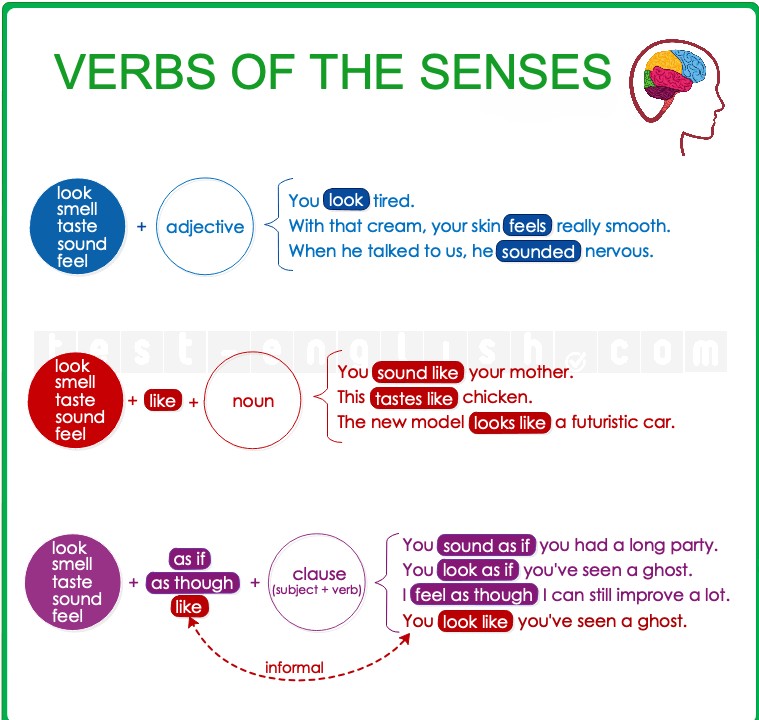
When used as linking (copular) verbs, sense verbs are followed by **adjectives** (not adverbs), nouns, or clauses.
➤ + Adjective
- You look tired. ✅ (NOT *tiredly*)
- She felt bad after the argument.
- The soup tastes salty.
➤ + like + noun
- You sound like your mother.
- This tastes like chicken.
➤ smell/taste OF vs. LIKE
- The soup smells of cheese. (= contains cheese)
- The soup smells like cheese. (= similar smell)
➤ + as if / as though + clause
- You sound as if you had a long party.
- You look as though you’ve seen a ghost.
- Informal: “You sound like you had a long party.”
🔷 Seem, Appear, and Look
➤ seem/appear + adjective / like + noun / as if + clause
- You seem tired.
- He seems like a nice guy.
- It seems as if they won’t come.
- Informal: “It seems like we’ll never find out.”
➤ seem/appear + to + infinitive
- She appears to be happy.
- He seems to have lost his keys.
➤ seem vs. look
- “You look tired.” → based on **appearance** (face, eyes)
- “You seem tired.” → based on **behavior** (voice, movements)
- She looks beautiful. ✅ (visual)
- She seems nice. ✅ (personality)
⚠️ Common Mistakes to Avoid
❌ You are smelling nice.
✅ You smell nice. (stative)
❌ She looks tiredly.
✅ She looks tired. (adjective after linking verb)
❌ I saw him to kiss her.
✅ I saw him kiss her. (bare infinitive)
Related tests:
Verbs of the senses: look, sound, feel, etc.