Grammar / B2 Grammar lessons and exercises / ‘There’ and ‘it’: Preparatory subjects
There and It: Preparatory Subjects
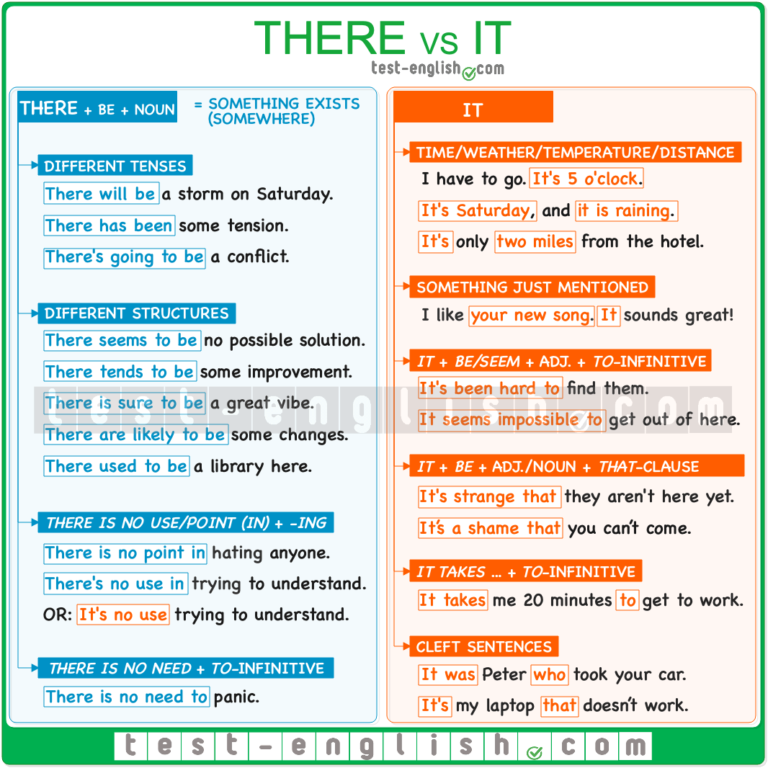
In English, we often use “there” and “it” as preparatory (or dummy) subjects. They don’t carry real meaning but help structure the sentence when the true subject comes later. Understanding when to use each is key to sounding natural and grammatically correct.
🟦 “There” as a Preparatory Subject
We use there + be to say that something exists or happens. The real subject comes after the verb.
➤ Basic Structure: There + be + noun
- There are lots of people in the waiting room.
- There used to be a fancy restaurant on this street.
➤ All Tenses & Modals
“There + be” works in any tense, voice, or with modals:
- There will be a storm on Saturday.
- There has been some tension between the participants.
- There must be something wrong here.
- There’s going to be a conflict.
➤ Other Structures with “There”
We can use “there” with verbs like seem, tend, or expressions of probability:
- There seem to be no consequences.
- There tends to be an evolutionary arms race in nature.
- There is sure to be a full house at the festival.
- There are likely to be side effects.
➤ “There used to be” (Past Habit/State)
- There used to be a library here.
- There didn’t use to be any bars in our neighbourhood.
➤ “There is no use/point/need...”
- There is no point in hating those who hate you.
- There is no use in trying to make him understand.
- There is no need to panic.
- There is no need for you to worry.
🟩 “It” as a Preparatory Subject
➤ Time, Weather, Temperature, Distance
- It’s 5 o’clock.
- It’s Saturday tomorrow.
- It’s snowing.
- It’s very hot today; it’s 35 degrees.
- It’s only 2 miles from the hotel.
➤ Referring to Something Already Mentioned
- “What is that?” — “It seems like an old piece of metal.”
- I read a good book last week. It was my second this month.
➤ “It + be + adjective + to-infinitive”
Used when the real subject is a long infinitive phrase:
- It seems impossible to get out unharmed.
- It’s been hard to go through all the difficulties.
- It’s nice to hear from you again.
💡 Also common: It + be + noun + to-infinitive→ It would be a pleasure to have you at my house.
➤ “It + be + adjective + that-clause”
- It’s unlikely that they will agree.
- It’s surprising that the paramedics saved her.
- It’s wonderful that we can all be here.
💡 Also common: It + be + noun + that-clause→ It’s a shame that you can’t come.
➤ “It takes … to + infinitive”
Used to talk about time required:
- It takes me 20 minutes to get to work.
- How long did it take you to write your essay?
➤ Cleft Sentences (for Emphasis)
“It” introduces a cleft sentence to highlight part of the message:
- It was Peter who took your car.
- It’s my laptop that doesn’t work.
- It was in the evening that they arrived.
🟪 When “There” and “It” Overlap
With expressions like “no use”, both “there” and “it” are possible:
- It’s no use arguing with your brother.
- There’s no use (in) arguing with your brother.
💡 Both are correct and common—“it” is slightly more frequent in modern usage.
⚠️ Common Mistakes to Avoid
❌ Is a problem with the system.
✅ There is a problem with the system.
❌ It are many reasons to celebrate.
✅ There are many reasons to celebrate.
❌ There is 5 o’clock.
✅ It is 5 o’clock.
💡 Remember:→ Use “There” for existence. → Use “It” for time, weather, distance, or delayed subjects.
Chart based on content from test-english.com
© Copyright 2016–2025 test-english.com — All rights reserved.
Related tests: Cleft sentences – adding emphasis, Gerund or infinitive: Verb patterns