Grammar / B2 Grammar lessons and exercises / Relative clauses: Defining and non-defining
Defining vs Non-Defining Relative Clauses
There are two types of relative clauses: defining and non-defining. In the grammar chart below, you can see the main differences between them.
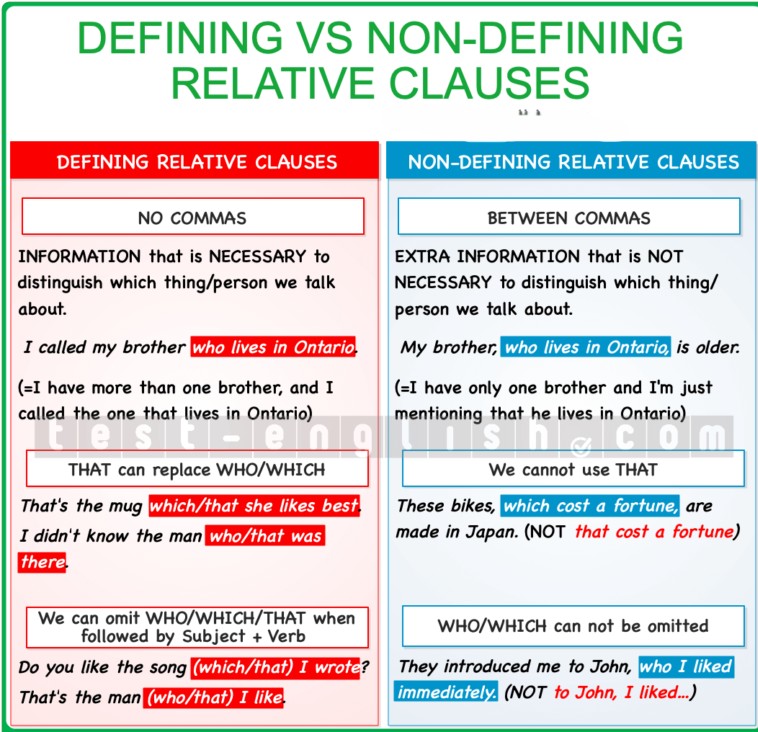
Download full-size image from Pinterest
🟦 Relative Pronouns
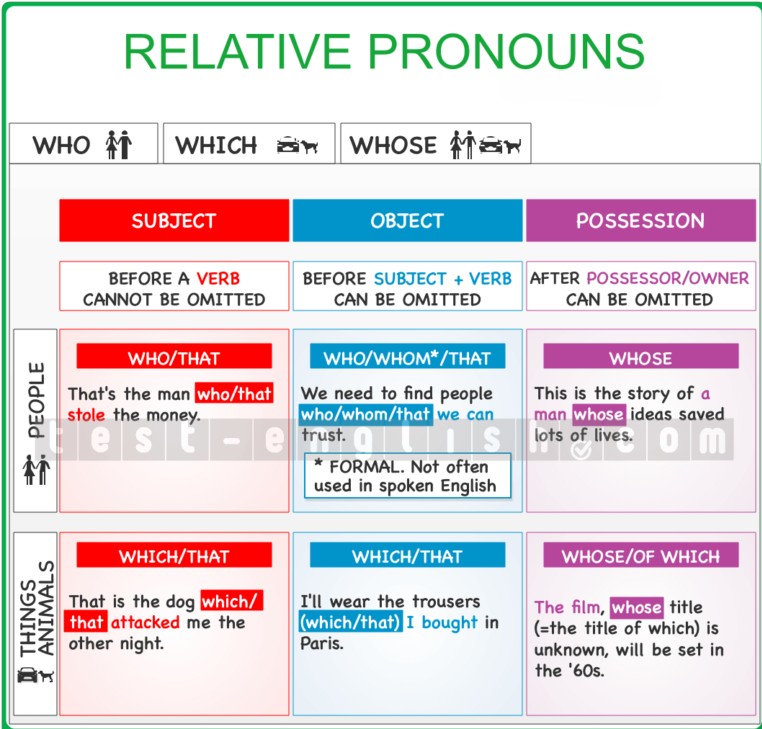
Relative pronouns are the words that introduce relative clauses. They can act as the subject or the object of the relative clause.
❗ Note:
That can be used in informal English instead of who/whom/which, but it is never used after a comma (in non-defining relative clauses) or after a preposition.
- That’s the man who/that offered me the job.
- My mother’s older brother, who lives in New York, is coming to visit. (NOT that)
- That’s the house in which they lived all their lives. (NOT in that)
Which/that vs What
We use which/that as relative pronouns. They refer back to a noun or sentence.
- I gave her the letter which/that I had been keeping since the war. (which/that = the letter)
- He offered to help us, which was a nice gesture. (which = the whole action)
We don’t use what as a relative pronoun. It cannot refer back to a noun or sentence.
❌ I gave her the letter what I had been keeping since the war.
❌ He offered to help us, what was a nice gesture.
We use what independently to mean “the thing/s that”:
- I didn’t like what he did. = I didn’t like the thing/s that he did.
- What I don’t understand is why we are here. (what = the thing that)
🟩 Prepositions in Relative Clauses
Preposition + relative pronoun
It’s not very common to use prepositions before relative pronouns; we only do it in formal language.
- He wrecked the car for which he had paid a fortune.
- He was a man for whom everybody had great respect.
❗ Note:
After a preposition, we can only use whom or which. (NOT who or that).
We can also use whose after a preposition:
The team signed the young Maradona, in whose skills everybody had their hopes.
Preposition at the end of the relative clause
The most common position of the preposition is at the end (informal/spoken English).
- He wrecked the car (which/that) he had paid a fortune for. (Informal)
- The man (who/that) I spoke to was kind.
🟪 Relative Adverbs
Relative adverbs introduce relative clauses about time (when), place (where), or reason (why).

- The coach changed the time when the players had to get up.
- The bench where they were sitting was dirty.
❗ Note:
We can use preposition + which instead of a relative adverb. This structure is more formal and less common.
- The time at which the players had to get up.
- The bench on which they were seated.
🟨 Quantifier + of which/whom
In non-defining relative clauses (= between commas), we can use of which/whom after quantifiers like some, any, none, all, both, several, enough, many, few.
- Their daughters, both of whom are in university, don’t visit them very often.
- The students, none of whom had failed the exam, were thrilled.
- Their house was full of cats, most of which had been found in the street.
- The two rooms, neither of which had windows, were small and dirty.
We can also use quantifier + of whose:
- I belong to a reading club, most of whose members are retired teachers.
- The parents, some of whose children were already grown-ups, marched down the street.