Grammar / B2 Grammar lessons and exercises / Reflexive and reciprocal pronouns
Reflexive and Reciprocal Pronouns
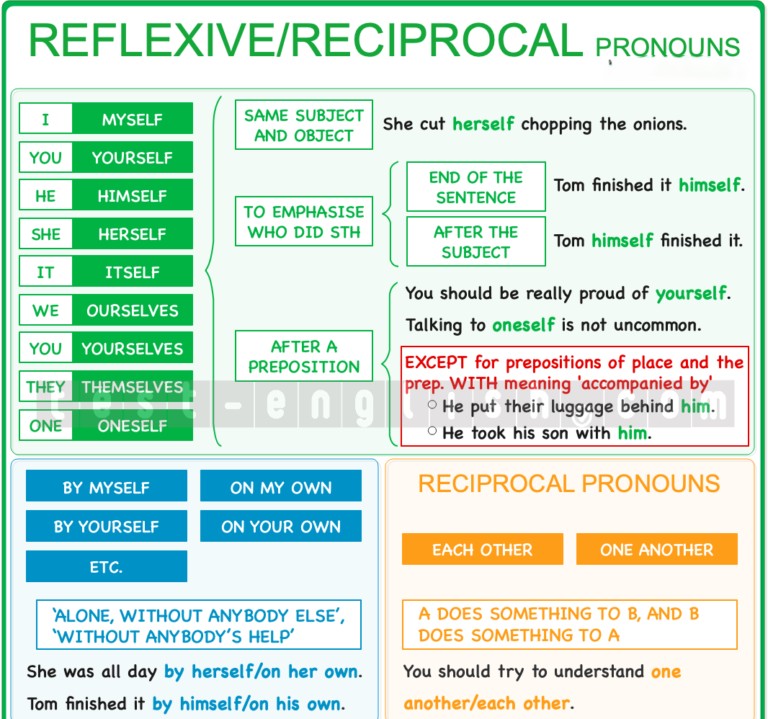
Reflexive and reciprocal pronouns help us express when someone acts on themselves or when two or more people act on each other. This guide covers their forms, uses, and common mistakes — perfect for B1–B2 learners.
🟦 Reflexive Pronouns
Forms: myself, yourself, himself, herself, itself, ourselves, yourselves, themselves(Also: oneself – formal/generic)
➤ 1. Same Subject and Object
Use a reflexive pronoun when the subject and object are the same person.
- She cut herself chopping onions.
- We really enjoyed ourselves at the party.
- Talking to oneself isn’t always a sign of madness.
➤ 2. After Prepositions (Except Place & "with")
Use reflexive pronouns after most prepositions **if they refer back to the subject**.
- He’s proud of himself.
- You can print a model of yourself.
❌ She sat in front of herself.
✅ She sat in front of her. (Preposition of place → use object pronoun)
❌ He went to the park with himself.
✅ He went to the park with his son. (No reflexive after "with" for accompaniment)
➤ 3. For Emphasis (Intensive Use)
Add a reflexive pronoun to stress that the subject did something personally.
- I’ll speak to the manager myself.
- Paul himself designed the whole website.
- You should do it yourself, not ask someone else.
➤ 4. “By + Reflexive” = Alone or Without Help
- My daughter doesn’t like being by herself.
- She raised four children by herself.
- Also: on my own, on your own (same meaning)
🟨 Common Mistake: Unnecessary Reflexives
In English, many everyday verbs **do not** take reflexive pronouns — even if they do in other languages.
❌ I washed myself and shaved myself.
✅ I washed and shaved.
❌ The door opened itself.
✅ The door opened.
✅ Common verbs that don’t need reflexives:wash, shave, dress, relax, hurry, sit, stand, open, close, wake up, feel, meet
🟪 Reciprocal Pronouns: Each Other / One Another
Use these when two or more people do something **to or for one another**.
➤ Basic Use
- The twins hadn’t seen each other in ten years.
- We should help one another in difficult times.
➤ Possessive Forms
Add ’s to show possession.
- They were found in each other’s arms.
- The couple enjoyed one another’s company.
💡 Note: “Each other” is more common in modern English. “One another” is slightly more formal, but both are correct.
✅ Quick Summary
- Use reflexives only when subject = object.
- Never use reflexives after prepositions of place (in front of her, not herself).
- Don’t add reflexives to verbs like wash, dress, relax.
- Use each other or one another for mutual actions.