Grammar / B2 Grammar lessons and exercises / Possessive ’s with time expressions: Two hours’ walk
The Possessive ’s with Time Expressions
We don’t normally use the possessive ’s with inanimate objects. Instead, we usually use of. However, time expressions are a common exception—we often use the possessive ’s to show duration.
🟦 When to Use the Possessive ’s with Time
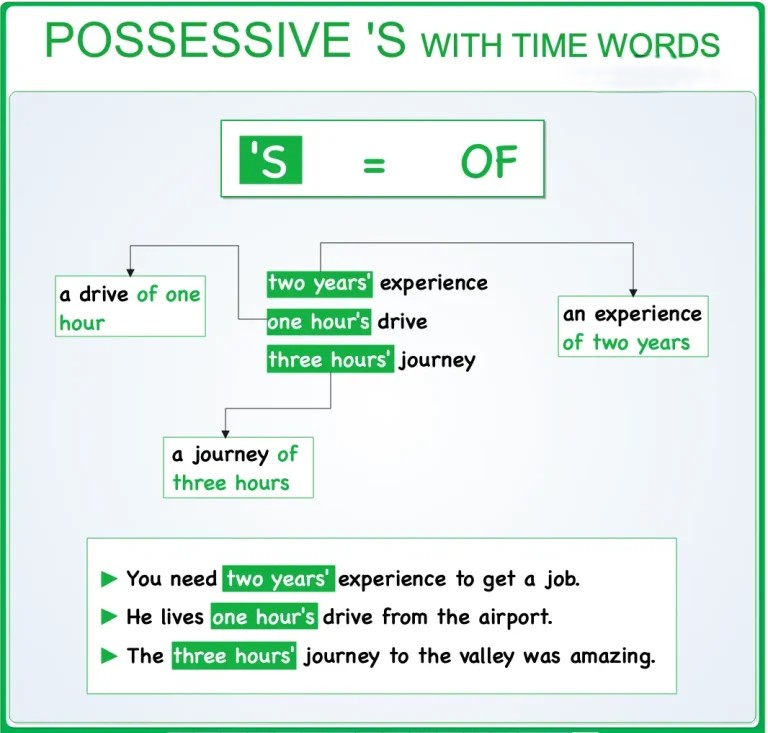
The possessive ’s is used with time words to describe how long something lasts:
- You need two years’ experience to get a job. (= an experience of two years)
- He lives one hour’s drive from the airport. (= a drive of one hour)
- The three hours’ journey to the valley was amazing. (= a journey of three hours)
🔍 Quick test: Try replacing the phrase with “of”. If it makes sense, use the possessive form.
- ✅ two years’ experience → “an experience of two years” → correct
- ❌ two months old → “two months of old” → nonsense → no possessive!
- ❌ nine months pregnant → “nine months of pregnant” → incorrect
❌ The apostrophe is sometimes omitted (e.g., two years experience), but this is generally considered grammatically incorrect.
🟩 Singular vs. Plural Time Expressions
➤ Singular time words → add ’s
- one year’s notice
- an hour’s walk
- a day’s work
➤ Plural time words (ending in -s) → add only ’ (apostrophe)
- three years’ notice
- two hours’ walk
- ten minutes’ delay
💡 Note: A two-day journey = two days’ journey(Both are correct—but used in different grammatical structures!)

🟪 Compound Adjectives with Numbers + Time
We often place a number + time word **before a noun** to describe duration. In this case:
- The time word is singular
- The number and time word are joined by a hyphen
- It functions as a compound adjective
Examples:
- a four-hour journey = four hours’ journey
- a thirty-minute delay = thirty minutes’ delay
- a two-hour drive = two hours’ drive
➤ This pattern also works for other measurements:
- a one-hundred-dollar bill
- a five-litre bottle
- a twenty-foot container