Grammar / B2 Grammar lessons and exercises / Participle clauses
Participle Clauses
Download full-size image from Pinterest
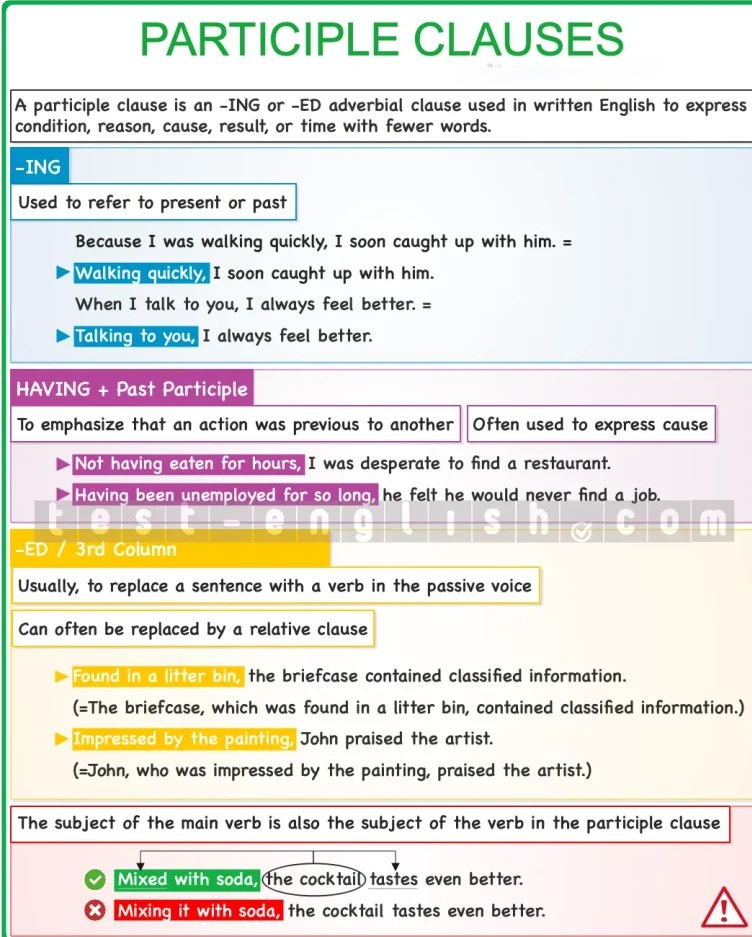
Participle clauses are not very common in spoken English, but they appear frequently in written English. They allow us to express time, reason, cause, result, or condition more concisely than full adverbial clauses—using fewer words while keeping the same meaning.
🔹 What Are Participle Clauses? (Examples)
- After she had finished the exam, she felt very happy. →Having finished the exam, she felt very happy. (time)
- As she didn’t know where the theatre was, she asked for directions. →Not knowing where the theatre was, she asked for directions. (reason)
🟩 -ING Participle Clauses
These are the most common type. They refer to actions happening at the same time as the main clause or provide background information (reason, time, or condition).
- Being such a great singer, she had no problems finding a job. (= As she was such a great singer…)
- Talking to you, I always feel better. (= When I talk to you…)
- Walking quickly, I soon caught up with him. (= Because I was walking quickly…)
🟪 Having + Past Participle
This perfect participle form emphasizes that one action happened before the main action—often showing cause or reason.
- Having lost all the games, he felt depressed. (= After he had lost all the games…)
- Not having eaten for hours, I was desperate to find a restaurant. (= Because I hadn’t eaten for hours…)
Passive Perfect: Having been + past participle
- Having been unemployed for so long, he felt he would never find a job. (= Since he had been unemployed…)
- Having been offered a promotion, she decided to stay in the company. (= Since she had been offered…)
🟨 -ED / Past Participle Clauses
These usually replace passive voice constructions and describe the subject of the main clause.
- Found in a litter bin, the briefcase contained classified information. (= The briefcase was found in a litter bin.)
- Impressed by the painting, John praised the artist. (= John was impressed by the painting.)
- Founded 20 years ago, the company has received many awards. (= The company was founded 20 years ago.)
- Located in the city centre, the bar is very popular among tourists. (= The bar is located in the city centre.)
🔍 Note: These can often be rewritten as non-defining relative clauses:“The briefcase, which was found in a litter bin, contained…”
🔵 Used After Prepositions or Conjunctions
Participle clauses (especially -ing) often follow prepositions or conjunctions like after, before, instead of, without, when, while.
- Remember to take your bags when leaving the bus.
- Instead of listening to me, Tom left the room.
- After having lost many games, he felt depressed.
- I visited her after talking with her mother.
- People often use their phones while driving.
🟥 Be Careful! Common Mistake
The subject of the participle clause must be the same as the subject of the main clause.
- ❌ Mixing it with soda, the cocktail tastes even better.(Who is mixing? “You” vs. “the cocktail” → different subjects!)
- ✅ Mixed with soda, the cocktail tastes even better.(Passive: the cocktail is mixed → same subject)
- ❌ Watering them at night, the plants live longer.
- ✅ Watered at night, the plants live longer.