Grammar / B2 Grammar lessons and exercises / Unless, even if, provided, as long as, etc.: Other expressions in conditionals
Other Expressions in Conditionals
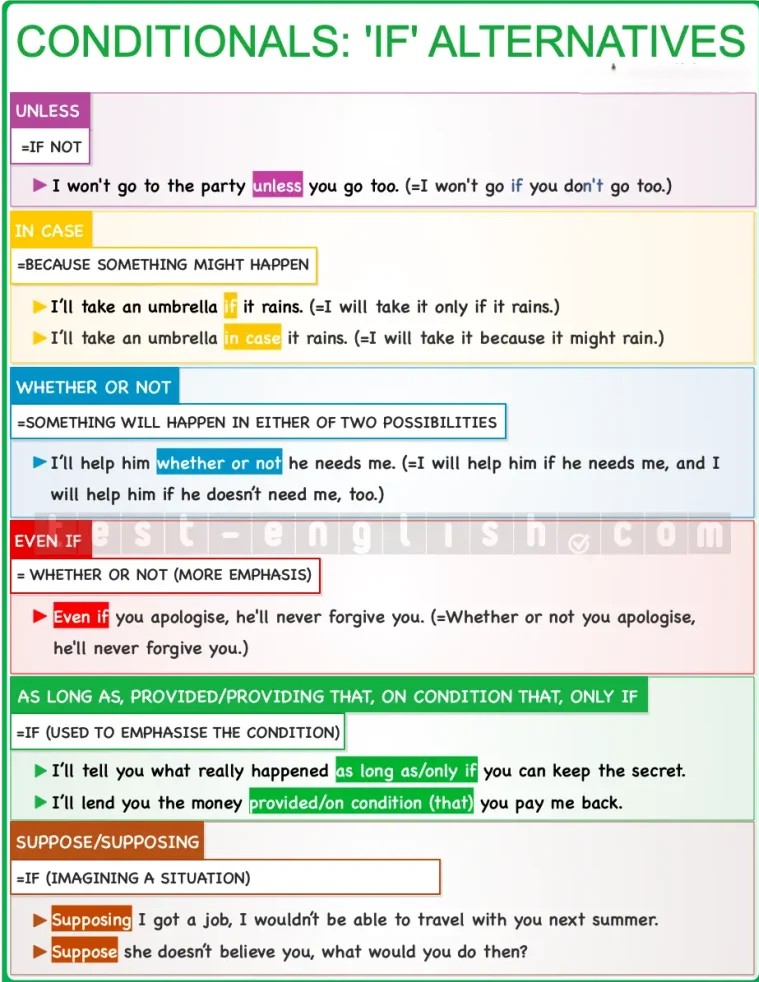
Beyond “if”, English offers many useful expressions to introduce conditional clauses. These include unless, in case, as long as, provided (that), even if, whether or not, suppose, and more. Understanding them helps you express conditions, possibilities, and hypothetical situations with greater nuance—especially at B2 level and above.
🔴 Unless (= if … not)
Use unless to mean “if not”. It introduces a negative condition.
- I won’t go on holiday unless I save some money.
(= I won’t go on holiday if I don’t save some money.) - You’ll fail the exam unless you study.
💡 Note: Never use not after unless (“unless you don’t” is incorrect).
🟦 In case
Use in case to talk about actions taken as a precaution—because something might happen.
- I’ll take my umbrella in case it rains.
(= because it might rain) - Keep your receipt in case you need to return the item.
💡 Note: “In case” ≠ “if”. We don’t use “in case” for general conditions—only for preparation.
🟩 As long as / Provided (that) / Providing (that) / On condition (that) / Only if
These phrases emphasize that a condition must be met for something to happen.
- I’ll tell you what really happened as long as you keep the secret.
- I’ll lend you the money provided (that) you pay me back next month.
- They will speak to the press on condition (that) they remain anonymous.
- We will invest the money, but only if you can prove it’s safe.
💡 Only if is the most restrictive—it implies the condition is absolutely necessary.
🟪 Whether or not
Use this to say that something will happen regardless of two possible situations.
- I’ll help him if he needs me.
(= only if he needs me) - I’ll help him whether or not he needs me.
(= I’ll help him even if he doesn’t need me) - Whether or not it rains, the match will go ahead.
🟨 Even if
Use even if to emphasize that a result will stay the same despite a condition.
- Even if you apologise, he’ll never forgive you.
(= Whether or not you apologise, he won’t forgive you.) - I wouldn’t trust him, even if he promised to be honest.
🟦 Suppose / Supposing
These are used to introduce hypothetical or imaginary situations—similar to “what if”.
- Supposing I got a job, I wouldn’t be able to travel with you next summer.
- Suppose she doesn’t believe you; what would you do then?
- Supposing it snows, will the school close?
💡 Often used in spoken English to explore possibilities or give advice.