Grammar / B2 Grammar lessons and exercises / Modal verbs: Permission, obligation, prohibition, necessity
Permission
The most common modal verbs to talk about permission are can, could, may, and might.
Asking for Permission
- Informal: Can I sit here?
- Formal: Could I use this chair? / May I use this chair? / Might I use this chair?
Giving Permission
- Informal: You can sit here.
- Formal: You may use this chair.
Refusing Permission
- Informal: Sorry, you can’t use this chair.
- Formal: Sorry, you may not use this chair.
Permission in the Past
To talk about permission in the past, we use was/were allowed to or the negative couldn’t. ❗ We do not use the affirmative could for past permission.
- He wasn’t allowed to sit down during the lesson.
- He couldn’t sit down during the lesson.
- He was allowed to receive visits.
- ✅ He could receive visits. → This is acceptable in some contexts (especially British English), but generally avoided in formal grammar teaching.
Obligation
Download full-size image from Pinterest
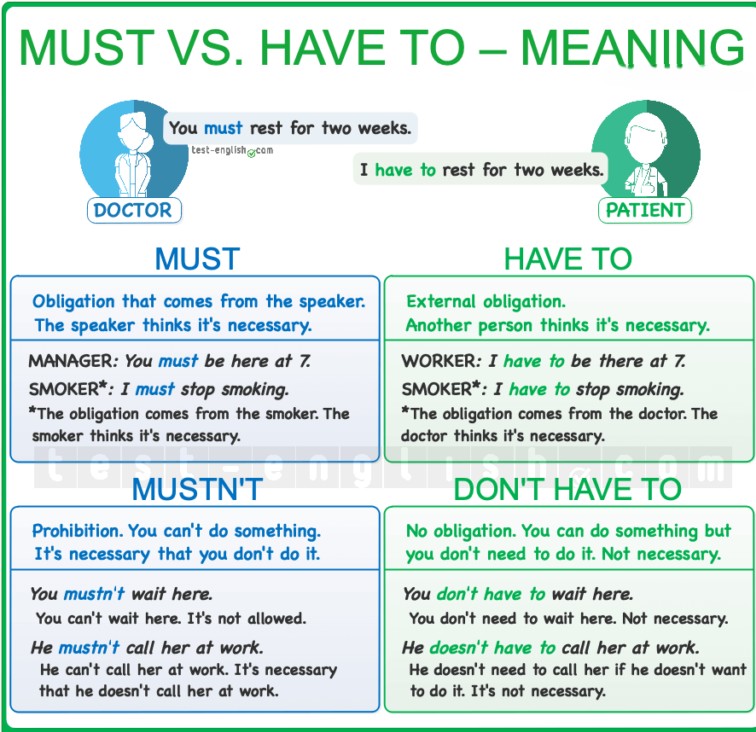
Must / Have to
Both express obligation, but the source differs:
- I must give up smoking. → Personal decision (speaker’s own rule).
- I have to give up smoking. → External rule (doctor, law, etc.).
In informal English, we often use ’ve got to:
- I’ve got to be there before ten.
In the past, we always use had to:
- I had to give up smoking. (personal or external)
Mustn’t / Don’t have to
These negatives have very different meanings:
- You mustn’t reveal the source. → Prohibition (it’s forbidden).
- You don’t have to arrive before 7. → No obligation (it’s optional).
Necessity
Download full-size image from Pinterest
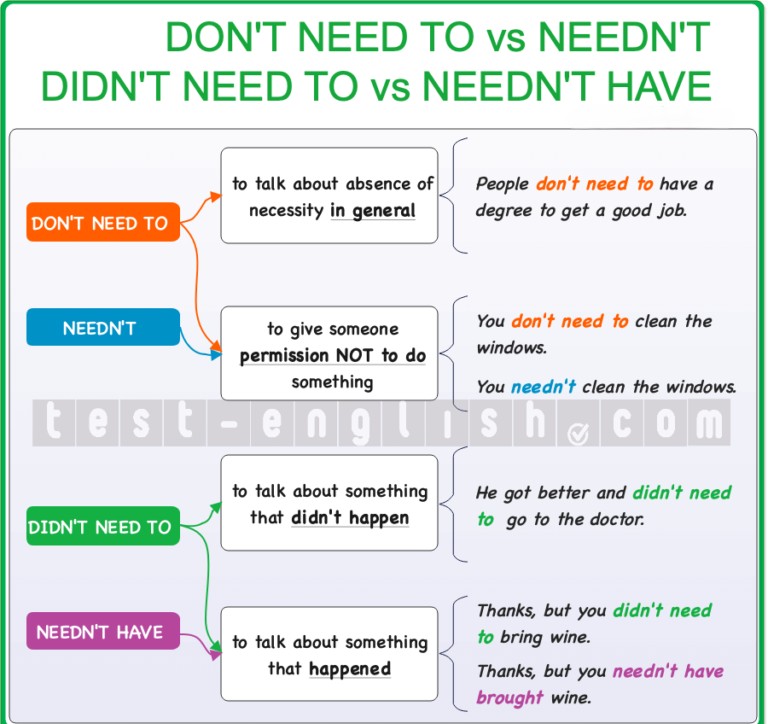
Need to / Don’t need to
Used to say something is (or isn’t) necessary:
- We need to/have to confirm our reservations before Friday.
- You don’t need to/don’t have to believe in God to be good.
Don’t need to vs. Needn’t
- General necessity: I don’t need to wear glasses. (always)
- Specific occasion: You don’t need to / needn’t wash the dishes. (just now)
Didn’t need to vs. Needn’t have
- You did it, but it wasn’t necessary:You didn’t need to buy / needn’t have bought anything. ✅
- You didn’t do it, and it wasn’t necessary:I didn’t need to buy anything. ✅ ❌ I needn’t have bought anything. → (implies you DID buy it!)
Other Expressions: Permission, Possibility & Obligation
Download full-size image from Pinterest
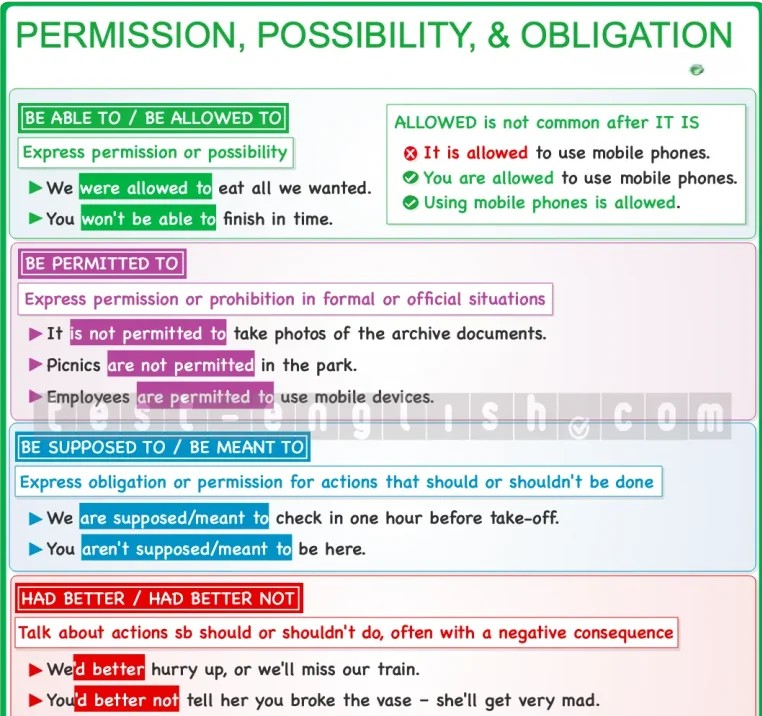
Be able to / Be allowed to
Used instead of can/could for permission or ability, especially in tenses where can isn’t available.
- We were allowed to eat all we wanted.
- You won’t be able to finish on time.
💡 We do not say: “It is allowed to...”✅ Say: “You are allowed to...” or “Using phones is allowed.”
Be (not) permitted to
Formal way to state rules or laws. Both personal and impersonal forms are possible.
- It is not permitted to take photos.
- Picnics are not permitted in the park.
- Employees are permitted to use mobile devices.
Be supposed to / Be meant to
Express expected behavior, rules, or plans.
- We are supposed/meant to check in one hour before take-off.
- You aren’t supposed/meant to be here!
Had better / Had better not
Used for strong advice or warnings (often with negative consequences). Always use ’d better (not “hadn’t better”).
- We’d better hurry up or we’ll miss our train.
- You’d better not tell her you broke the vase—she’ll get very mad.
- ❌ You hadn’t better tell her...