Grammar / B2 Grammar lessons and exercises / Inversion with negative adverbials: Adding emphasis
Inversion with Negative Adverbials: Adding Emphasis
In formal or emphatic English, we often place a negative or restrictive adverbial at the beginning of a sentence to add drama, emphasis, or stylistic weight. When we do this, we must use inversion: the auxiliary verb comes before the subject (just like in questions). This structure is common in writing, speeches, and advanced spoken English.
Example:
I could find my keys nowhere. → Nowhere could I find my keys.
I understand the true meaning only now. → Only now do I understand the true meaning.
If there’s no auxiliary verb in the original sentence, we add do / does / did to form the inversion.
🟦 Common Negative or Restrictive Adverbials
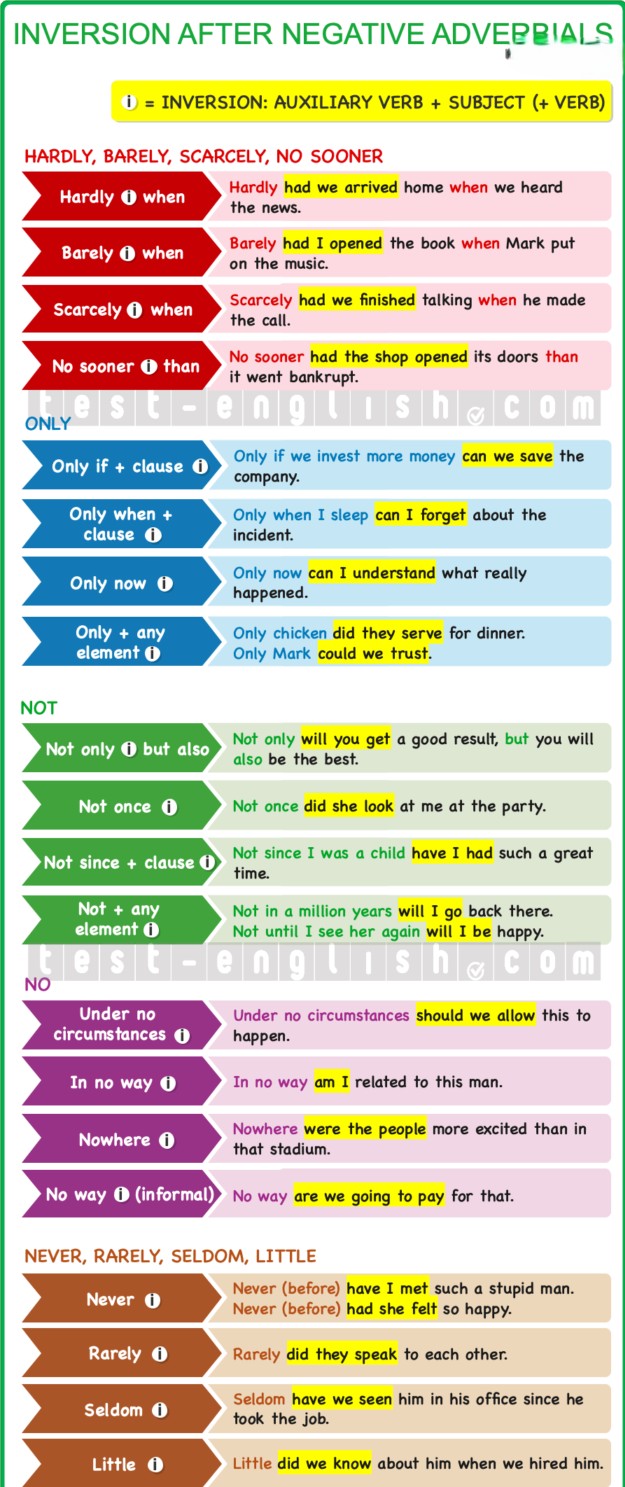
These expressions often trigger inversion when placed at the start of a sentence:
- Never, rarely, seldom, hardly, barely, scarcely
- No sooner... than
- Not until, not since, not only... but also
- Only after, only when, only if, only by, only then
- Little, under no circumstances, on no account, in no way, at no time
🟩 Hardly, Barely, Scarcely, No Sooner
These are used in narratives to describe two events happening in quick succession. They require past perfect in the inverted clause and are followed by specific conjunctions:
- Hardly / Barely / Scarcely + had + subject + past participle + when...
Hardly had I arrived home when my phone rang. - No sooner + had + subject + past participle + than...
No sooner had they launched the product than it failed.
💡 Important: Use than after no sooner—never when or that.
🟪 Only + Phrase or Clause
When only is followed by a phrase or clause (e.g., only when, only if, only after), that clause comes first and uses normal word order. The inversion happens in the main clause.
- ❌ Only when do I sleep I can forget...
✅ Only when I sleep can I forget about the accident. - ❌ Only if will you succeed you try hard.
✅ Only if you try hard will you succeed.
💡 Tip: Remove the "only" phrase and check the base sentence: I can forget... only when I sleep. → The main verb is can forget, so inversion applies to that part.
🟨 Not Until / Not Since
Like "only" structures, these begin with a subordinate clause (normal word order), followed by an inverted main clause.
- ❌ Not since was I a child I have had...
✅ Not since I was a child have I had such a great time. - Not until she arrived did I say anything.
🔵 Not + Other Elements (Not Often, Not for a Moment, etc.)
"Not" must be combined with another word (e.g., often, once, for a moment) before inversion.
- ❌ Not can we see such art often.
✅ Not often can we see such great expressions of art. - Not once did he apologise.
🟥 Negative Adverbs of Frequency: Never, Rarely, Seldom
These adverbs trigger inversion when placed at the beginning. With never, we often use perfect tenses to talk about life experiences.
- Never have we faced such a challenge!
- Rarely has the Queen cried in public.
- Seldom do people admit their mistakes.
💡 Final Tip
If you're unsure whether to invert, try removing the negative adverbial and look at the original sentence. The subject and verb that come first in the normal sentence are the ones that get inverted when the adverbial moves to the front.