Grammar / B2 Grammar lessons and exercises / Have: Auxiliary or main verb
Have: Auxiliary or Main Verb?
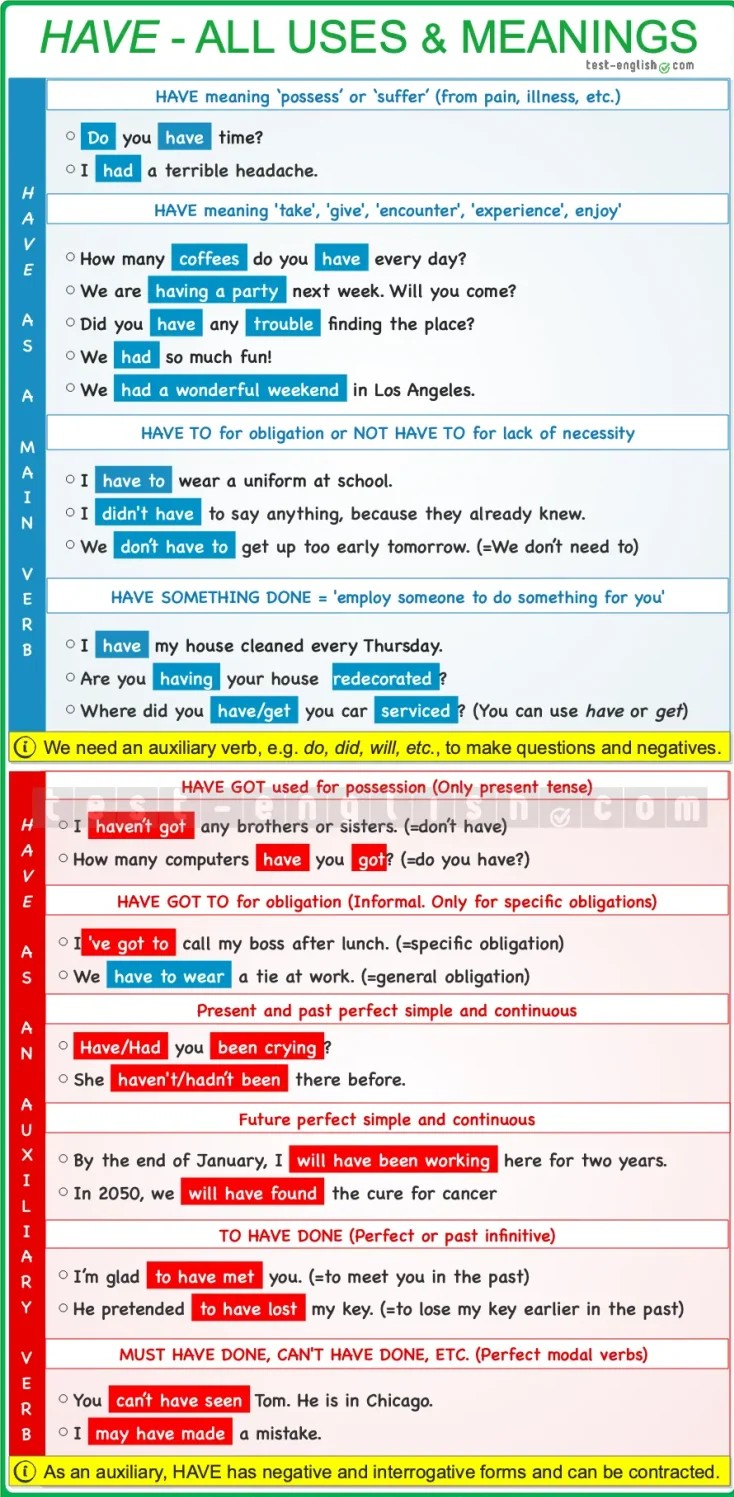
The verb have is one of the most common — and most confusing — verbs in English. It can act as a main verb (like “possess”, “experience”, or “consume”) or as an auxiliary verb (helping form perfect tenses or obligation structures). Let’s break down its many uses so you can master them all.
🟦 Have as a Main Verb
When have is a main verb, it behaves like any other verb: you need do/does/did to form questions and negatives. It’s often not contracted in formal writing.
➤ Meaning “possess” or “suffer”
Used for ownership or experiencing something (like illness, pain). It’s a stative verb → cannot be used in continuous tenses.
- Do you have time?
- I’ve had this watch since I was a child.
- I have a terrible headache.
➤ “Have to” for obligation (external rules)
Expresses necessity, often from outside sources (laws, rules, parents, etc.). Also stative.
- We have to wear a uniform at school.
- Remember you have to return the book.
- You won’t have to show credentials.
- I didn’t have to say anything.
💡 Note: “Don’t have to” = lack of necessity (not prohibition). “You don’t have to go” = It’s optional.
➤ “Have something done” (causative)
Means you arrange for someone else to do something for you — or something bad happens to you.
- I have my house cleaned every Thursday.
- He had his wallet stolen in Piccadilly.
- They had their house destroyed by fire.
✅ Dynamic verb → can be used in continuous tenses:
- We are having the house redecorated.
💬 Informal: Use get instead of have: “Where did you get your car serviced?”
➤ “Have” meaning “take”, “give”, “experience”, etc.
Depends on the noun that follows. Often means:
- Take: a shower, meal, lesson, massage → “I’m going to have a massage.”
- Give: a party → “We are having a party next week.”
- Encounter: trouble, difficulties → “Did you have any trouble?”
- Experience/enjoy: day, time, weather → “We had so much fun!”
✅ Dynamic verb → can be continuous:
- I’m having problems with my computer.
- We are having fantastic weather.
❗ Always use do/did for questions/negatives:
- Do you have a shower in the mornings?
- You won’t have any trouble.
🟩 Have as an Auxiliary Verb
As an auxiliary, have helps form perfect tenses and can be contracted. It often appears in negative and question forms without “do”.
➤ “Have got” for possession (informal)
In informal English, “have got” = “have” (possession). Here, “have” acts as an auxiliary.
- I haven’t got any siblings = I don’t have any siblings.
- How many computers have you got? = How many computers do you have?
⚠️ Only exists in present tense. For past, use “didn’t have”:
- We didn’t have an umbrella and got wet. (✅)
- We hadn’t got an umbrella... (❌ uncommon / old fashioned)
➤ “Haven’t” for possession (formal/negative)
In some formal or literary contexts, “got” is dropped in negatives:
- I haven’t time to do what I want.
- I haven’t a clue.
- I haven’t the slightest idea.
➤ “Have got to” for obligation (informal, specific)
Informal way to express specific (not general) obligation.
- I’ve got to call my boss after lunch. (✅ specific)
- I have to wear a tie at work. (✅ general rule)
➤ Perfect tenses (present, past, future)
“Have” is essential in all perfect tenses to show completed actions or duration.
- Present perfect: I’ve been writing all morning.
- Present perfect (duration): We’ve been married for ten years.
- Past perfect: She told me she hadn’t been there before.
- Past perfect continuous: I could see she had been crying.
- Future perfect: In 2050, we will have found the cure.
- Future perfect (duration): In 2030, we will have been married 25 years.
- Future perfect continuous: By January, I will have been working here 2 years.
🟪 Advanced: Perfect Infinitives & Modals
➤ Perfect infinitive: “to have + past participle”
Used when the infinitive refers to a past action.
- I’m glad to have met you. (= met in the past)
- He pretended to have lost my number.
➤ Perfect modal verbs: “must have done”, “may have done”, etc.
Used to make deductions or talk about possibilities in the past.
- You can’t have seen Tom — he’s in Chicago.
- I may have made a mistake.
- She must have been tired.
⚠️ Common Mistakes to Avoid
❌ Do you have got a pen? (in questions — informal but redundant)
✅ Do you have a pen? OR Have you got a pen?
❌ I’m having a car. (possession → stative verb)
✅ I have a car. (NOT continuous)
❌ I didn’t had time.
✅ I didn’t have time. (after “did”, use base verb)
💡 Remember: After “do/does/did”, always use have (base form), not “has” or “had”.