Grammar / B2 Grammar lessons and exercises / Distancing: Expressions and passive of reporting verbs
Intentions, Plans, and Decisions: Future Forms in English
A grammar chart titled "Future: Plans & Predictions"
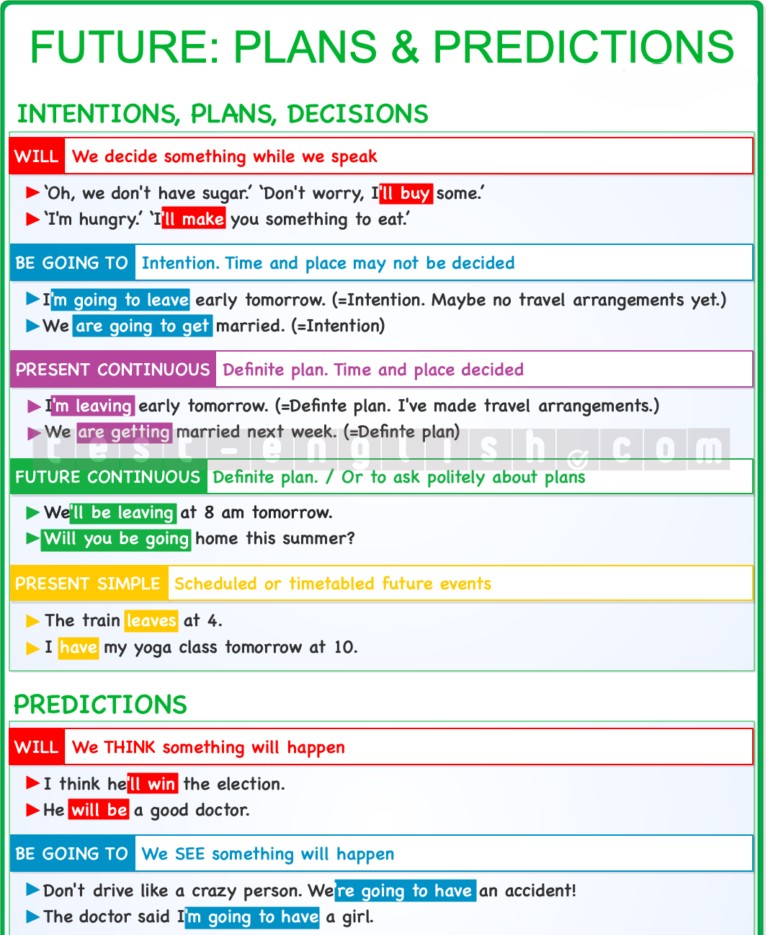
English uses several verb forms to talk about the future—depending on whether we’re expressing a spontaneous decision, a fixed plan, an intention, a prediction, or a scheduled event. This guide explains the key differences.
🟦 Will — Instant Decisions
We use will for decisions made at the moment of speaking.
- “Oh, we don’t have sugar.” — “Don’t worry, I’ll buy some.”
🟩 Present Continuous — Fixed Future Plans
Used for future events that are already arranged—with a specific time and/or place.
- I’m seeing the dentist at 6.
- We are getting married next week.
- I’m flying to New York tomorrow morning.
🟪 Be Going To — Intentions
Expresses future intentions or plans that may not yet be fully arranged.
- I’m going to play tennis with Elisabeth today.
➤ Present Continuous vs. Be Going To
- I’m going to have a drink after work.
(= it’s my intention) - I’m having a drink with some colleagues after work.
(= it has been arranged)
🟨 Future Continuous — Polite Questions & Ongoing Future Actions
Can replace present continuous for planned events (more tentative):
- We’ll be coming next weekend.
- We’ll be leaving at 8 a.m. tomorrow.
Often used to ask politely about someone’s plans:
- Will you be going home this summer?
Also describes actions in progress at a future time:
- This time next week, we’ll be travelling to Paris.
- Tomorrow at 10, you’ll be doing your exam.
🔵 Present Simple — Scheduled Events
Used for timetables, programs, and fixed schedules.
- The train leaves at 4.
- Shops close at 6.
- I have my yoga class tomorrow at 10.
🌸 Predictions
➤ Will — General Predictions
- I think he’ll win the election.
- He will be a good doctor.
➤ Be Going To — Predictions with Present Evidence
- Don’t drive like a crazy person. We’re going to have an accident!
- The doctor said I’m going to have a girl.
🟢 Future Perfect Simple & Continuous
➤ Future Perfect Simple
For actions that will be completed before a specific future time:
- By 2050, researchers will have found a cure for cancer.
- By this time next year, I’ll have graduated.
Also used with stative verbs to express duration up to a future point:
- I will have been in England for six months by the time I leave.
- In 2 years, we will have been married for 20 years.
➤ Future Perfect Continuous
Used with dynamic verbs to emphasize the duration of an ongoing action up to a future time:
- By the end of the year, she will have been working on the publication for over ten years.
- When he steps into the boxing ring on Saturday, he will have been training for about 18 months.
🟠 Future Time Clauses (when, as soon as, until, before, after)
Use the present simple (NOT future) after time conjunctions:
- I’ll retire when I’m 70.
(NOT: when I’ll be) - I won’t call you until I arrive.
(NOT: will arrive)
⚪ Other Uses of "Will"
➤ Promises and Refusals
- I will help you whenever you need me.
- I won’t lend him my car.
➤ Future Facts
- The president will visit the Vatican next November.
➤ Offers
- I’ll carry that bag for you.
- Shall I organise the meeting?
➤ Suggestions
- Shall we eat out today?
➤ Requests
- Will you open the door, please?
A grammar chart titled "Future: Plans & Predictions"
