Ellipsis and substitution: Omitting or replacing words
Grammar / B2 Grammar lessons and exercises / Ellipsis and substitution: Omitting or replacing words
Ellipsis and Substitution: Avoiding Redundancy
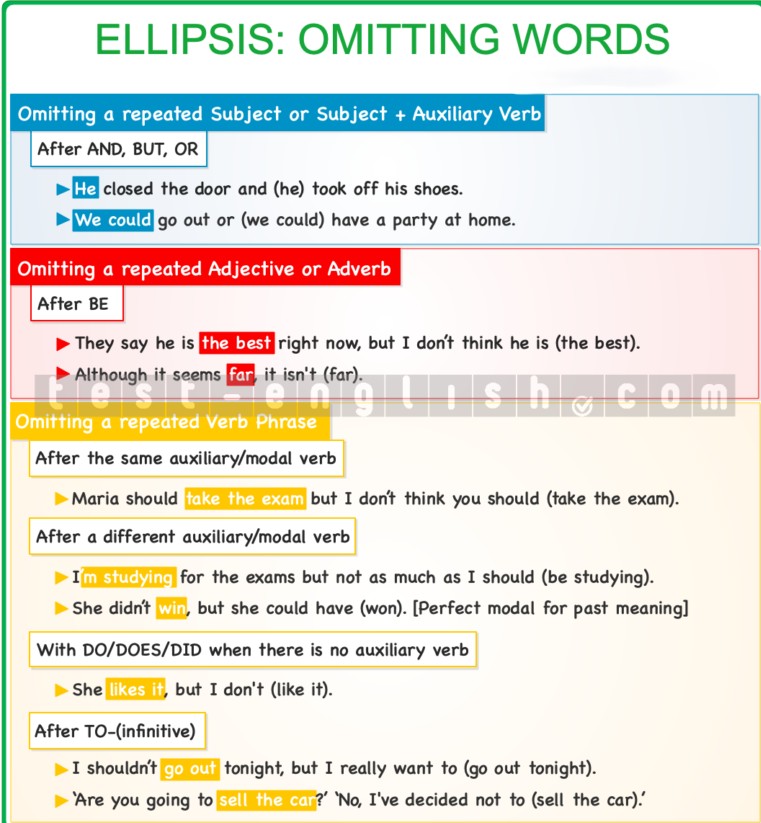
In spoken and written English, we often omit words that are understood from context to avoid repetition and make our language more fluent. This is called ellipsis. Similarly, we can replace repeated words or phrases with short forms like one, do so, or so/neither—this is known as substitution.
🟦 Ellipsis: Omitting Repeated Elements
➤ Repeated Subject or Subject + Auxiliary Verb
After and, but, or or, we can leave out a repeated subject or subject + auxiliary.
- He closed the door and (he) took off his shoes.
- We could go out or (we could) have a party at home.
- She called, but (she) didn’t leave a message.
➤ Repeated Adjective or Adverb after be
- They say he is the best right now, but I don’t think he is (the best).
- Although it seems far, it isn’t (far).
➤ Repeated Verb Phrase
After the same auxiliary/modal:
- Maria should take the exam, but I don’t think you should (take the exam).
- She’ll go to the meeting, but I won’t (go to the meeting).
After a different auxiliary/modal:
- I’m studying for the exams, but not as much as I should (be studying).
- I told you I’d help you, but I can’t (help you).
With past meaning (two auxiliaries):
- She didn’t win, but she could have (won).
- “Did you go?” “No, but I should have (gone).”
With do/does/did (no auxiliary in original):
- She doesn’t like it, but I do.
- She liked it, but I didn’t.
After to- (infinitive) – reduced infinitive:
- I shouldn’t go out tonight, but I really want to (go out).
- “Are you going to sell the car?” “No, I’ve decided not to (sell the car).”
🟩 Substitution: Replacing Repeated Words
➤ One / Ones (for nouns)
- “Do you need a pen?” “No, I’ve already got one.”
- “Which car do you prefer?” “I like the red one.”
- Will you wear these trousers or the ones that I gave you?
- I’d lend you a pen, but this is the only one I have.
➤ Do so (for verb phrases)
- If I can help, I’ll be happy to do so. (= to help)
- I won’t apologise because doing so would be admitting that I was wrong. (= apologising)
- They told me to be quiet, and I did it/that/so. (informal alternatives)
➤ If so / If not
- Do you want to be better at what you do? If so, pay attention to what I have to say. (= If you want to be better…)
- Mr Chen should be there when you arrive. If not, just give me a call. (= If Mr Chen isn’t there…)
➤ So / Not after thinking/speaking verbs
- “Are they coming?” “I think so.” (= they are coming)
- “I didn’t do it.” “If you say so.” (= that you didn’t do it)
- “Is she going to be there?” “I hope so.”
- “Did they leave a copy of the key?” “It doesn’t seem so / It seems not.”
- “Shall we go for a run tomorrow?” “I’m afraid not. I have to be at the office all day.”
- “Will it take long to fix it?” “I don’t think so.”
➤ So / Neither + Auxiliary + Subject (for agreement)
- “I can be there at any time tomorrow.” “So can I.” (= I can too)
- “I shouldn’t take the offer, and neither should you.” (= and you shouldn’t either)
- “I love this book.” “So do I.”
- “We arrived on time, and so did all the other guests.”
🔵 Substitution Chart
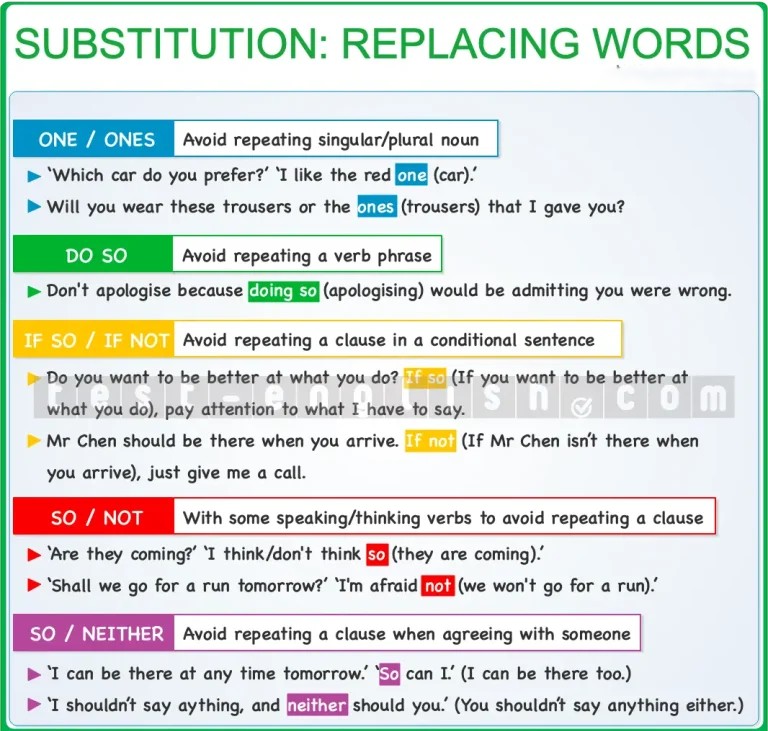
Download full-size image from Pinterest
✅ Quick Summary
- Ellipsis = omitting words that are understood from context (subjects, verbs, adjectives, etc.).
- Substitution = replacing repeated words with short forms like one, do so, so, or neither.
- Use so/neither + auxiliary + subject to agree with someone’s statement.
- These techniques make English more natural, fluent, and less repetitive—especially in conversation.