Distancing: Expressions and passive of reporting verbs
Grammar / B2 Grammar lessons and exercises / Distancing: Expressions and passive of reporting verbs
Passive Voice with Reporting Verbs: Distancing
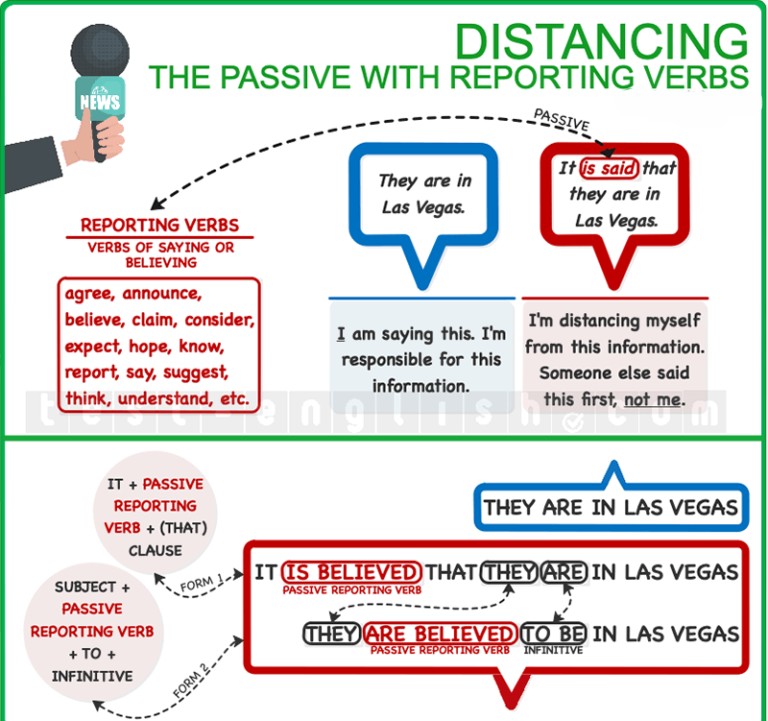
In news reports, academic writing, and formal contexts, we often use the passive voice with reporting verbs (e.g., say, believe, report, claim) to distance ourselves from information—especially when we’re unsure if it’s true or when we want to sound objective.
Common reporting verbs include: agree, announce, believe, claim, consider, expect, hope, know, report, say, suggest, think, understand.
🟦 Structure 1: It + Passive Reporting Verb + That-Clause
This impersonal structure emphasizes the information, not the source.
- It is believed that the murderer is no longer in the country.
- It has been announced that they are going to cancel the tour.
- It has been suggested that the team can’t be trusted defensively.
- It was thought that the building could collapse.
🟩 Structure 2: Subject + Passive Reporting Verb + To-Infinitive
This version is more concise and commonly used in headlines and summaries.
➤ Simultaneous Actions (Simple or Continuous Infinitive)
- He is thought to be a close associate of the terrorist.
- They were believed to be secretly in love.
- They are thought to be living under strict protection.
➤ Future Reference (Simple Infinitive)
- She is expected to become a superstar.
➤ Past Actions (Perfect Infinitive)
- She was thought to have left the previous week.
- He is claimed to have hit another student.
- He is known to have been hiding somewhere in Panama since he escaped.
🟪 Structure 3: There + Passive + To-Infinitive
Use this when the subject is introduced with there.
- There are said to be new leads on the case.
- There is believed to be a new donor who is partially financing the campaign.
🟨 Seem / Appear (for Distancing)
➤ It seems/appears + that-clause
- It seems that the new series will begin shooting in about two months.
➤ It would seem/appear + that-clause (more formal)
- It would appear that the situation is finally under control.
➤ Subject + seem/appear + to-infinitive
- The new secretary seems to be very concerned about climate. (Simple)
- They appear to be having some difficulties. (Continuous)
- Their leaders seem to have suffered some setbacks. (Perfect)
- The company appears to have been doing very well over the last year. (Perfect continuous)
➤ There seem(s) to be / to have been
- There seem to be two options for kids.
- There seems to have been a great response on social media.
🔵 Other Distancing Expressions
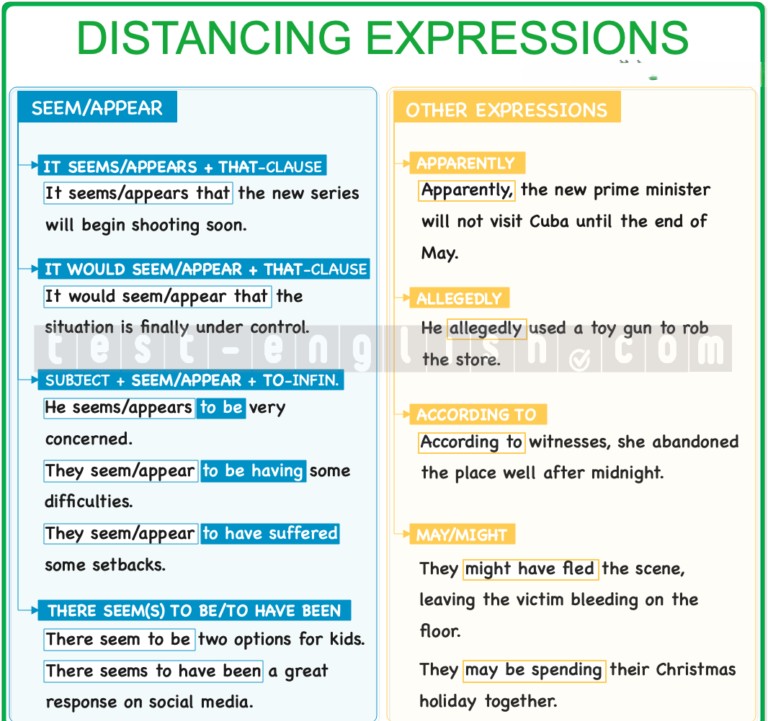
➤ Apparently
- Apparently, the new prime minister will not visit Cuba until the end of May.
➤ Allegedly
Used for unproven claims, especially about wrongdoing.
- He allegedly took a knife and stabbed the victim in the stomach.
➤ According to
- According to witnesses, she abandoned the place well after midnight.
➤ May / Might (for speculation)
- They might have fled the scene, leaving the victim bleeding on the floor.
- They may be spending their Christmas holiday together.
✅ Quick Summary
- Use passive reporting verbs to distance yourself from unconfirmed information.
- Two main patterns: It is said that... and He is said to be...
- Choose the correct infinitive form based on timing (simple, continuous, perfect).
- Also use seem/appear, apparently, allegedly, according to, or may/might for cautious or neutral reporting.