Grammar / B2 Grammar lessons and exercises / Compound nouns and possessive forms
Possessive ‘s
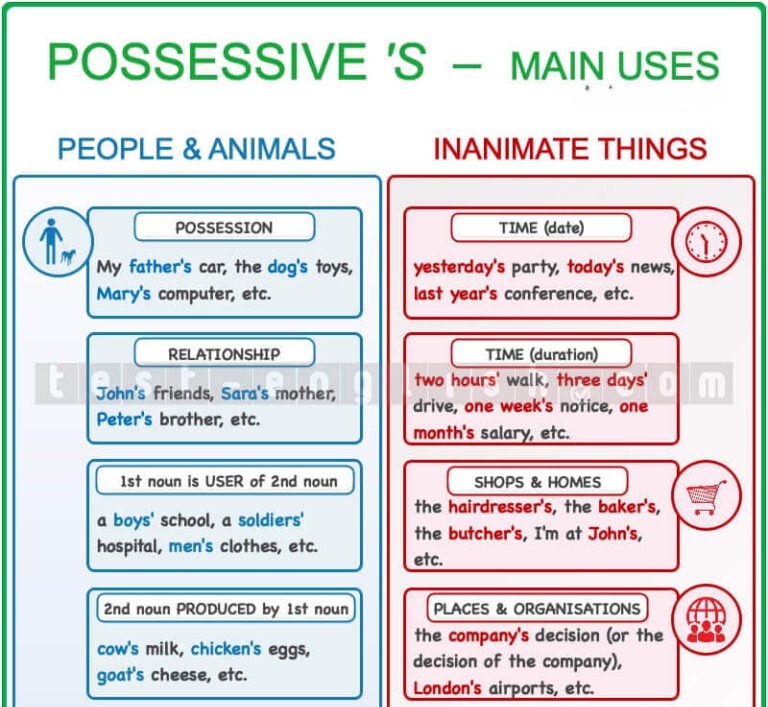
We normally use ‘s with people or animals. However, we can also use it with time expressions, shops, places (cities, countries, etc.) and organisations.
🔍 Note that we can use both the possessive ‘s or of when talking about places or organisations:
- The decision of the country / The country’s decision to raise taxes is very controversial.
- The prediction of the bank / The bank’s prediction is very optimistic.
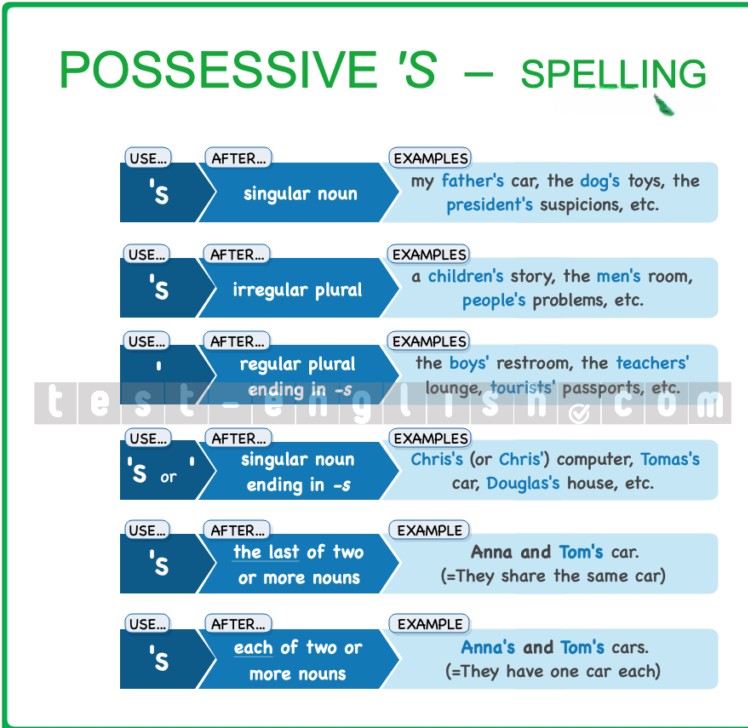
Look at the table below to see how to use the possessive case.
🔍 Note that we use of + possessive case or possessive pronoun if there is a determiner (a, some, this, etc.) before the nouns.
- Some friends of Anna’s came to the party. (= some of Anna’s friends.)
- Some friends of hers came to the party.
- Isn’t that a friend of your sister’s? (= one of your sister’s friends.)
Using possessive of
Inanimate things and abstract nouns
We normally use of instead of ‘s when talking about inanimate things, parts of things, or abstract nouns.
- We enjoyed the beauty of the park.
- The head of the shower is broken.
- Go to the end of the street.
- Love is the secret of life.
Long noun phrases
We also use of instead of ‘s with long noun phrases.
- ❌ This is the child the neighbours who live next door’s child.
✅ This is the child of the neighbours who live next door. - That’s the wife of one of my friends from Liverpool.
Compound nouns
In many cases, we use noun + noun, instead of possessive ‘s or of. When we use noun + noun, the first noun is acting as a modifier of the second noun, like an adjective, and is normally singular (tourist destination, stomach bug, school bus, etc.). Sometimes more than one form is possible:
- The head of the shower / shower head is broken.
- What’s the school policy / school’s policy on bullying?
However, we often prefer one form over the other because it’s more common: bus stop, car key, toothpaste, car park, ice cream, haircut, etc.
One word, two separate words or two words linked with a hyphen?
Compound nouns are often two separate words, e.g. school bus, car park, etc., but very common compound nouns are sometimes used as one word, e.g. bathroom, haircut, etc., and sometimes linked with a hyphen, e.g. letter-box. But on many occasions, you can see the same compound noun written in different ways.
Containers
We can use a compound noun to refer to a container, which is usually empty: a tea cup, a wine glass, a beer glass, a matchbox, etc.
- Can you pass me those tea cups? I’m going to wash them. (= they are empty)
- She keeps the insects that she catches in that matchbox.
❗ But we use noun + of + noun to refer to a container together with its contents: a cup of tea, a glass of wine, a glass of beer, a box of matches, etc.
- Would you like a cup of tea? (= a cup with tea in it)
- I need to light this candle. Do you have a box of matches?