Grammar / B2 Grammar lessons and exercises / Cleft sentences: Adding emphasis
What Are Cleft Sentences?
Cleft sentences are complex sentence structures used to emphasize one particular part of a sentence—such as the subject, object, time, place, or action. They are especially useful in writing, where we can’t rely on intonation for emphasis, but they’re also common in spoken English for clarity and focus.
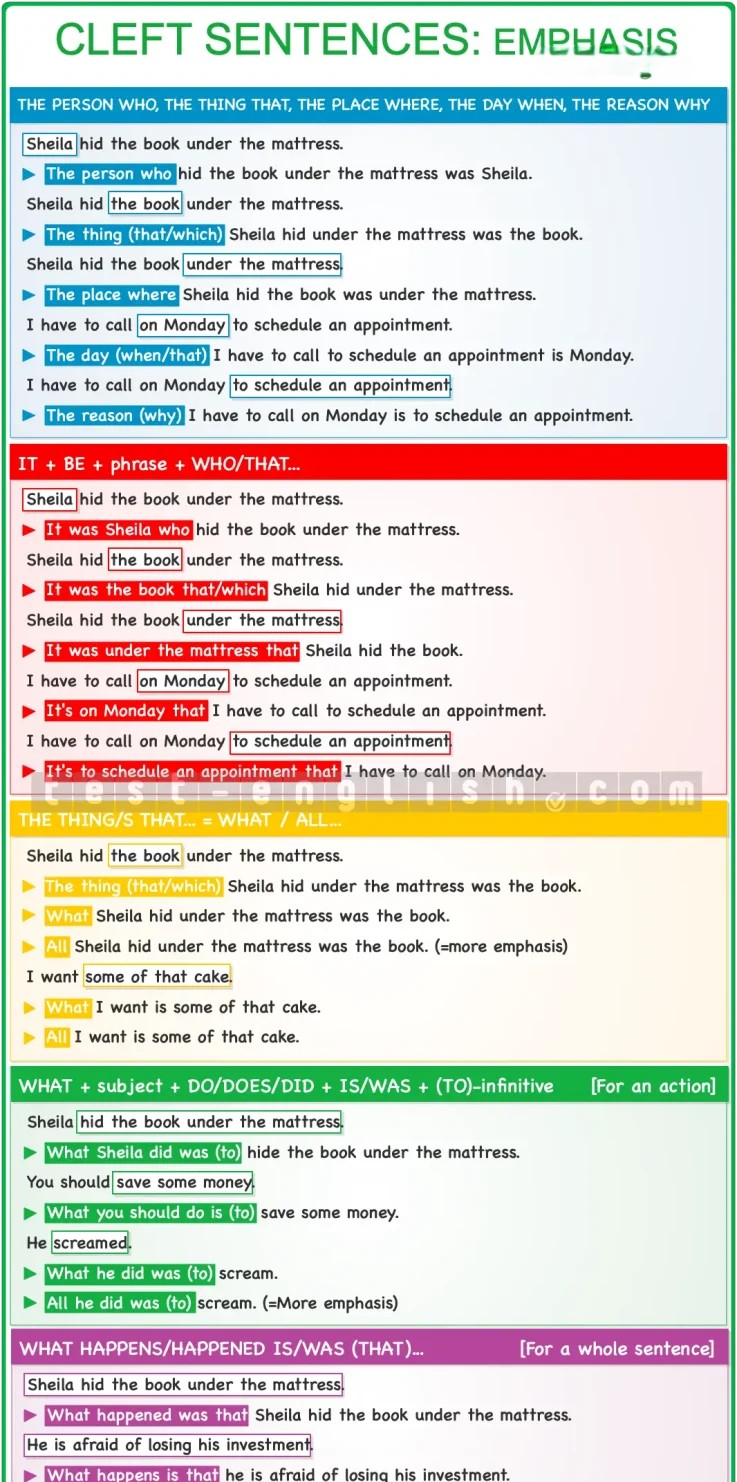
🟦 Types of Cleft Sentences
➤ The reason why / The thing that / The person who / The place where / The day when…
These structures use a noun phrase + relative clause to highlight a specific element.
- The person who called me was my boss.
- The place where we met was magical.
- The reason why she left is still unknown.
- The day when everything changed was June 12th.
➤ It + be + [focused element] + relative clause
This is the most common cleft structure. Use who/which/that after noun phrases, and that (not when) after adverbial phrases.
- It was Sheila who broke the vase.
- It was the book that I lost.
- It was under the mattress that he hid the money. ✅
- It was on Monday that I have to call. ✅
❗ Important Note:
We can say: “It’s Monday when I have to call.” (focusing on “Monday” as a time reference).
But we cannot say: “It’s on Monday when I have to call.” ❌
After adverbial phrases like on Monday, in the garden, etc., use that, not when or where.
🟩 “What” Clefts: The Thing(s) That = What / All
Instead of “the thing that,” we often use what (or all for stronger emphasis).
➤ What + subject + do/does/did + is/was + (to) infinitive
Used to emphasize the action (verb phrase).
- What I did was (to) apologize.
- What she does is teach piano.
- What they did was cancel the trip.
➤ What happens is (that)… / What happened was (that)…
Used to emphasize an entire situation or event.
- What happened was (that) the power went out.
- What happens is (that) people forget to save their work.
⚠️ Common Mistakes to Avoid
❌ It was on Monday when I called.
✅ It was on Monday that I called.
❌ The thing that I need is to go.
✅ What I need is to go. (More natural than “the thing that”)
❌ It was my brother which helped me.
✅ It was my brother who helped me. (“Who” for people)
💡 Remember: Choose your relative pronoun carefully—who for people, which/that for things, and that (not when/where) after prepositional time/place phrases.