Grammar / B2 Grammar lessons and exercises / Clauses of contrast, purpose, reason and result
Clauses of Contrast, Purpose, Reason and Result
Mastering linking words is essential for expressing complex ideas in English. In this guide, we’ll explore how to use clauses of contrast, purpose, reason, and result — with clear explanations and examples for B2 learners.
🟦 Clauses of Contrast
Use these to show differences or unexpected outcomes.
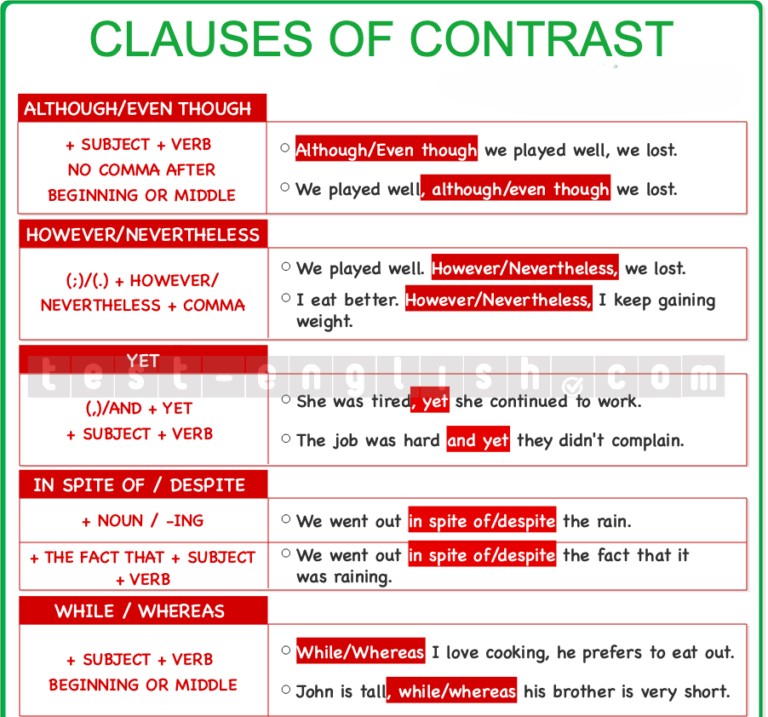
➤ Although / Even though
Followed by a clause (subject + verb). Can go at start or middle. Never use a comma after.
- Although/Even though we had a bad game, we won.
- We won, although/even though we had a bad game.
➤ However / Nevertheless
Connects two sentences. Usually at start of second sentence, after “.” or “;”. Always followed by a comma.
- We didn’t like the hotel. However, we had a fantastic time.
- We went to the beach; however, the weather wasn’t perfect.
- We didn’t like the hotel. We had a fantastic time, however.
➤ Yet
Means “but”. Often after comma or “and”. Less common after full stop.
- She was tired, yet she continued to work.
- The task was difficult and yet they managed to complete it.
- She was tired. Yet, she continued to work. (Not common.)
➤ Despite / In spite of
Followed by noun or -ing verb. Can start or middle of sentence.
- Despite/In spite of the rain, we went to the concert.
- They arrived despite/in spite of leaving very early.
- We went out despite/in spite of the fact that it was raining.
➤ While / Whereas
Show contrast between two facts. Interchangeable. Can go at start or after comma.
- While/Whereas she enjoys cooking, he prefers to eat out.
- Mary likes classical music, while/whereas her sister prefers jazz.
🟩 Clauses of Purpose
Explain why something is done — the intention behind an action.
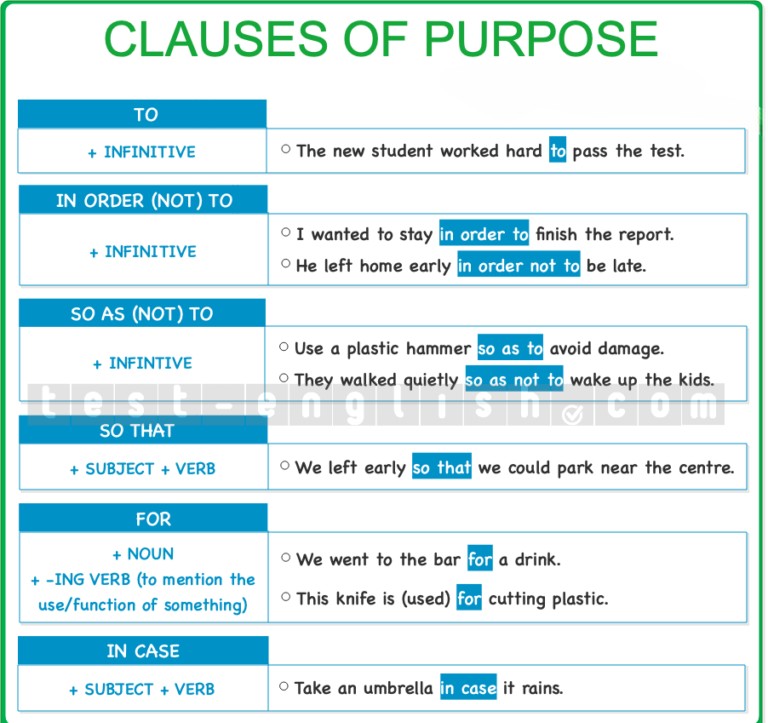
➤ To + infinitive
Most common and natural.
- The student worked hard to pass the test.
➤ In order to / So as to + infinitive
More formal. Negative: in order not to / so as not to.
- We were asked to stay in order to finish the project.
- He left early in order not to be late.
- Use a plastic hammer so as to avoid damage.
- They walked quietly so as not to wake the children.
- We need to mobilize the media in order for the Government to listen to us.
➤ So that + clause
Followed by subject + verb. Often includes modal (can, could, would).
- We left early so that we could park near the centre.
- He made flashcards so that it would be easier for his mum.
➤ For + noun
Expresses purpose of object or action.
- We went to the bar for a drink.
- This knife is for cutting plastic.
- Schools are for educating, not for entertaining.
➤ In case + clause
Used for precautions — doing something to avoid a possible negative outcome.
- Take an umbrella in case it rains.
- I won’t tell Ann in case she tells everyone else.
🟨 Clauses of Reason
Explain why something happened or was done.
➤ Because
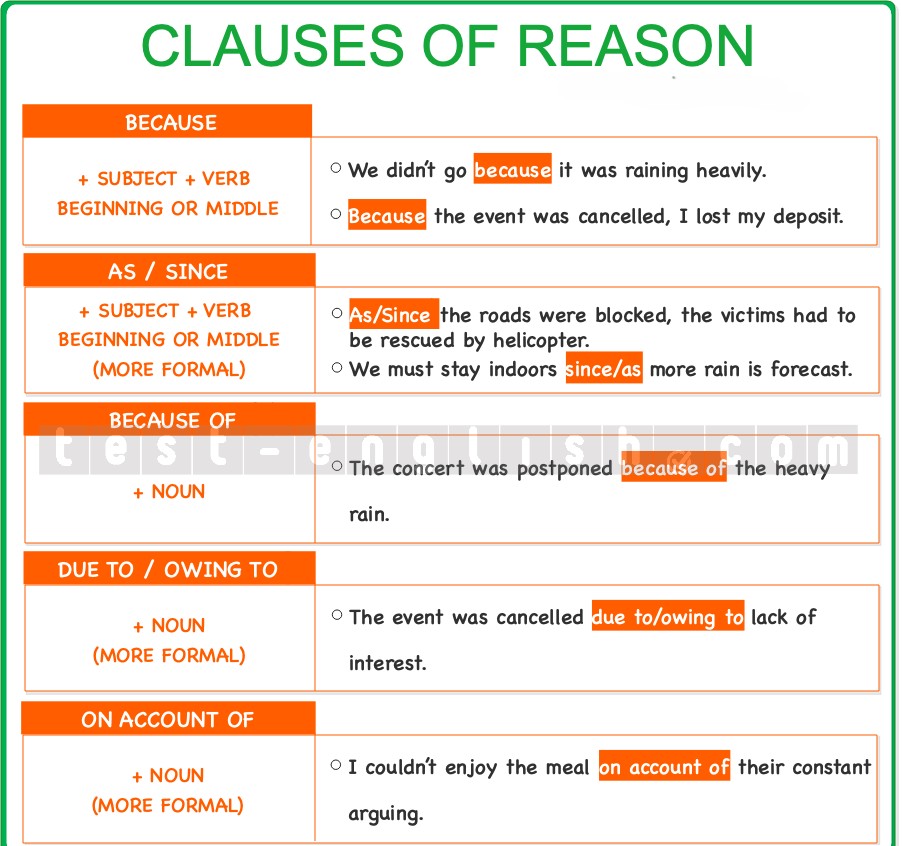
Most common. Followed by clause. Comma if at start.
- We didn’t go because it was raining heavily.
- Because the event was cancelled, they lost their deposits.
➤ As / Since
More formal. Similar to “because”. Often in writing.
- The Government urged people to stay indoors since/as more rain is forecast.
- As/Since the roads were blocked, the victims had to be rescued.
➤ Because of / Due to / Owing to / On account of
Followed by noun. “Due to”, “owing to”, “on account of” = more formal.
- The concert was postponed because of the heavy rain.
- The event was cancelled due to/owing to/on account of lack of interest.
- I couldn’t enjoy the meal due to/owing to/on account of their constant arguing.
🟪 Clauses of Result
Show the consequence or outcome of an action or situation.
➤ So
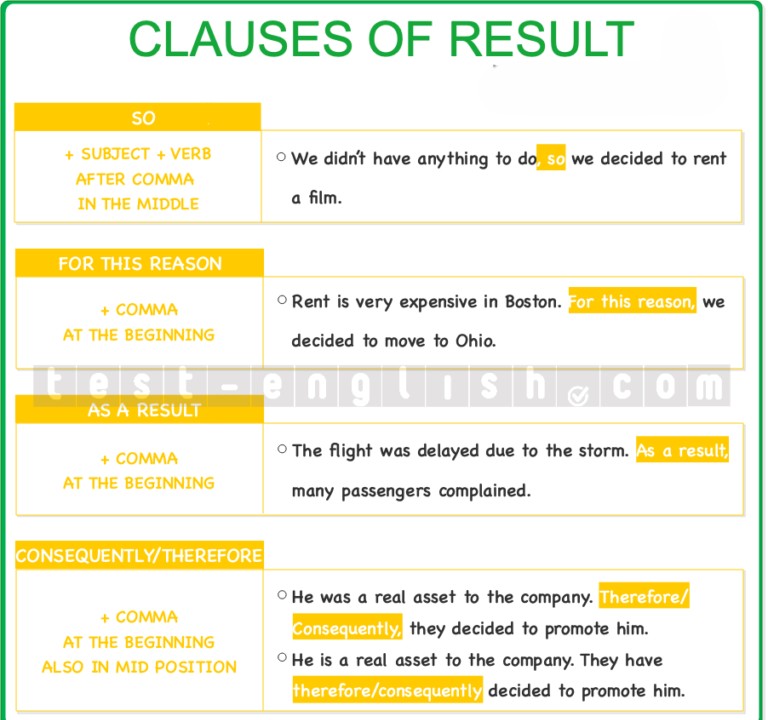
Informal. At end of sentence. Followed by subject + verb.
- We didn’t have anything to do, so we decided to rent a film.
- I worked very hard today, so I’m exhausted.
➤ For this reason
Formal. At start of sentence. Followed by comma.
- Rent is very expensive in Boston. For this reason, we decided to move to Ohio.
- He threatened to commit suicide. For this reason, we kept him under surveillance.
➤ As a result / Consequently / Therefore
Formal. Usually at start of sentence, followed by comma. “Consequently” and “therefore” can also go mid-sentence.
- The flight was delayed due to the storm. As a result, many passengers complained.
- Animals were his only passion. Therefore/Consequently, he decided to study biology.
- You have been a real asset. We have therefore/consequently decided to promote you.
⚠️ Common Mistakes to Avoid
❌ Although it was raining, but we went out.
✅ Although it was raining, we went out. (Don’t use “but” after “although”)
❌ We took an umbrella for it might rain.
✅ We took an umbrella in case it rains. (“for” + noun only)
❌ Due to he was late, we started without him.
✅ Because he was late, we started without him. (“due to” + noun only)
💡 Remember: Match the connector to what follows — clause (subject + verb) or noun phrase.