Grammar / B2 Grammar lessons and exercises / All conditionals: Mixed conditionals, alternatives to ‘if’, inversion
Zero, First, Second, Third & Mixed Conditionals
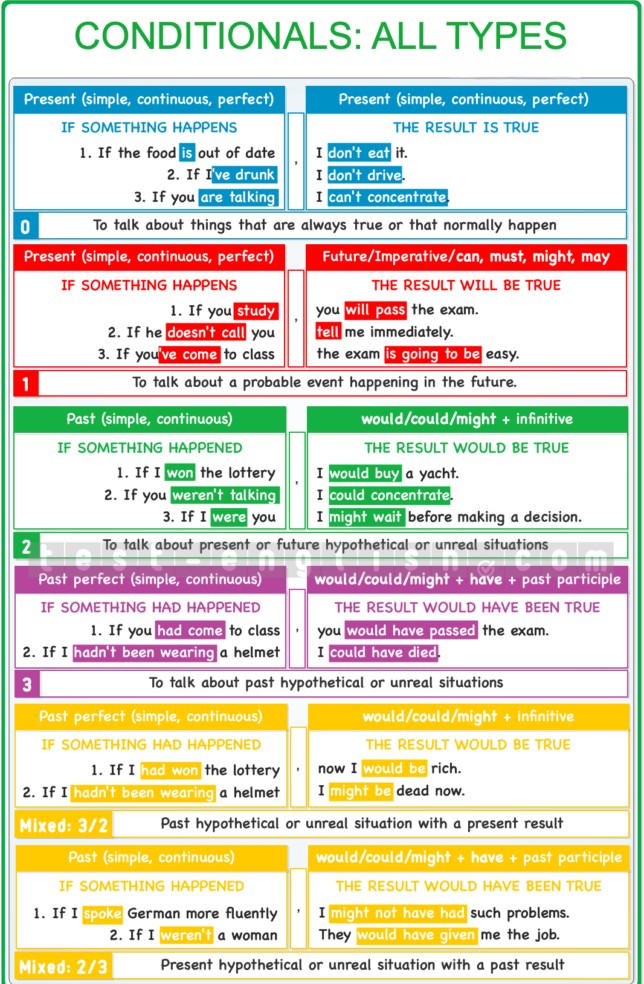
Conditionals are essential for talking about real and unreal situations in the present, future, and past. This guide covers all five types — zero, first, second, third, and mixed conditionals — plus alternatives to “if” and inversion for formal or stylistic effect.
🔵 Zero Conditional
Use: General truths, scientific facts, or habits.
Structure: If + present simple, ... present simple
- If you heat ice, it melts.
- If people don’t eat, they get hungry.
- Plants die if they don’t get enough water.
💡 “When” can often replace “if” in zero conditionals.
🟢 First Conditional
Use: Real or likely future situations.
Structure: If + present simple, ... will + base verb
- If it rains tomorrow, we ’ll cancel the picnic.
- If you study hard, you ’ll pass the exam.
- She ’ll be late if the bus doesn’t come soon.
💡 Other modals like can, may, might, should can also be used in the main clause.
🟡 Second Conditional
Use: Unreal, hypothetical, or unlikely present/future situations.
Structure: If + past simple, ... would + base verb
- If I won the lottery, I ’d buy a mansion.
- If she spoke Spanish, she ’d work in Madrid.
- They ’d travel more if they had more time.
💡 “Were” is often used for all subjects (e.g., If I were you…).
🟣 Third Conditional
Use: Regrets or imagined changes to past events.
Structure: If + past perfect, ... would have + past participle
- If I had studied harder, I ’d have passed the test.
- If they ’d left earlier, they ’d have caught the train.
- She ’d have called you if she ’d known your number.
🔷 Mixed Conditionals
Combine time frames: a past condition with a present result, or a present condition with a past result.
➤ Past condition → Present result
If + past perfect, ... would + base verb
- If I hadn’t dropped out of school, I ’d have a better job now.
- If she ’d taken that job, she ’d be living in Tokyo.
➤ Present condition → Past result
If + past simple, ... would have + past participle
- If I weren’t so busy, I ’d have helped you yesterday.
- If he spoke French, he ’d have understood the lecture.
🟢 Alternatives to “If”
Use these to add nuance or emphasis to conditions.
➤ As long as / Provided (that) / Providing (that) / On condition (that) / Only if
Emphasize necessary conditions.
- I’ll tell you the truth as long as you keep it secret.
- We’ll lend you the car provided (that) you fill the tank.
- You can join us on condition that you follow the rules.
- I’ll go only if you come with me.
➤ Whether or not / Even if
Show that the result is unchanged regardless.
- I’ll support you whether or not you win.
- Even if you apologize, he won’t forgive you.
➤ Suppose / Supposing
Introduce hypothetical situations (like “what if…?”).
- Supposing I lost my job, what would I do?
- Suppose she doesn’t believe you — then what?
🌸 Inversion in Conditional Sentences (Formal Style)
Omit “if” and invert the subject and auxiliary verb for a more formal tone.
➤ First Conditional → Should + subject + verb
- Should you find the answer, let me know. (= If you find…)
- Should she agree, we’ll proceed immediately.
➤ Third Conditional → Had + subject + past participle
- Had we arrived earlier, we could have helped. (= If we had arrived…)
- Had they known, they would have acted differently.
➤ Second Conditional → Were + subject + to + verb
- Were we to announce the truth, there would be chaos. (= If we announced…)
- Were she to accept, it would change everything.
➤ Negative Forms
Use not after the subject — no contractions.
- Should you not wish to continue, please inform us.
- Had you not intervened, the situation would have worsened.
- Were he not my friend, I’d report him.
⚠️ Common Mistakes to Avoid
❌ If I would have known, I would have come.
✅ If I had known, I would have come. (Third conditional uses past perfect after “if”)
❌ If I will win the lottery, I’ll buy a yacht.
✅ If I win the lottery, I’ll buy a yacht. (First conditional: present tense after “if”)
❌ If I were you, I would went.
✅ If I were you, I would go. (“Would” is always followed by base verb)
💡 Remember: The verb form after “if” depends on the type of conditional — never use “will” or “would” after “if” in standard conditionals.