Writing/ A1 Writing lessons and / A description of my house – A1 English writing
A Description of My House – A1 English
🟩Think about your house
Before you start writing, think about these questions:
- Where is your house? → I live in a small house in the countryside. / I live in a flat in the city centre.
- What rooms are there? → There are two bedrooms, a kitchen, a living room and a bathroom.
- What is in each room? → In the living room, there is a sofa, a TV and a coffee table.
- What is near your home? → There’s a park across the street. / It’s near the train station.
🟩Vocabulary: Rooms and furniture
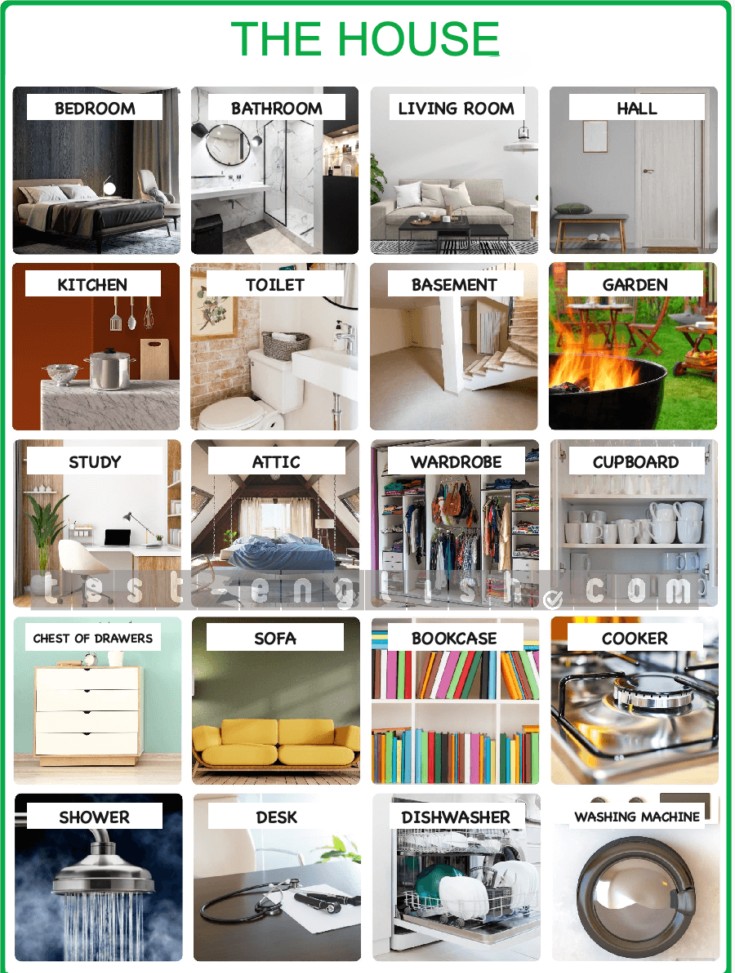
Review these useful words before you write:
- Rooms: bedroom, bathroom, kitchen, living room, dining room, garden, balcony
- Furniture & appliances: bed, sofa, table, chair, fridge, oven, washing machine, TV, cupboard, shelf
🟩Prepositions of place
Use these phrases to describe where your home is:
- I live in a small house / big apartment.
- The house is on a quiet street.
- It’s near the train station.
- There’s a garden behind the house.
- It’s a ten-minute walk to the town centre.
🔍 Note: Use a hyphen and singular “minute” in phrases like a ten-minute walk.
🟩There is / There are
- Use there is (or there’s) with singular nouns:
There’s a sofa in the living room. - Use there are with plural nouns:
There are two armchairs and a bookshelf. - Negative: There isn’t / There aren’t any:
There isn’t a bath. / There aren’t any towels.
🟩Has / Has got
- Positive: The house has got a garden. / The flat has WIFI.
- Negative: The house hasn’t got a garage. / The flat doesn’t have a balcony.
🟩Just / Only
Use just or only to show something is limited:
- There’s only one bedroom. / There’s just one bedroom.
- The flat only has a shower. / The house has just got a small kitchen.
🟩Using “with”
Add extra details using with:
- I live in a house with a big garden.
- There’s a kitchen with three chairs.
- There’s a cupboard with five shelves.
🟩Useful adverbs to start sentences
- Upstairs, there are two bedrooms.
- Downstairs, there is a kitchen and a living room.
- Inside, there are five rooms.
- Outside, there is a small garden.
🟩Writing lists
When listing items, follow these rules:
- Use there is if the first item is singular:
In the kitchen, there is a fridge, a microwave and a table. - Use commas between items, and and before the last item.
- To contrast, use but:
There’s a bath, a toilet and a sink, but there isn’t a shower.
Example paragraph:
I live in a small flat in the city centre. It’s near the train station and only a ten-minute walk from the park. Downstairs, there is a living room with a sofa, a TV and a coffee table. Upstairs, there are two bedrooms and a bathroom. The bathroom has a shower, a toilet and a sink, but it doesn’t have a bath. The kitchen has got a fridge, an oven and a washing machine. There isn’t a dishwasher, but that’s okay! Outside, there’s a small balcony with two chairs. I love my flat because it’s quiet and comfortable.