Vocabulary/ B1+ Vocabulary lessons and / The weather and natural disasters – B1+ English Vocabulary
The Weather and Natural Disasters
Discover essential vocabulary to describe weather conditions, temperature, humidity, and natural disasters.
About This Lesson
In this lesson, you will learn vocabulary to describe everyday weather, extreme conditions, and natural disasters. These terms are essential for travel, news comprehension, safety, and daily conversation.
Weather & Natural Disaster Vocabulary (B1 Level)
Infographic showing sunny skies, thunderstorms, blizzards, hurricanes, earthquakes, and more.
Adjectives for Describing the Weather
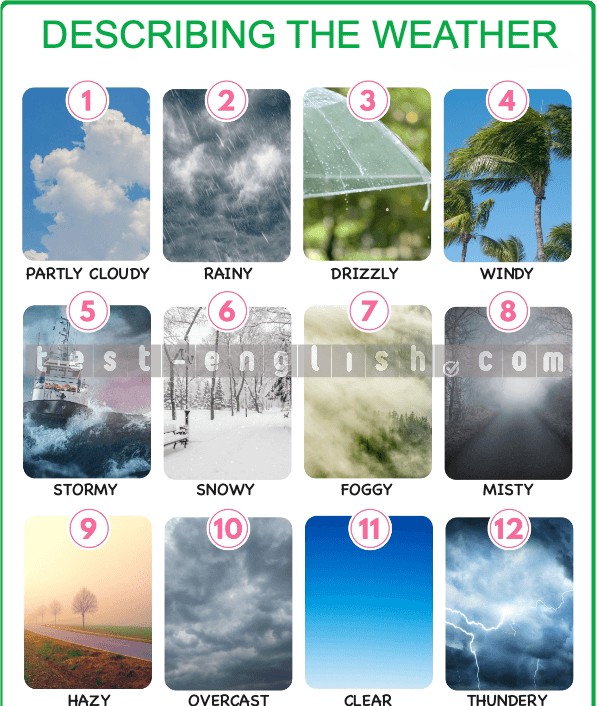
Use these adjectives to talk about daily weather conditions.
Partly sunny / Partly cloudy
It may be sunny or cloudy for part of the day.
Rainy
During a rainy day, season, or period, it rains a lot.
Drizzly
There’s light rain falling continuously, often making the ground wet and uncomfortable for outdoor activities.
Windy
There is a lot of wind, making things blow around.
Stormy
There are likely to be frequent storms throughout the day, with heavy rain, strong winds, thunder, and lightning.
Snowy
There is considerable snowfall.
Foggy
There is a lot of fog—a cloud of small water droplets that makes it difficult to see.
Misty
There is mist in the air—a thin fog that reduces visibility of distant objects.
Hazy
It is difficult to see due to light mist, hot air, or dust.
Overcast
The sky is covered with clouds, making the weather seem dull.
Clear
There are no or very few clouds in the sky, offering excellent visibility.
Thundery
There are intermittent thunderstorms throughout the day.
Temperature and Humidity
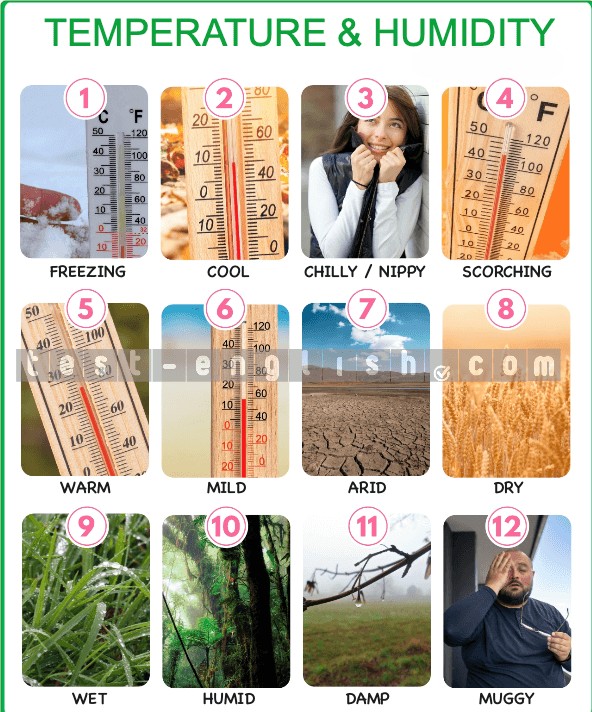
Learn how to describe how hot, cold, dry, or humid it feels.
Freezing
The temperature is at or below 0°C (32°F)—very cold.
Cool
Slightly cold, but not unpleasant.
Chilly
Uncomfortably cold. (People may also say, 'It’s nippy.')
Scorching
Extremely hot.
Warm
Pleasantly hot—not too intense.
Mild
Neither too hot nor too cold—pleasant weather.
Arid
Very dry climate with little to no rainfall; vegetation struggles to grow.
Dry
Hot with little or no chance of rain.
Wet
It’s raining, and surfaces are covered in water.
Humid
The air contains a lot of moisture (tiny water droplets).
Damp
Slightly wet in an unpleasant way; also used for rooms or buildings with moisture in walls or air.
Muggy
Warm and uncomfortably humid.
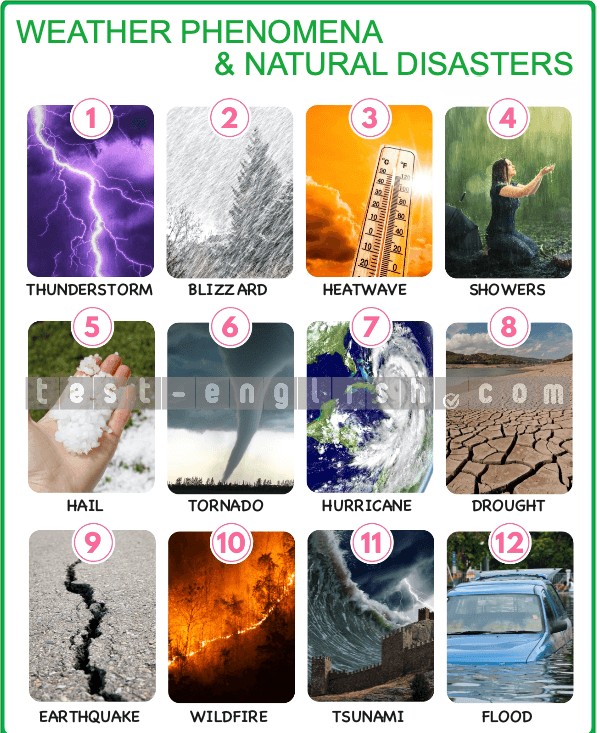
Weather Phenomena and Natural Disasters
Understand and discuss extreme weather events and natural disasters.
Thunderstorm
A heavy rainstorm accompanied by thunder and lightning.
Blizzard
A severe snowstorm with strong winds and low visibility.
Heatwave
An extended period of unusually hot weather.
Shower
A short period of light rain.
Hail
Precipitation in the form of small balls or lumps of ice.
Tornado
A violently rotating column of air extending from a thunderstorm to the ground.
Hurricane
A powerful tropical storm with violent winds and heavy rain, forming over warm ocean waters.
Drought
A prolonged period with little or no rainfall, causing water shortages and crop failure.
Earthquake
A sudden, violent shaking of the ground, often causing destruction.
Wildfire
A large, uncontrolled fire spreading rapidly through forests or grasslands.
Tsunami
A massive ocean wave, usually triggered by an underwater earthquake, that floods coastal areas.
Flood
An overflow of water that submerges land normally dry.
Weather & Disaster Vocabulary Chart
Summary of key terms: freezing, humid, blizzard, tsunami, earthquake, etc.