Vocabulary/ B1+ Vocabulary lessons and / Fears and phobias – B1+ English Vocabulary
Fears and Phobias
In this B1+ Upper-intermediate Vocabulary Lesson about Fears and Phobias, you will learn common words and phrases related to fears and phobias and the emotions associated with them.
Check the definitions and examples below to understand these terms better.
Adjectives Related to Fear
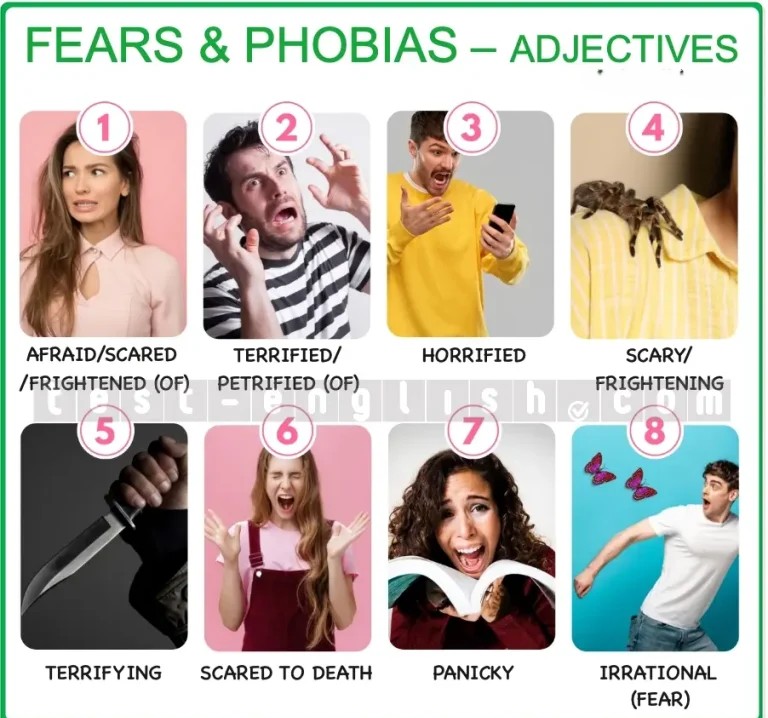
Adjectives
1 If you are scared, afraid, or frightened of something, you feel uncomfortable when you see or think about it.
Lucy is scared of dogs.
When I was a child, I used to be afraid of the dark.
After hearing that there were snakes in the garden, I was frightened.
2 Terrified and petrified are similar in meaning, only much stronger. If you are terrified by or petrified of something, you experience extreme fear and discomfort.
After hearing that our hotel room was haunted, I was terrified.
Cara is petrified of mice.
3 Horrified also means extremely afraid, but can also mean shocked—either very scared or negatively surprised.
I was horrified when I found out that my son had been stealing.
4 Scary and frightening describe things (not feelings) that cause fear.
I find deep water scary because I’m not a very good swimmer.
Speaking in front of many people can be very frightening.
5 Terrifying is much stronger—it describes something that causes extreme fear.
Looking down from the roof of the building was absolutely terrifying.
6 If you are scared to death, you are extremely afraid—usually due to a sudden event.
When I saw the spider moving towards me, I was scared to death.
7 If you feel panicky, you are anxious or afraid and may act rashly without thinking.
Lisa became quite panicky when she realised she was all alone.
8 An irrational fear is unreasonable—people often react extremely despite little real danger.
My sister has an irrational fear of butterflies.
Nouns Related to Fear
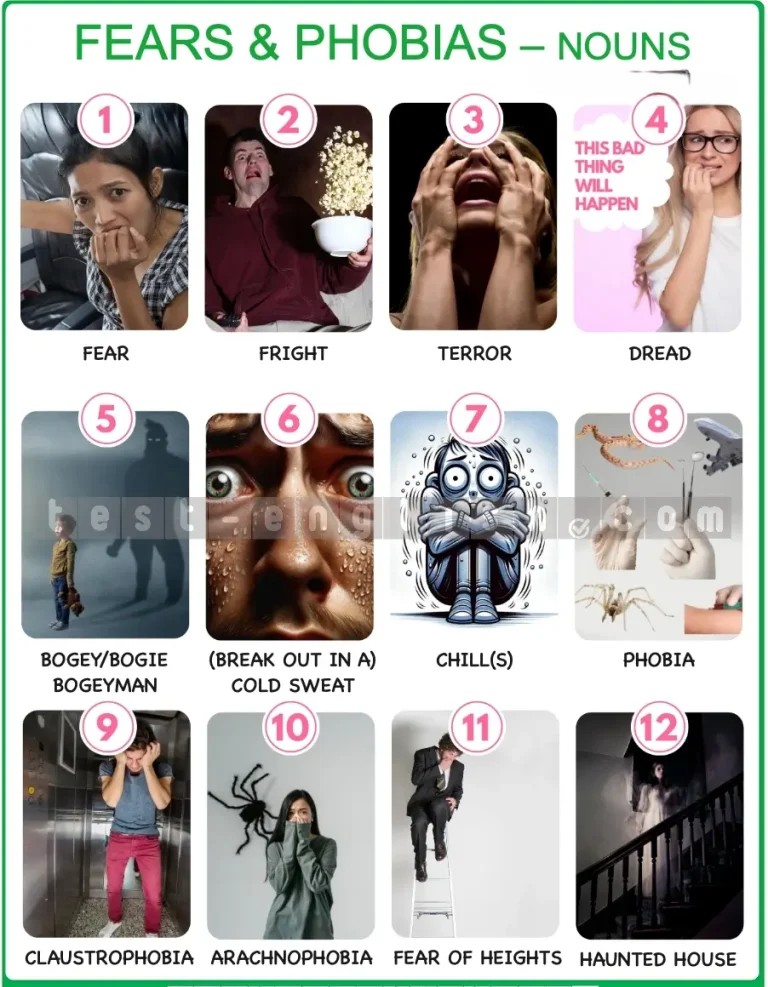
Nouns
1 Fear is the general feeling of being afraid. A fright is a sudden, intense scare.
My mother has a fear of flying and refuses to travel by plane.
I got a fright when the cat suddenly jumped through the window.
2 Terror is intense or extreme fear. Dread is fear about something that will happen in the future.
The thought of a big hairy spider fills me with terror.
I experience feelings of dread whenever I have to go to the dentist.
3 A bogey (or bogie) is something people worry about—often without reason. The bogeyman is an imaginary monster used to scare children.
The idea of a global pandemic became the bogey that worried governments.
Be good, or the bogeyman will come and get you!
4 A cold sweat is a physical reaction to extreme fear (e.g., “to break out in a cold sweat”). A chill is a sudden feeling of fear or unease—often “giving you the chills” or “sending a chill down your spine.”
When I realised there was an intruder in my house, I broke out in a cold sweat.
That horror film gave me the chills. It sent a chill down my spine.
5 A phobia is an irrational, intense fear of something specific. Many phobias end in “-phobia.”
My phobia of needles means I hate going to the doctor’s.
6 Claustrophobia is fear of small or enclosed spaces. Arachnophobia is extreme fear of spiders.
Peter avoids travelling in elevators because of his claustrophobia.
Susan suffers from arachnophobia and screams whenever she sees a spider.
7 A fear of heights is discomfort or anxiety when high up.
Alice’s fear of heights prevented her from going rock climbing.
8 A haunted house is believed to contain ghosts—many people are afraid to enter one.
The children were too scared to go inside the haunted house.
Verbs and Idioms
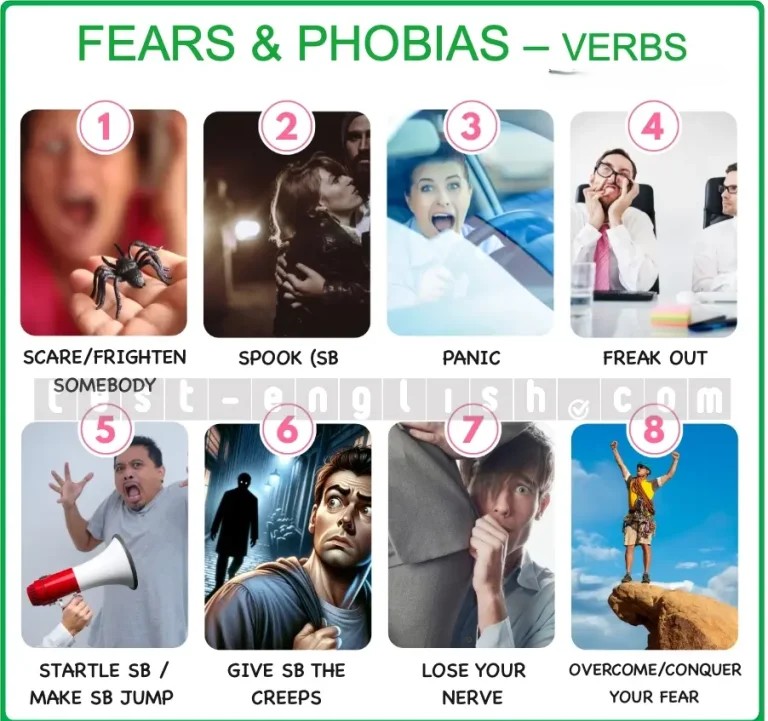
Verbs and Idioms
1 If something scares or frightens you, it makes you afraid. If something spooks you, it scares you in a ghostly or eerie way.
The sound of thunder really scares me.
My brother tried to frighten me by putting a frog in my bag.
Gary tried to spook his sister by telling her their hotel was haunted.
2 To panic means to become so scared you can’t think clearly—often in emergencies.
Sam panicked during the fire alarm, forgetting where the emergency exits were.
3 To freak out is to have a strong emotional reaction—due to fear, anger, surprise, or excitement.
Jake freaked out when he heard loud noises in the basement.
When dad finds out you’ve scratched his car, he will totally freak out.
4 If something startles you or makes you jump, it surprises you suddenly and causes a fright.
I didn’t mean to startle you; I’ll knock next time.
The sudden bang of the fireworks made me jump.
5 If something gives you the creeps, it makes you feel uneasy, afraid, or disgusted.
Snakes and other reptiles give me the creeps.
6 To lose your nerve means to lose the courage to do something difficult.
When I got to the top of the rock, I lost my nerve and couldn’t jump into the water.
I wanted to ask her out, but I lost my nerve.
7 To overcome or conquer a fear means to stop being afraid of it.
I hope that I will be able to overcome my fear of flying.
My therapist helped me to conquer my fear of heights.