Vocabulary/ A2 Vocabulary lessons and / Say, tell, speak, talk, etc. – A2 English Vocabulary
Speaking Verbs: Say, Tell, Speak, Talk, and More
Learn how to use common English verbs related to speaking
About This Lesson
In this pre-intermediate vocabulary lesson about Speaking Verbs, you will learn the meanings and correct usage of verbs like say, tell, speak, talk, ask, reply, shout, whisper, and more. Understanding the differences will help you speak and write more accurately in English.
Key Differences: Say vs. Tell
- say → Focuses on the words spoken.
✅ He said he was tired.✅ She said “goodbye” to her friend.❌ He said me he was tired. - tell → Always includes the listener.
✅ He told me he was tired.✅ She told a story.❌ He told he was tired.
Remember: tell + person, but say + words (and optionally “to + person”).
Common Speaking Verbs
Chart showing 15 speaking verbs: say, tell, speak, talk, ask, request, beg, answer, reply, shout, yell, scream, whisper, complain, suggest.
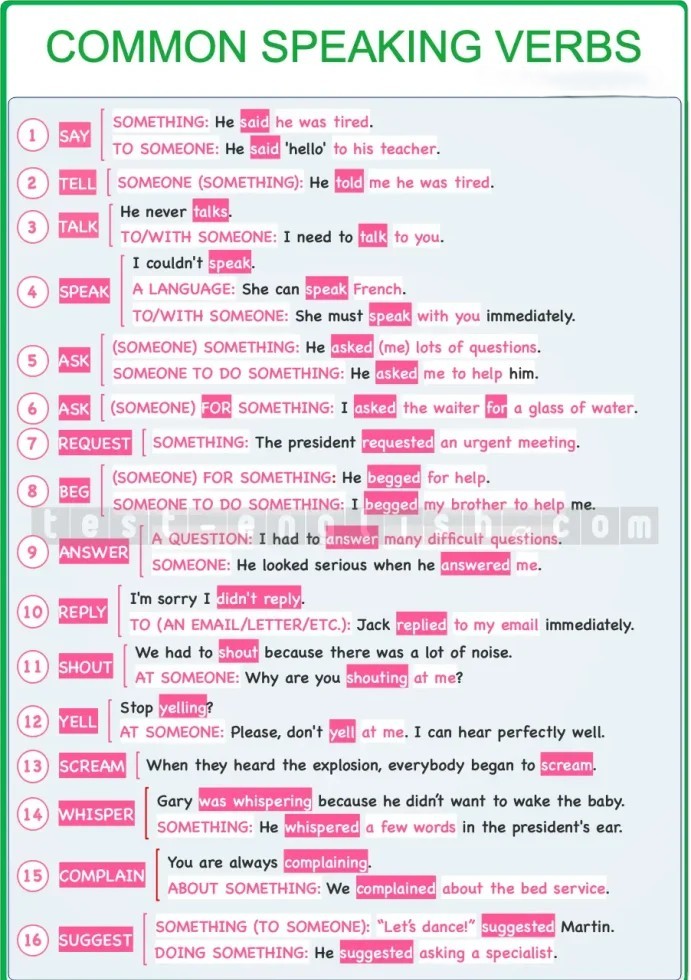
Speaking Verbs Explained
say
To speak words; often used without mentioning the listener directly.
She said ‘hello’ to her teacher.
💡 We usually don’t say who we are speaking to right after 'say'. Use 'say to someone'.
tell
To give information or instructions to someone; always includes the listener.
He told me a funny story.
💡 Always use: tell + person + (something / to do something).
speak
To communicate using words; more formal than 'talk'. Also used for languages.
They speak Spanish at home.
💡 Use 'speak to/with someone' or 'speak a language'.
talk
To have a conversation; less formal than 'speak'.
We talked about our weekend plans.
💡 Use 'talk to/with someone' or 'talk about something'.
ask
To say something to get information or request help.
She asked what time the meeting started.
💡 Also: ask someone to do something.
request
To ask for something formally or politely.
He requested a copy of the report.
💡 More formal than 'ask for'.
beg
To ask for something desperately or urgently.
They begged for food after the storm.
💡 Often shows strong emotion or need.
answer
To respond to a question, request, or problem.
He answered the phone immediately.
💡 Can be used with a person or a question: answer me / answer the question.
reply
To respond to any form of communication (email, message, comment, etc.).
She hasn’t replied to my message yet.
💡 Usually followed by 'to': reply to an email.
shout
To speak very loudly, often because of excitement, anger, or distance.
Don’t shout—I can hear you!
💡 Can be neutral or emotional.
yell
To shout, usually because you are angry or upset.
The coach yelled at the players.
💡 Stronger emotional tone than 'shout'.
scream
To make a very loud, high sound because of fear, pain, or surprise.
She screamed when she saw the spider.
💡 Usually linked to strong fear or shock.
whisper
To speak very quietly so only nearby people can hear.
He whispered a secret in my ear.
💡 Opposite of shouting.
complain
To say you are unhappy or dissatisfied with something.
They complained about the noise.
💡 Often followed by 'about'.
suggest
To propose an idea or plan.
She suggested going to the beach.
💡 Followed by a noun, -ing verb, or that-clause.