Vocabulary/ A2 Vocabulary lessons and / Giving directions – A2 English Vocabulary
Giving Directions
Learn essential vocabulary and phrases to give and understand directions in English
About This Lesson
In this pre-intermediate vocabulary lesson about Giving Directions, you will learn essential terms and phrases used to give directions clearly and effectively. The pictures, definitions, and sentence examples below will help you understand and remember these useful terms.
Vocabulary for Giving Directions
Illustrated chart showing key direction phrases: go past, go along, turn left, etc.
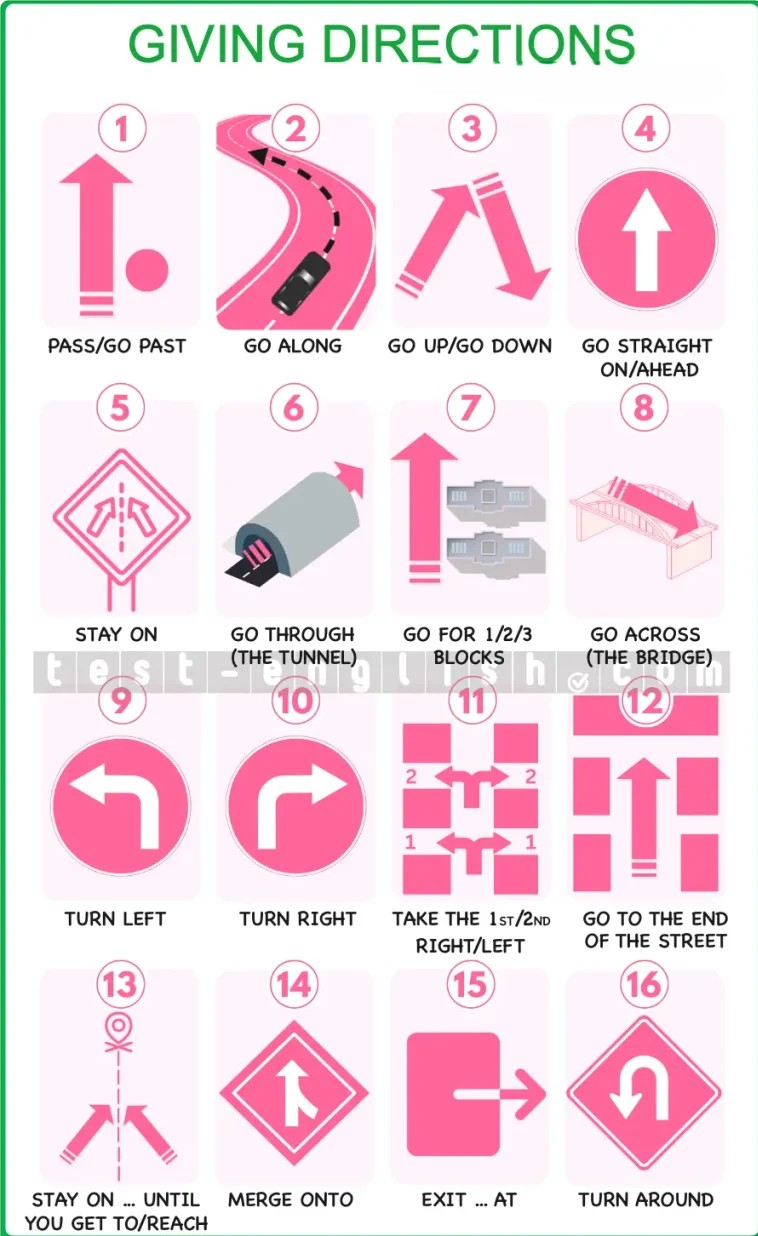
Direction Phrases (Movement)
go past / pass
Reach a point (like a building or traffic light) and continue moving further.
Go past the supermarket and keep driving straight.
go along
Follow a street in a certain direction.
Go along Main Street for two blocks.
go up / go down
Move in one direction (up) or the opposite direction (down) on a street.
Go down Elm Street until you see the park.
go straight on / go straight ahead
Keep moving forward without turning. You can also say 'go straight along + street name'.
Go straight on until you reach the traffic lights.
Go straight along Winston Street for a few blocks, and you will see the park on your left.
stay on
Continue following the same street or road without turning off it.
Stay on Pine Road until you get to the roundabout.
go through
Travel into and out of the other side of a tunnel.
Go through the tunnel and continue straight.
go for [number] blocks
Continue traveling for the specified number of city blocks.
Go for three blocks and then turn right.
walk / drive across
Travel over a bridge from one side to the other.
Walk across the bridge and turn left at the end.
turn left
Change direction to your left.
Turn left at the next intersection.
turn right
Change direction to your right.
Turn right after the gas station.
take the first/second/etc. right/left
Make a turn at the first, second, or specified street on your right or left.
Take the second right after the bank.
go to the end of the street
Continue traveling until the street finishes or you can’t go further.
Go to the end of the street and you will see the library on your right.
stay on … until you get to/reach …
Keep following the street until you reach the specified location.
Stay on this street until you get to the hospital.
merge onto
Join the flow of traffic on a highway from an entrance ramp.
Merge onto the highway and stay in the right lane.
exit at [exit number]
Leave the road or highway by taking the specified exit ramp.
Exit the highway at Exit 5 and turn left at the stop sign.
turn around
Change direction to face the opposite way.
We’ve missed the exit. We need to turn around.
Prepositions of Location
These prepositions describe where something is located (not movement).
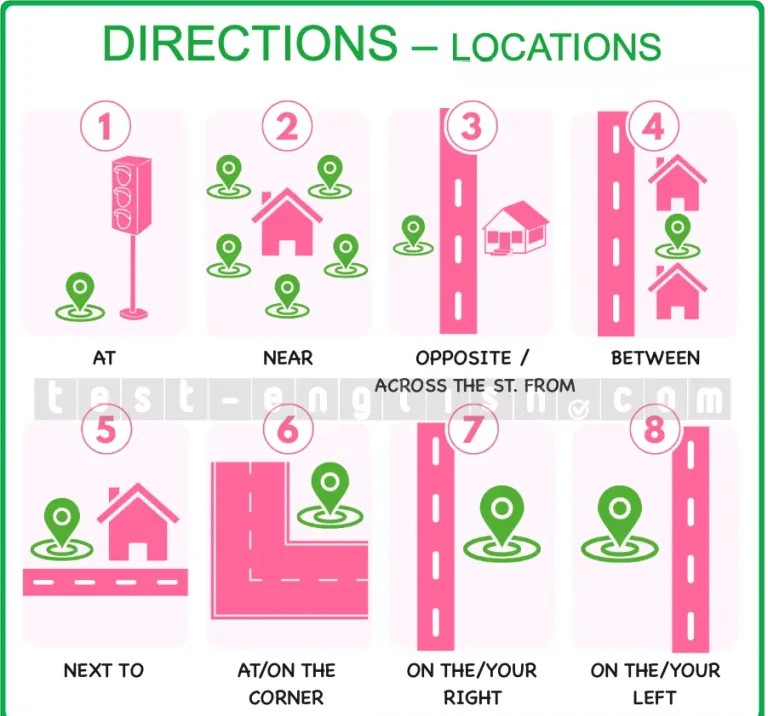
at
Used to describe a point near a location (e.g., at the traffic light, at the intersection).
Turn left at the traffic sign to enter the parking lot.
near
Describes a location that is close to another place, but not necessarily adjacent.
The pharmacy is near the train station.
opposite / across the street from
Describes a location on the other side of the street from another place.
The library is across the street from the park.
The bank is opposite the supermarket.
between
Describes a location in the middle of two other places.
The cafe is between the bookstore and the supermarket.
next to
Describes a location immediately adjacent (right or left) to another place.
The bakery is next to the post office.
on the corner of
Describes a building located at the intersection of two streets.
The pharmacy is on the corner of Main Street and 5th Avenue.
on your/the right
Describes something located on the right side.
After you pass the bridge, the museum will be on your right.
on your/the left
Describes something located on the left side.
After you pass the bridge, the museum will be on your left.
Asking for Directions
Useful questions to ask when you need help finding your way:
- • How can I get to (the nearest) …?
- • Where’s the nearest …?
- • Is there a … near here?
- • Could you tell me how to get to…?
Example: “Could you tell me how to get to the post office?”