Vocabulary/ B2 Vocabulary lessons and / Work and jobs – B2 English Vocabulary
Work and Jobs
Learn essential English vocabulary for employment and the workplace.
About This Lesson
In this Pre-advanced Vocabulary Lesson about Work and Jobs, you will learn various terms and phrases associated with employment and the workplace. Explore the pictures below and read the definitions and sentence examples.
Work and Jobs: Nouns and Noun Phrases
Infographic for the B2 English Vocabulary lesson titled 'Work and Jobs' displaying a colorful array of icons and images representing various employment terms such as nine-to-five job, demanding job, dead-end job, steady job, out-of-work, shifts, etc.
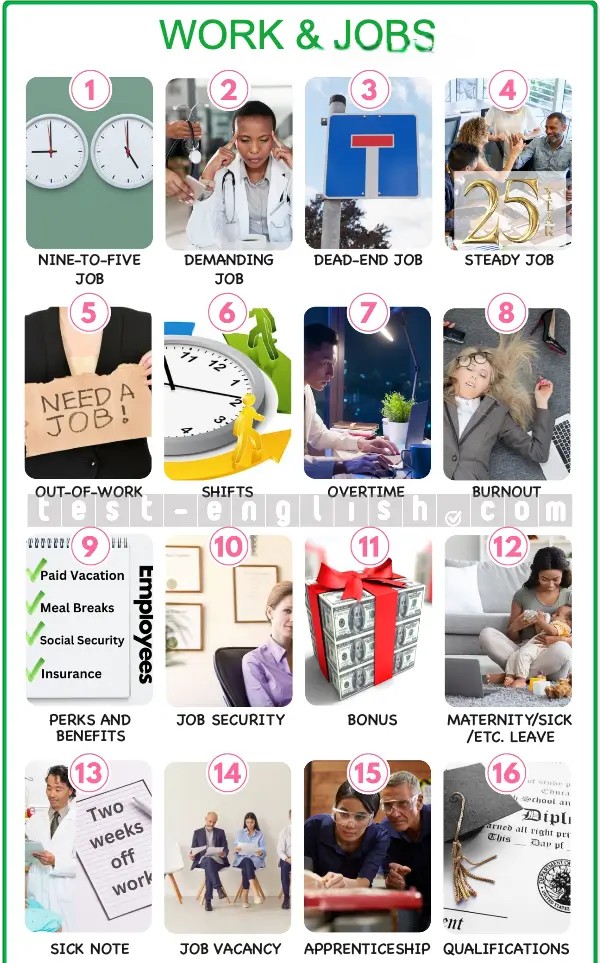
Work and Jobs: Nouns and Noun Phrases
Key vocabulary for describing types of jobs, employment status, workplace benefits, and career concepts.
Nine-to-five job
A full-time job that you do during normal office hours.
Tom has a nine-to-five job with a bank in the city.
Demanding job
A job that demands a lot of attention, energy, and hard work.
Jane has a demanding job that leaves her with little time for herself.
Dead-end job
A job that leads nowhere, with few prospects of promotion or career advancement.
It sounds like a dead-end job. You should look for something more stable.
Steady job
A reliable job that guarantees you regular hours and income.
Joe has a steady job with an insurance firm.
Out of work
Currently unemployed.
John is currently out of work and is searching for a job.
Shifts
Scheduled periods of work during the day or night.
I’m working the night shift tonight; I start at 8 p.m. and finish at 6 a.m.
Overtime
Working more hours than contracted, usually for extra pay.
I’m doing a lot of overtime this month because we’re very busy at work.
Burnout
Exhaustion and illness caused by working too hard for an extended period.
Jean’s demanding job left her suffering from burnout.
Perks and benefits
Privileges a job provides: benefits include insurance or tax coverage; perks are extras like free passes or memberships.
My job offers basic benefits, such as insurance and healthcare. One of the perks of working for a gym is free membership and use of all its facilities.
Job security
Having a reliable job from which you are unlikely to be dismissed.
This position offers no job security, and I worry about the future.
Bonus
Extra money received on top of your annual salary, usually for good performance.
After receiving record sales, Henry was given a well-deserved bonus.
Maternity, paternity, and sick leave
Extended absences from work: maternity/paternity leave after a child’s birth; sick leave due to illness or accident.
Alice is on maternity leave as she just had a baby last month. After his awful car accident, Peter was on sick leave for a year.
Sick note / Doctor’s note
A written statement from a doctor excusing someone from work due to illness.
The doctor gave me a sick note for two weeks.
Job vacancy
A position a business is currently trying to fill.
I’m currently looking for work, so I asked the manager if there were any job vacancies.
Apprenticeship
A training arrangement where a person learns a skill by working under qualified professionals for a fixed period.
Mike is doing an apprenticeship with a local insurance company.
Qualifications
Certifications such as diplomas or degrees that qualify someone for a particular job.
Although Mary has little experience in this field, her qualifications are impressive.
Work and Jobs: Verbs and Verb Phrases
Colorful infographic showcasing 'Work & Jobs: Verb Phrases' for B2 English Vocabulary, featuring images and icons that depict actions like 'do an internship/work experience', 'have experience in', 'talk shop', 'clock in, clock out', 'meet a deadline', 'be snowed under', etc.
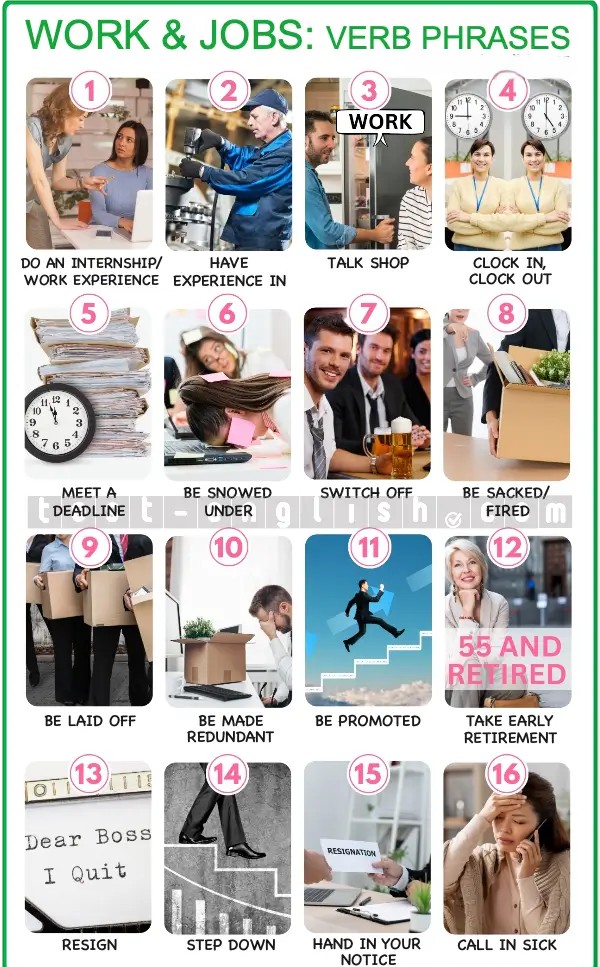
Work and Jobs: Verbs and Verb Phrases
Common verbs and phrasal verbs used to talk about work routines, employment changes, and workplace stress.
Do work experience / Do an internship
Work temporarily to gain experience in a specific field or trade.
This summer, I’m doing work experience with a local newspaper.
Have experience in
Possess prior experience in similar roles or tasks.
When hiring staff, we look for those who have experience in similar roles.
Talk shop
Discuss work-related topics outside of working hours or away from the workplace.
I wish you wouldn’t talk shop all the time; we’re not at work now!
Clock in / Clock out
To record your arrival (clock in) or departure (clock out) from work.
I usually clock in at 7 a.m. and then clock off around 3:30 p.m.
Meet a deadline
Complete a task or project by its required due date.
I had to work late because I needed to meet a deadline.
Be snowed under
Feel overwhelmed by a large amount of work.
With half the office off sick, we’re completely snowed under with work.
Switch off
Relax and stop thinking about work.
With a job as stressful as mine, it can be very hard to switch off.
Be sacked / Be fired
Dismissed from a job due to misconduct or poor performance.
The employee was sacked after several customers complained about his rudeness.
Be laid off
Lose your job due to company financial issues or closure.
If the company closes down, many people will be laid off.
Be made redundant
Lose your job because your position is no longer needed.
Now that we have self-checkout tills, many cashiers are being made redundant.
Be promoted
Receive a higher position with more responsibility.
I hope to get promoted to assistant manager soon.
Take early retirement
Stop working permanently before the standard retirement age.
I’d love to take early retirement and stop working when I’m fifty years old.
Resign from a job
Voluntarily leave a job.
Greg resigned from his job because he was moving abroad with his wife.
Step down
Resign from a position of authority.
I wonder who will replace the CEO when he steps down next year.
Hand in your notice
Formally inform your employer of your intention to leave your job.
When Tim handed in his notice, his boss said he was sad to see him go.
Call in sick
Phone your workplace to say you’re ill and can’t come to work.
Jane wasn’t feeling well this morning, so she decided to call in sick and rest at home.