Vocabulary/ B2 Vocabulary lessons and / War and peace – B2 English Vocabulary
War and Peace
Explore essential English terms related to conflict, peacekeeping, and diplomacy.
About This Lesson
In this pre-advanced vocabulary lesson about War and Peace, you will explore essential terms related to conflict, peacekeeping, and diplomacy, enhancing your understanding of global affairs. Check the following pictures and read the definitions.
Nouns and Noun Phrases
Infographic showing key terms: ceasefire, refugee, peace treaty, sanctions, etc.
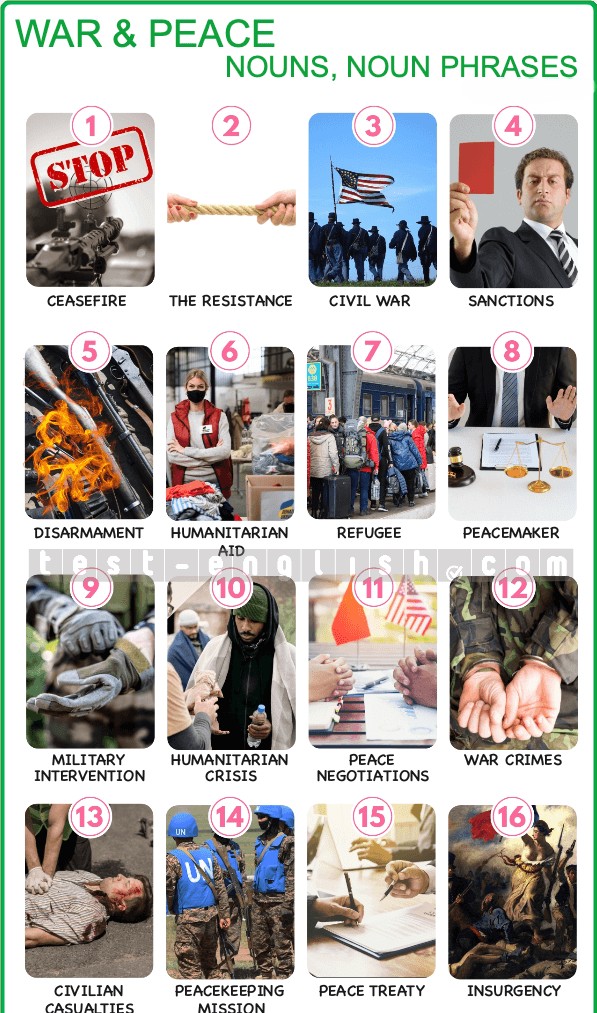
Nouns and Noun Phrases
Key vocabulary for discussing conflict, diplomacy, and humanitarian efforts.
Ceasefire
An agreement between two fighting parties to stop fighting temporarily.
A two-day ceasefire was announced to enable discussions between leaders of both parties.
The resistance
A group of people who secretly fight against those in power in a country under foreign occupation or harsh rule.
The resistance was determined to overthrow the tyrannical government and establish a new order.
Civil war
A war between two organised groups within a country or state.
Clashes between the two fundamentalist groups resulted in civil war.
Sanctions
Actions that countries use to punish and isolate another country when it breaks international rules.
Trade sanctions have been imposed on the country.
Disarmament
The act of reducing the number of weapons, especially nuclear weapons, that a country has.
Not all the heads of state were in favour of disarmament.
Humanitarian aid
Assistance given to people suffering from warfare or natural disasters, usually in the form of food, shelter, or medical care.
Without humanitarian aid, these people have little hope of survival.
Refugee
A person forced to leave their country to escape persecution or war.
The refugees had fled their country with very few worldly possessions.
Peacemaker
A person or party that tries to intervene and make peace between fighting sides.
We hope the peacemaker will influence the leaders’ decision.
Military intervention
Interference by a state or group of states in another’s political affairs using military force.
Military intervention by neighboring countries helped stabilize the war-torn nation.
Humanitarian crisis
An event threatening the health or well-being of many people, often due to war, disasters, or oppression.
This conflict has the potential to become the biggest humanitarian crisis of the century.
Peace negotiations
Formal discussions between warring parties to try to bring about peace.
We hope that the peace negotiations will bring an end to this horrible war.
War crimes
Illegal acts during wartime that violate international laws, such as torture or genocide.
The leader has been accused of genocide and other war crimes.
Civilian casualties
Members of the public who suffer or are killed as a result of wartime acts.
Raids on the villages resulted in numerous civilian casualties.
Peacekeeping mission
Deployment of military personnel to a conflict zone to prevent further violence.
Troops have been sent on a peacekeeping mission to the eastern region of the country.
Peace treaty
A written agreement that formally ends a state of war between hostile parties.
The peace treaty was signed by the leaders of both the warring parties.
Insurgency
A movement within a country dedicated to overthrowing the government, common under dictatorships.
The president’s fear of insurgency has caused him to increase security measures.
Verbs, Phrasal Verbs & Verb Phrases
Infographic showing key verbs: overthrow, escalate, surrender, retreat, etc.
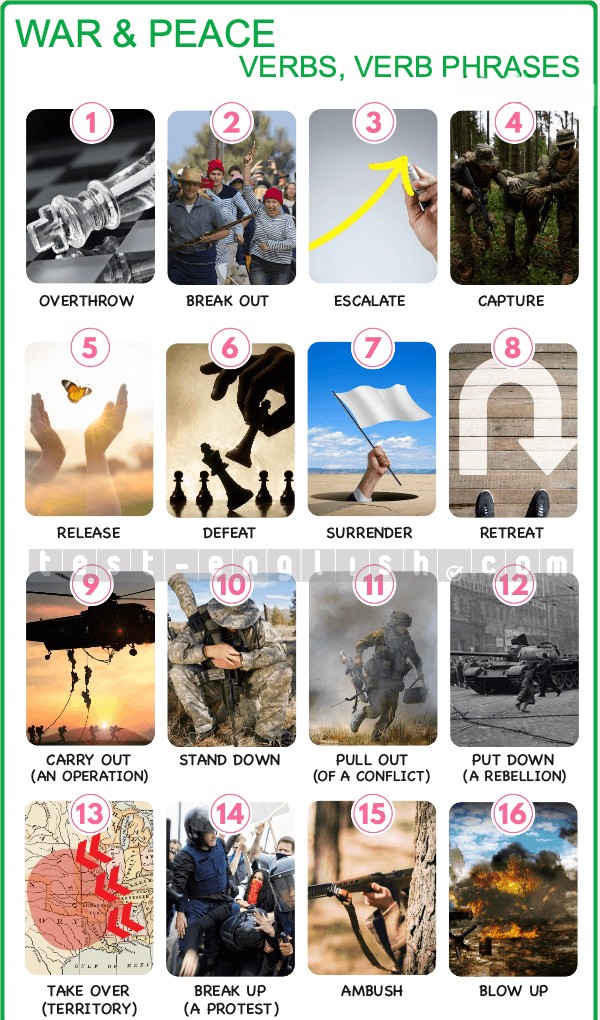
Verbs, Phrasal Verbs & Verb Phrases
Action words used to describe military, political, and diplomatic events.
Overthrow
To remove a government or leader from power by force.
Many attempts have been made to overthrow the leader.
Break out
When a war, conflict, or fight starts.
War broke out in the region last month.
Escalate
When a conflict intensifies or becomes worse quickly.
Fighting in the region has escalated in the past few days.
Capture
To catch someone or something, especially in war.
Many enemy soldiers have been captured and are now being held as prisoners of war.
Release
To free someone from confinement.
The hostages are unlikely to be released unless the soldiers’ demands are met.
Defeat
To win against someone in a fight or battle.
The French were defeated by the Germans in the battle.
Surrender
To give in and stop fighting after being defeated.
Realising victory was impossible, the leader had little choice but to surrender.
Retreat
When an army moves away from enemy forces to avoid fighting.
As the enemy advanced, the troops had to retreat quickly to avoid being surrounded.
Carry out
To perform a planned action (e.g., a ceasefire or operation).
Representatives from both parties agreed to carry out a 24-hour ceasefire.
Stand down
When troops withdraw from operations or reduce activity.
The general ordered his troops to stand down and return to base after tensions escalated.
Pull out
To withdraw from a conflict or situation.
Fearing further bombardment, two states pulled out of the conflict.
Put down
To stop a riot or rebellion using force.
The government is doing its utmost to put down the rebellion.
Take over
To assume control of territory or a system.
Victory in the battle enabled the leader to take over the eastern territory.
Break up
To end a protest, often forcibly.
Extra police were called in to try and break up the protest.
Ambush
To attack enemies after hiding and waiting for them.
During our mission in the jungle, we were ambushed by an enemy guerrilla group.
Blow up
To destroy something by explosion.
Terrorists blew up the building by planting a bomb in the parking lot.