Vocabulary/ B2 Vocabulary lessons and / News and media – B2 English Vocabulary
News and Media
Learn essential English vocabulary related to television, radio, newspapers, and publishing.
About This Lesson
In this pre-advanced vocabulary lesson, you’ll learn essential words and phrases related to the world of news and media—from anchors and correspondents to headlines, tabloids, and censorship. Review the definitions and examples to understand how and when to use each term.
Radio and Television
Infographic showing key terms: anchor, correspondent, viewer, broadcast, breaking news, etc.

Radio and Television
Key vocabulary for understanding and discussing broadcast media.
Anchor
A person who reads the news on television, usually from a studio.
The anchor who reads the news each night has a very clear voice.
Correspondent
A journalist who reports news from a specific location or on a particular topic.
The correspondent was speaking from Turkey, where the earthquake took place.
Viewer
A person who watches a programme on television.
The programme has over 200,000 regular viewers.
Listener
A person who listens to programmes on the radio.
The majority of the radio station’s listeners are over the age of sixty.
Broadcast
To send out a programme on TV, radio, or online; also refers to the programme itself.
The programme has been broadcast in over 30 countries.
Live coverage
A report shown while an event is happening or has just happened.
Live coverage of the match enabled viewers all over to watch the match as it happened.
Breaking news
News about events that are developing or have just occurred.
We’ve just heard some breaking news about an explosion in the capital.
Talk show
A TV or radio programme where guests are interviewed, often in front of an audience.
One of my favourite actors was interviewed on a local talk show.
Commercials / Ads
Paid advertisements shown on TV or radio to promote products or issues.
The only thing I don’t like about the channel is the fact that there are so many commercials.
Ratings
Measurements of how popular or well-received a programme is.
The programme had received high ratings, so I assumed it would be good.
Current affairs programme
A show discussing current political, social, or environmental topics.
We watched a current affairs programme about the war last night.
Weather forecast
A prediction of upcoming weather conditions, often shown after news.
The weather forecast for the weekend is not good.
Newspapers and Publishing
Infographic showing: headline, editorial, journalist, tabloid, censorship, etc.
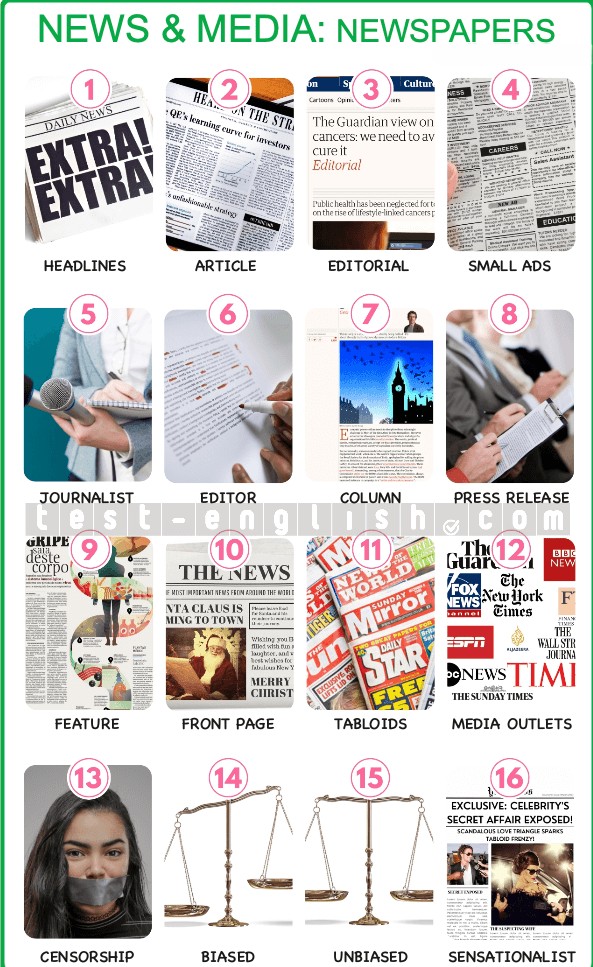
Newspapers and Publishing
Essential terms for print and digital journalism, editing, and media ethics.
Headline
Large text at the top of a newspaper article, especially on the front page.
The story made the headlines in newspapers all over the country.
Article
A piece of writing in a newspaper, magazine, or online publication.
I read an interesting article in yesterday’s newspaper.
Editorial
An article expressing the official opinion of a newspaper’s editorial board.
The editorial in today’s newspaper discusses climate change and its impact.
Small ads
Brief, simple advertisements in the classified section of newspapers.
I checked the small ads in the paper to see if there were any job vacancies listed.
Journalist
A person who collects and writes news for media outlets.
After the journalist had submitted the article, the editor checked it.
Editor
A person who checks, corrects, and decides what gets published in a newspaper or magazine.
The editor is also in charge of the newspaper’s content and direction.
Column
A regular feature in a newspaper or magazine, usually by the same writer.
I read his column in the Saturday paper every week.
Press release
An official statement issued to the media by an organization or public figure.
The Queen’s abdication was announced in a press release.
Feature
A longer, in-depth article that explores a topic more thoroughly than a standard news piece.
I read a five-page feature about veganism in a food magazine last week.
Front page
The first page of a newspaper, containing the most important stories of the day.
The scandalous revelation about the mayor’s secret dealings made the front page.
Tabloid
A newspaper with smaller pages, short articles, and often sensationalist content.
The tabloid featured sensationalist headlines about the celebrity’s supposed alien encounter.
Media outlet
Any channel that distributes news and information (TV, radio, print, online).
The news company has a number of popular media outlets.
Censorship
The suppression of information deemed unsuitable, harmful, or offensive.
The government has strict censorship laws.
Biased
Showing personal opinions rather than neutral facts.
The writer’s scepticism was evident throughout the biased article.
Unbiased
Neutral and objective, without personal opinion.
The feature was informative and unbiased.
Sensationalist
Designed to provoke strong reactions, often exaggerating facts for attention.
The tabloid is full of sensationalist articles, many of which are hard to believe.
News & Media Vocabulary Summary
Key terms: anchor, correspondent, headline, editorial, tabloid, censorship, biased, media outlet, etc.