Vocabulary/ B2 Vocabulary lessons and / Money and finance – B2 English Vocabulary
Money and Finance
Learn essential English vocabulary for personal and business financial matters.
About This Lesson
In this pre-advanced vocabulary lesson about Money and Finance, you will learn a wide range of terms and expressions that are essential for discussing personal and business financial matters effectively. Check the pictures and read the texts and definitions below.
Personal and Business Finances
Educational infographic with Money and Finance terms such as 'Bills,' 'Income,' and 'Mortgage,' with corresponding pictures.
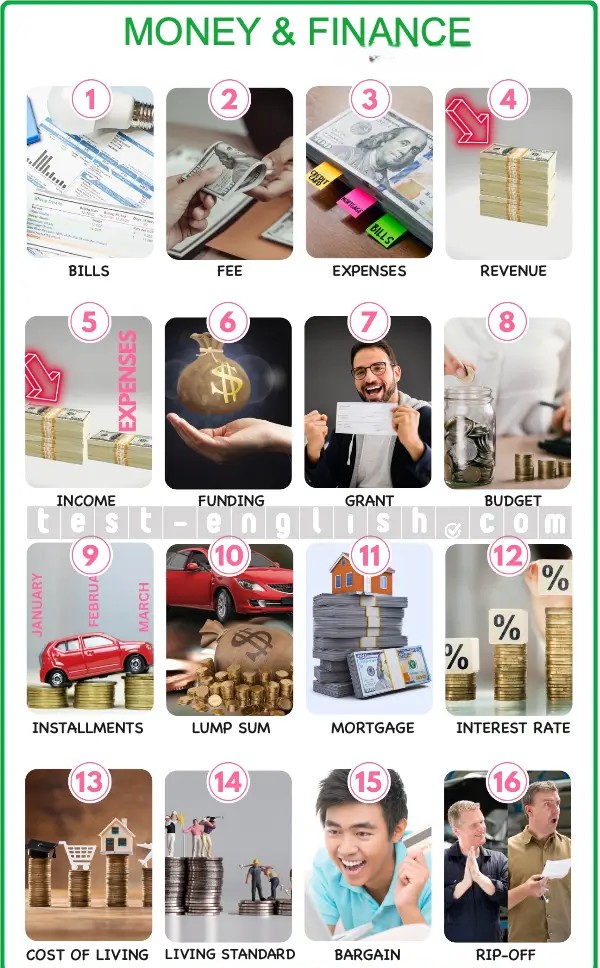
Personal and Business Finances
Key terms for understanding income, spending, loans, and financial planning.
Bill
A printed statement showing the money you owe for services, goods, or utilities.
Our electricity bill was higher than usual last month.
Fee
A fixed price you pay a person or organization for their services.
The lawyer’s fee was much higher than I’d expected it to be.
Expenses
The money that a person or company has to pay for goods or services, such as food and bills.
I generally use cash to pay for my day-to-day expenses.
Revenue
The total amount of money made by an organization’s operations over a given period.
The company’s revenue came to over $20,000,000 last year.
Income
The money that remains from revenue after all taxes and expenses have been deducted.
Their income more than doubled in less than a year.
Funding
Money given to finance a specific project or purpose, from sources like governments or investors.
We received funding from the government to carry out our research.
Grant
A type of funding, typically from a government or organization, given for a specific purpose and not requiring repayment.
I received a grant from the government to study for my postgraduate degree.
Budget
The amount of money you have available to spend over a specific period.
Our monthly household budget includes expenses for groceries, utilities, and rent.
Installment
One of a series of fixed payments made over time for goods or services.
I decided to pay for it in installments over a twelve-month period.
Lump sum
A single payment made at one time instead of in installments.
You save a bit more money by paying the lump sum.
Mortgage
A loan specifically used to purchase property, such as a house or apartment.
We recently took out a mortgage to buy a flat in the center of town.
Interest rate
The percentage charged by a lender on a loan, affecting the total repayment amount.
The interest rate on our loan has risen by 2%.
Cost of living
The amount of money needed to cover basic necessities like housing, food, and healthcare.
The cost of living has risen in the past year.
Standard of living
The general level of wealth, comfort, and access to goods and services in a society.
We have a relatively high standard of living around here.
Bargain
An item offered at a lower price than expected, offering good value.
I bought these heels for $10. What a bargain!
Rip-off
Something purchased that was too expensive for the quality received.
$30 for a pizza is an absolute rip-off!
Adjectives and Modifiers
Educational infographic illustrating adjectives related to 'Money and Finance' with terms like 'Worthless,' 'Good Value,' 'Frugal,' 'Affluent,' etc.
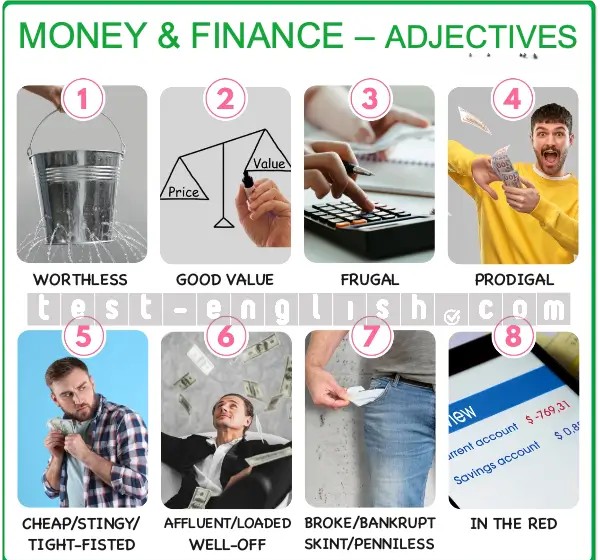
Adjectives and Modifiers
Words to describe financial situations, value, and spending habits.
Worthless
Without any value; worth nothing.
This is completely worthless; it’s rusty and doesn’t work.
Good value
Of good quality or abundant relative to its price; well worth the money.
This vacuum was good value; it didn’t cost much and it’s an excellent brand.
Frugal
Careful or economical with money; avoids unnecessary spending.
I’m trying to be more frugal and not buy anything I don’t need.
Prodigal
Spends money carelessly on unnecessary things.
Joe needs to be less prodigal and stop buying clothes he’s not going to wear.
Cheap / Stingy / Tight-fisted
Unwilling to spend money; mean with money.
Tony was too cheap to buy his girlfriend a birthday present.
Affluent / Well-off / Loaded
Financially comfortable or wealthy; 'loaded' implies extreme wealth.
Peter has homes in four countries; he’s absolutely loaded!
Broke / Skint / Penniless / Bankrupt
Having no money; 'bankrupt' is a legal status indicating inability to repay debts.
After a year of poor sales, the company was declared bankrupt.
In the red
Having spent more money than is in your account; owing money to the bank.
After purchasing the sofa, my account was in the red.
Verbs, Phrasal Verbs and Verb Phrases
Infographic with icons depicting finance-related verbs: invest, save up, haggle, make ends meet, etc.
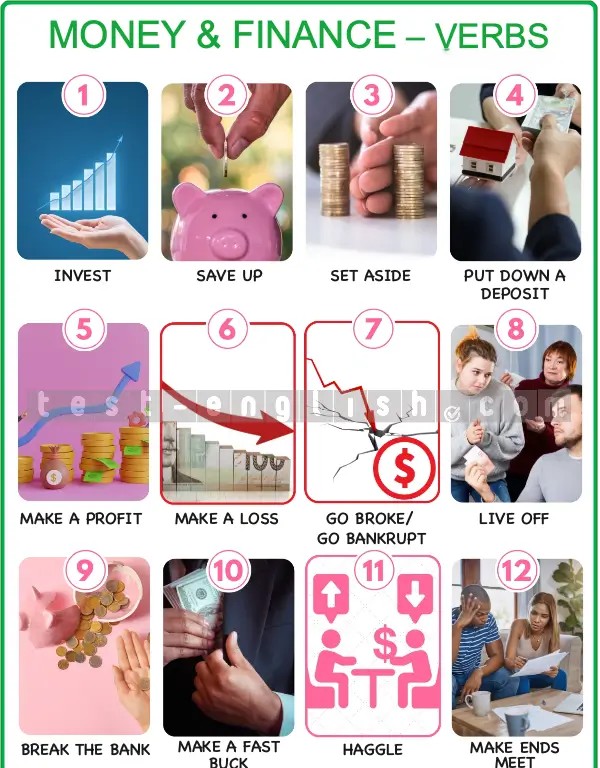
Verbs, Phrasal Verbs and Verb Phrases
Action words and expressions used when managing, spending, or discussing money.
Invest
To put money into something (e.g., shares or a business) in the hope of making a profit.
I invested several hundred euros in shares last month.
Save up
To accumulate money over time for a specific future purpose.
James is saving up for a new bicycle.
Set aside
To reserve money for a particular future expense or need.
I set aside money every month to pay for petrol.
Put down a deposit
To make an initial payment for something (e.g., a house), with the rest paid later.
We recently put down a deposit on a cottage in Wales.
Make a profit
To earn more money than was invested or spent.
We made quite a good profit from our investment in those shares.
Make a loss
To earn less money than was invested or spent.
Richard was annoyed when he realised that he’d made a loss from his investment.
Go broke
To spend all your money and end up with none.
At the rate I’m spending money, I’ll go broke by the end of the week!
Live off
To depend financially on another person.
He is 35 and still lives off his parents.
Break the bank
To cost so much that it uses up most or all of your available money.
Buying that engagement ring nearly broke the bank.
Make a fast buck
To earn money quickly, often in a way that is considered dishonest or unethical.
Sam tried to make a fast buck by investing in a financial scheme.
Haggle
To negotiate a lower price with a seller.
I haggled with the carpet vendor and managed to negotiate a lower price.
Make ends meet
To earn just enough money to cover basic living expenses.
Now that I’ve gone part-time at work, I’m barely making ends meet.