Vocabulary/ B2 Vocabulary lessons and / The human voice and other sounds – B2 English Vocabulary
The Human Voice and Other Sounds
Learn essential English vocabulary to describe human vocal sounds and common non-human noises.
About This Lesson
In this B2 Pre-advanced Vocabulary Lesson about the Human Voice and Other Sounds, you will learn various terms to describe different types of noises and actions related to both human and non-human sounds. Check the pictures, definitions, and example sentences below to understand these terms better.
Human Voice Sounds
Vocabulary chart illustrating different human voice sounds for B2 English learners, including whisper, hum, scream, yell, sob, etc.
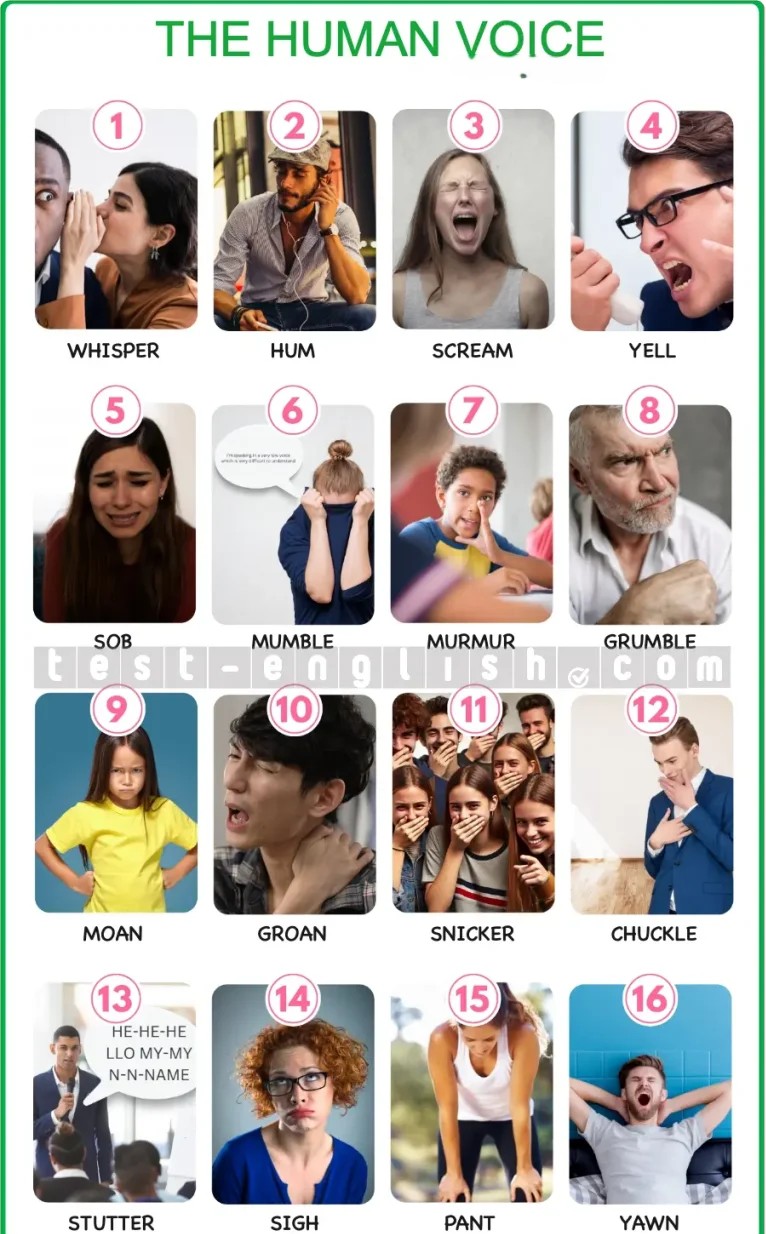
Human Voice Sounds
Key vocabulary for describing how people produce sounds with their voices.
Whisper
To speak very softly and quietly, often directly into someone’s ear, so that only one person can hear you.
The girls were whispering to each other at the back of the classroom.
Hum
To sing a tune or melody with your lips closed.
Mary hummed as she dusted the shelves.
Scream
To make a loud, high-pitched noise, usually because you are scared, hurt, or excited.
Anna screamed when she saw the masked man in her living room.
Yell
To shout loudly, usually because you are angry, excited, or trying to get someone’s attention.
The child was yelling for his mother because his sister had taken his toy.
Sob
To cry noisily and breathe in short breaths, usually because you are very sad or upset.
Nina was sobbing loudly, and I was unable to comfort her.
Mumble
To speak quietly and not clearly, usually because you are nervous or not confident.
Please stop mumbling; I can’t hear what you’re saying.
Murmur
To speak very softly and quietly, often so others can barely hear you.
Fran murmured a reply quickly, but I didn’t catch what it was.
Grumble
To complain in a low voice, usually because you are annoyed or unhappy.
The students grumbled when the teacher told them they’d be having a test.
Moan
To make a long, low sound, usually because you are in pain or unhappy.
‘I don’t want to clean my room. I did it yesterday,’ moaned the child.
Groan
To make a deep, long sound to express physical pain, discomfort, frustration, annoyance, or disappointment.
The child was clutching its sore stomach and groaning in pain.
Snicker
To laugh quietly and often in a disrespectful or mocking way.
The children snickered cruelly when the actor forgot his lines.
Chuckle
To laugh quietly and softly to yourself.
I couldn’t help chuckling when the child recounted his version of the story.
Stutter
To speak with repeated sounds or words, usually because you are nervous or have a speech problem.
Mike was very nervous and stuttered as he introduced himself.
Sigh
To breathe out loudly and slowly, usually because you are tired, relieved, or disappointed.
After finishing her long essay, Sara sighed loudly.
Pant
To breathe fast and loudly, usually because you have been exercising or doing something tiring.
After running up the hill, Sarah was panting, trying to catch her breath.
Yawn
To open your mouth wide and breathe in deeply, usually because you are tired or bored.
She couldn’t stop yawning during the long, boring lecture.
Non-Human Sounds
Vocabulary chart illustrating different non-human sounds for B2 English learners, including rattle, thud, click, beep, hiss, thump, bang, clatter, pop, crackle, tap, and splash.
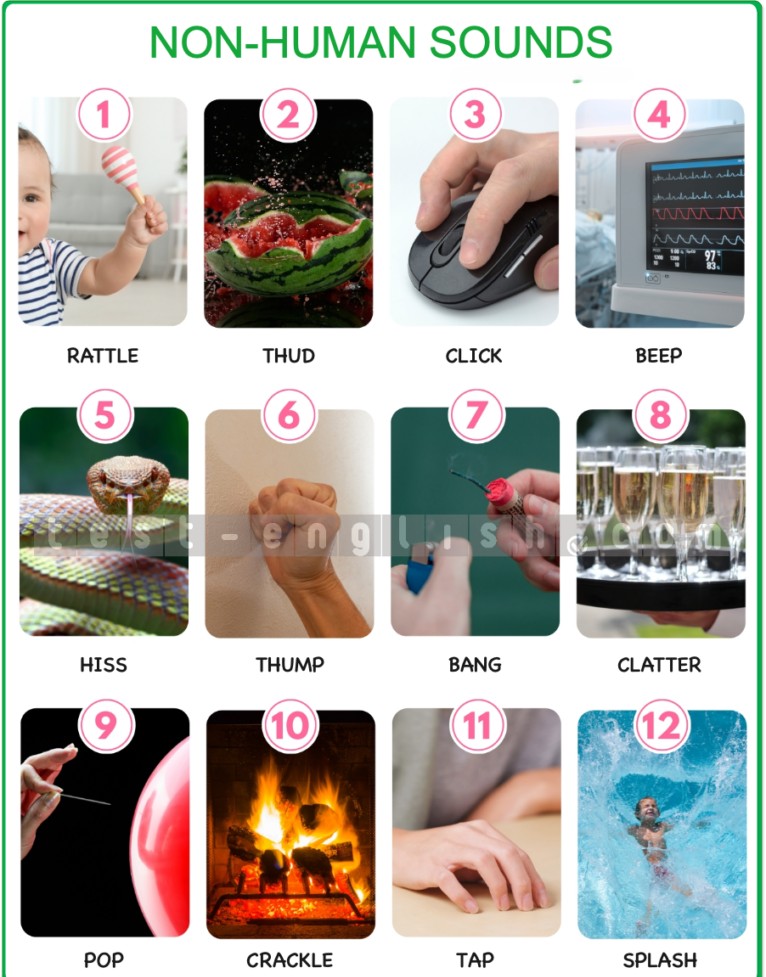
Non-Human Sounds
Essential terms for describing everyday sounds made by objects, animals, machines, and nature.
Rattle
To make a quick succession of short knocking sounds, as when loose objects (often metal or wood) shake or collide.
The strong wind caused the shutters to rattle against the wall.
Thud
A dull, heavy sound made when something falls or hits a surface.
I heard a loud thud as the melon rolled off the table and onto the hard floor.
Click
A short, sharp sound, like that of a light switch or keyboard key.
I heard the light click on in the next room and realised Fred was home.
Beep
A short, high-pitched sound, as from an alarm, microwave, or car horn.
The driver beeped their horn at the car blocking the car park exit.
Hiss
A long, sharp sound like that of a snake or escaping steam; also made by angry cats or geese.
When I heard the snake hiss, I knew I was in trouble.
Thump
A loud, heavy sound; can also mean to hit something hard (e.g., with a fist) or describe a strong heartbeat.
I was woken by the sound of someone thumping on the door.
Bang
A loud, sudden, explosive noise, often from a door slamming or an explosion.
We heard a loud bang when the door slammed shut.
Clatter
A series of loud, sharp sounds made by hard objects hitting each other (e.g., dishes or cutlery).
The cutlery in the box clattered as I carried it into the new house.
Pop
A quick, explosive sound made when something bursts (e.g., a balloon or bubble).
Sara cried loudly when her sister popped her balloon.
Crackle
A series of short, repetitive spitting noises, as from a fire or static on a radio.
We stood around the bonfire, listening to the crackling logs.
Tap
A light, quick sound made by gently striking something (e.g., a pencil on a desk or fingers on a keyboard).
I wish you’d stop tapping your foot on the floor. It’s very annoying.
Splash
The sound made when something hits or moves in water, causing droplets to fly up.
The children laughed as they jumped into the pool, causing a big splash.
Vocabulary Summary: Human Voice & Other Sounds
Key terms: whisper, hum, scream, yell, sob, mumble, rattle, thud, click, beep, hiss, thump, bang, clatter, pop, crackle, tap, splash.