Vocabulary/ B2 Vocabulary lessons and / Food and food products – B2 English Vocabulary
Food and Food Products
Learn essential English vocabulary to describe food, its qualities, preparation, and types.
About This Lesson
In this Pre-advanced Vocabulary Lesson about Food and Food Products, you will learn various terms and phrases used to describe food and its properties. Check the pictures, definitions, and example sentences below to understand these terms better.
Food Adjectives
B2 English vocabulary chart illustrating various food adjectives with 12 labelled images, including terms such as edible, crunchy, ripe, rotten, and more.
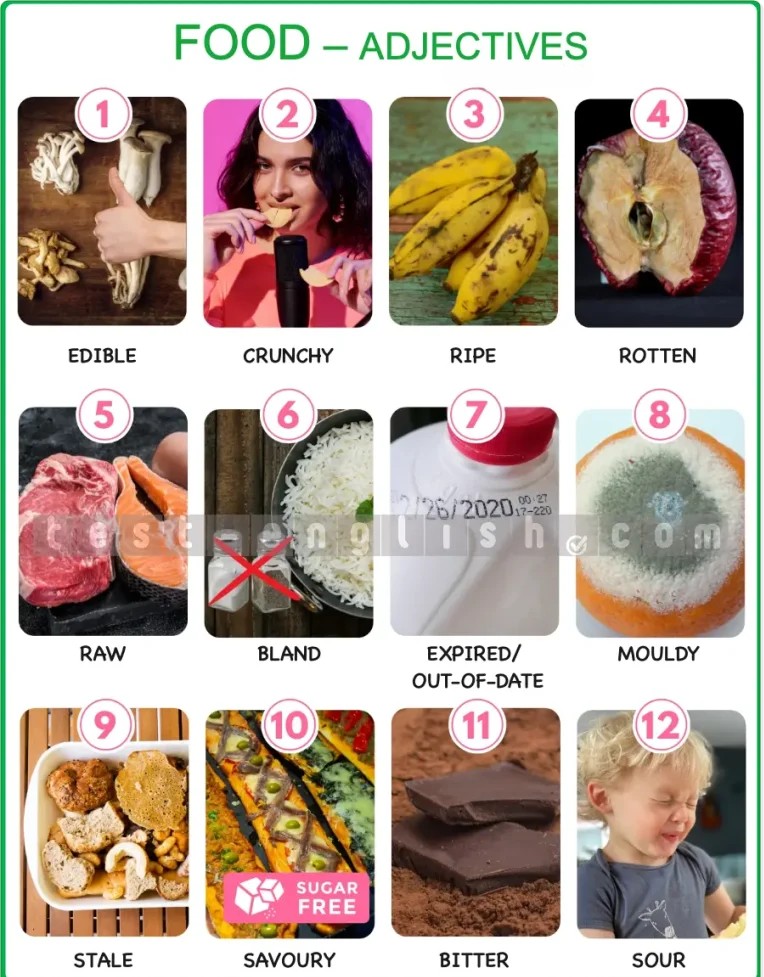
Food Adjectives
Descriptive words to talk about the taste, freshness, and condition of food.
Edible
Safe and suitable for eating.
All the berries in our garden are edible.
Crunchy
Hard and makes a noise when you bite or chew it.
The apple was hard and very crunchy.
Ripe
Fully developed and ready to eat (used for fruit/vegetables).
The tomatoes will soon be ripe and ready for us to eat.
Rotten
Decayed and no longer safe to eat; often discoloured or smelly.
Most of the carrots were rotten, and I had to throw them away.
Raw
Not cooked.
I prefer raw carrots to cooked ones.
Bland
Lacking strong taste or flavor.
Plain rice is very bland, so I usually add soy sauce.
Expired / Out-of-date
Past the recommended date for safe consumption.
The supermarket throws away all of its food that is out-of-date.
Mouldy
Covered in mould (often green, blue, or white fuzz) due to age or poor storage.
The bread was a week old and had started to turn mouldy.
Stale
Not fresh; dry and hard (often used for bread or crackers).
I threw the bread away because it was hard and stale.
Savoury
Not sweet; usually salty or spicy in flavor.
I tend to snack on savoury foods such as crisps, cheese, and crackers.
Bitter
Having a sharp, harsh taste—not sweet (e.g., dark chocolate, coffee).
I don’t like black chocolate, as I find it very bitter.
Sour
Having a sharp, acidic taste (e.g., lemons, grapefruit).
The grapefruit was sour and very hard to eat.
Food Verbs
B2 English vocabulary chart illustrating various food verbs with 12 labelled images, including terms such as go off, waste, preserve, peel, etc.
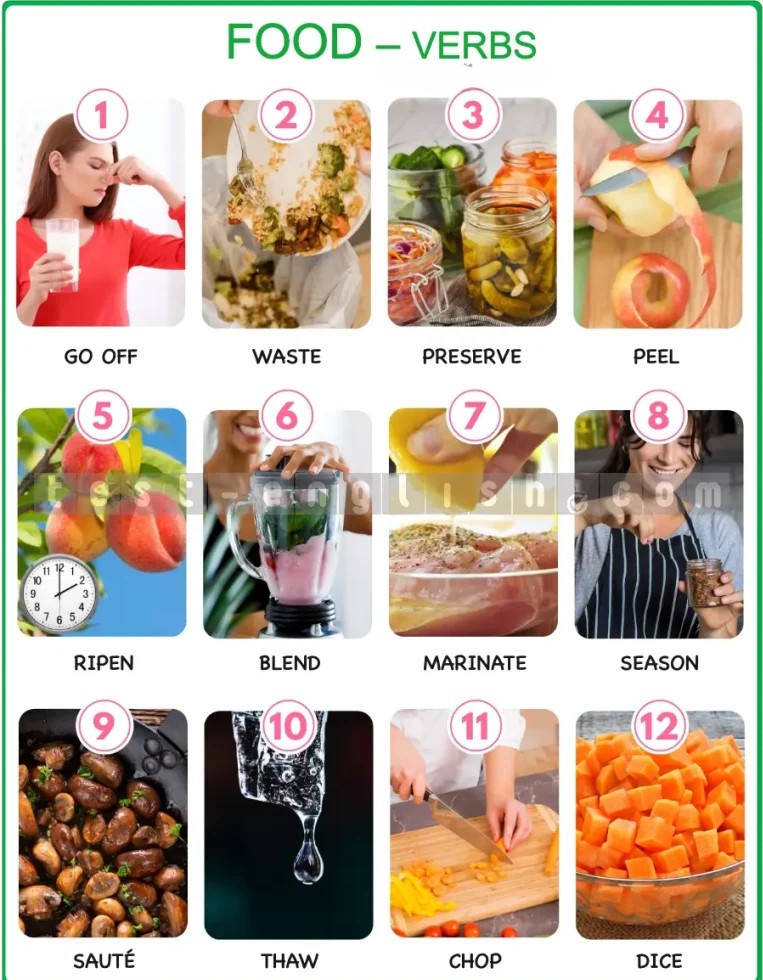
Food Verbs
Common verbs used when preparing, storing, or describing changes in food.
Go off
To spoil or become bad and unsafe to eat (especially dairy, meat, fish).
The fish was one week old and had started to go off.
Waste (food)
To throw away food that is still edible.
I try not to waste food, so I only buy small amounts at a time.
Preserve
To treat food (e.g., with salt, sugar, vinegar) to make it last longer.
My mother used to preserve cucumbers with vinegar, sugar, and salt.
Peel
To remove the skin or outer layer of fruit or vegetables.
I peeled the potatoes, then boiled them for ten minutes.
Ripen
To become ripe over time.
The apples need to ripen; they’re not ready to eat just yet.
Blend
To mix ingredients (often with liquid) into a smooth puree using a blender.
I like to blend strawberries and bananas to make a delicious smoothie.
Marinate
To soak food (usually meat) in a seasoned liquid before cooking to add flavor.
You need to marinate the chicken in the sauce for a few hours before cooking it.
Season
To add salt, pepper, herbs, or spices to enhance flavor.
The sauce tasted bland, so I seasoned it with salt and pepper.
Sauté
To fry food quickly in a small amount of hot oil or butter.
I sautéed the vegetables in the pan with some olive oil and butter.
Thaw
To allow frozen food to return to a softer or liquid state at room temperature.
After taking the meat out of the freezer, I left it on the counter to thaw.
Chop
To cut food into pieces (not necessarily uniform).
I chopped the vegetables quickly, then threw them in the pot.
Dice
To cut food into small, uniform cubes.
Before cooking the potatoes, I diced them into small cubes.
Types of Food Products
B2 English vocabulary chart illustrating various types of food products with 12 labelled images, including terms such as packaged foods, processed foods, whole foods, dairy products, etc.
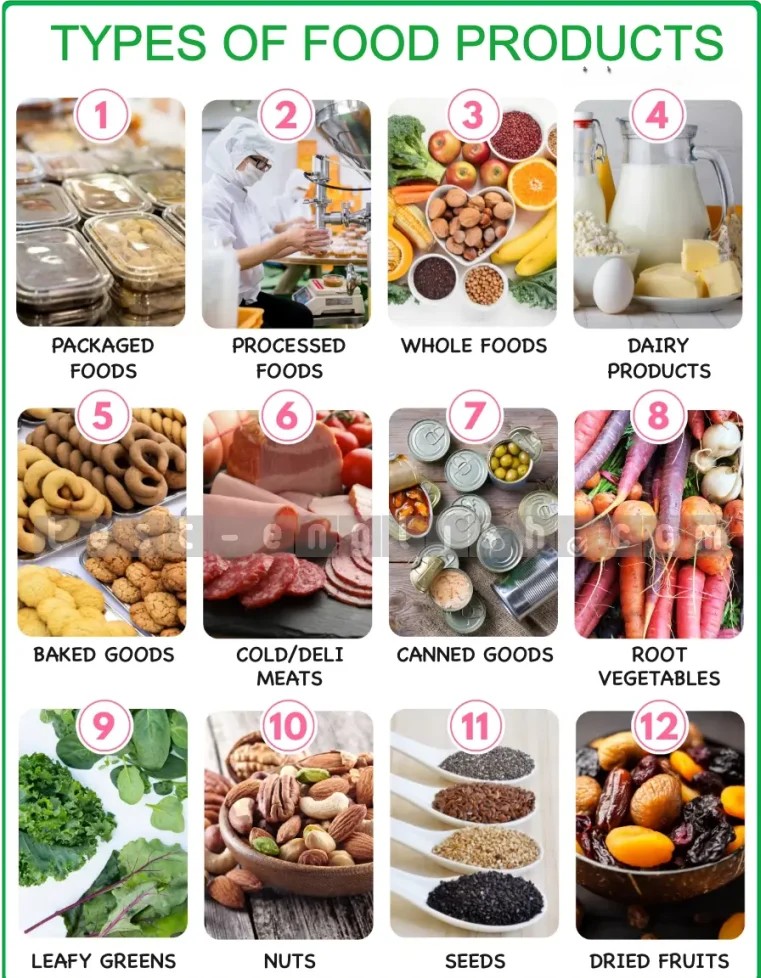
Types of Food Products
Vocabulary for categorizing different kinds of foods you buy or eat.
Packaged foods
Foods sold in sealed containers or wrappings for protection and convenience.
I prefer the taste of homemade biscuits to packaged ones.
Processed foods
Foods altered from their natural state, often with additives, for taste or shelf life.
I try to avoid processed foods as they are unhealthy and less tasty.
Whole foods
Natural, unrefined foods with no additives (e.g., brown rice, beans, lentils).
We eat a lot of whole foods, such as brown rice, beans, and lentils.
Dairy products
Foods made from or containing milk (e.g., cheese, yogurt, butter).
I eat a lot of dairy products, such as yogurt, butter, and cheese.
Baked goods
Foods made from flour and baked (e.g., bread, cakes, biscuits).
We bought biscuits and other baked goods from the cake stall at the market.
Cold / deli meats
Pre-cooked, preserved meats (e.g., ham, salami) often eaten cold in sandwiches.
My favourite deli meats are salami and smoked ham.
Canned goods
Foods preserved in sealed metal tins (e.g., beans, tuna, tomatoes).
Beans and other canned goods usually last a very long time.
Root vegetables
Vegetables that grow underground as plant roots (e.g., carrots, potatoes).
I made a soup with carrots, potatoes, and some other root vegetables.
Leafy greens
Edible green leaves of plants (e.g., spinach, kale, lettuce).
Spinach and other leafy greens make a good base for a salad.
Nuts
Edible fruits with a hard shell and oily kernel (e.g., almonds, walnuts).
Nuts and seeds are a good source of protein.
Seeds
Small, hard plant parts that can grow into new plants; often eaten for nutrition.
Nuts and seeds are a good source of protein.
Dried fruits
Fruits from which moisture has been removed to preserve them (e.g., raisins, apricots).
I usually snack on raisins and other types of dried fruits.