Vocabulary/ B2 Vocabulary lessons and / Feelings and emotions – B2 English Vocabulary
Feelings and Emotions
Learn essential English adjectives to describe how you feel—from happy to sad and everything in between.
About This Lesson
In this pre-advanced vocabulary lesson, you’ll learn many adjectives to describe your feelings—from joyful to devastated. Check the definitions and examples to understand how and when to use each term.
Positive and Negative Emotions
Infographic showing key adjectives: joyful, excited, anxious, disappointed, etc.
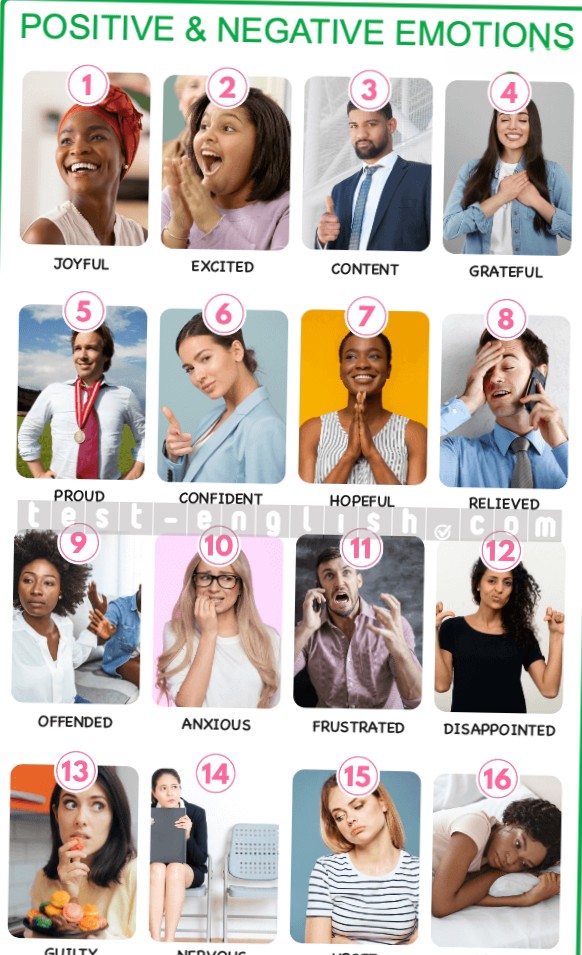
Positive Emotions
Adjectives to describe happy, satisfied, or hopeful feelings.
Joyful
Happy, perhaps because you’ve heard some good news.
She felt joyful when she received the unexpected gift from her friend.
Excited
Happy because you’re looking forward to something that is going to happen in the future.
The children were excited about their upcoming trip to Disneyland.
Content
Not extremely happy, but quite satisfied.
After a satisfying meal, he went back to work, feeling content.
Grateful
Thankful for something you have or that someone has done.
She was grateful for the support and kindness shown to her during difficult times.
Proud
Respect for yourself, often because of something you or someone close to you has achieved.
He was proud of his daughter’s achievements in school.
Confident
Believe in yourself and are not worried about failure.
With thorough preparation, she walked into the interview room feeling confident.
Hopeful
Have hope and believe that it is possible for something good to happen.
Despite the challenges, she remained hopeful that things would improve.
Relieved
Pleased because you have avoided a difficult or unpleasant situation.
After weeks of uncertainty, he was relieved to hear the good news about his health.
Negative Emotions
Adjectives to describe sadness, worry, anger, or regret.
Offended
Angry or hurt by something someone has said or done to you.
She was offended by the rude remark made by her coworker during the meeting.
Anxious
Worried or uneasy about something.
She felt very anxious about giving a presentation, but it went well.
Frustrated
Annoyed because something is not working or happening the way you want it to.
After hours of trying to assemble the complicated furniture, he grew frustrated.
Disappointed
Unhappy because something was not as good as you thought it would be.
She was disappointed when the concert she had been looking forward to was canceled.
Guilty
Feel bad for something you did wrong.
She felt guilty for eating sweets, especially since she had promised herself to stick to a healthy diet.
Nervous
Worried about a stressful situation that is going to arise in the future.
She felt nervous before her job interview, but she prepared thoroughly.
Upset
Sad because of something that has happened.
Learning about the earthquake on the news left her feeling upset.
Depressed
Unhappy and have little hope.
After the loss of her pet, she felt depressed for months.
Neutral and Intense Emotions
Infographic showing calm, curious, ecstatic, furious, devastated, etc.
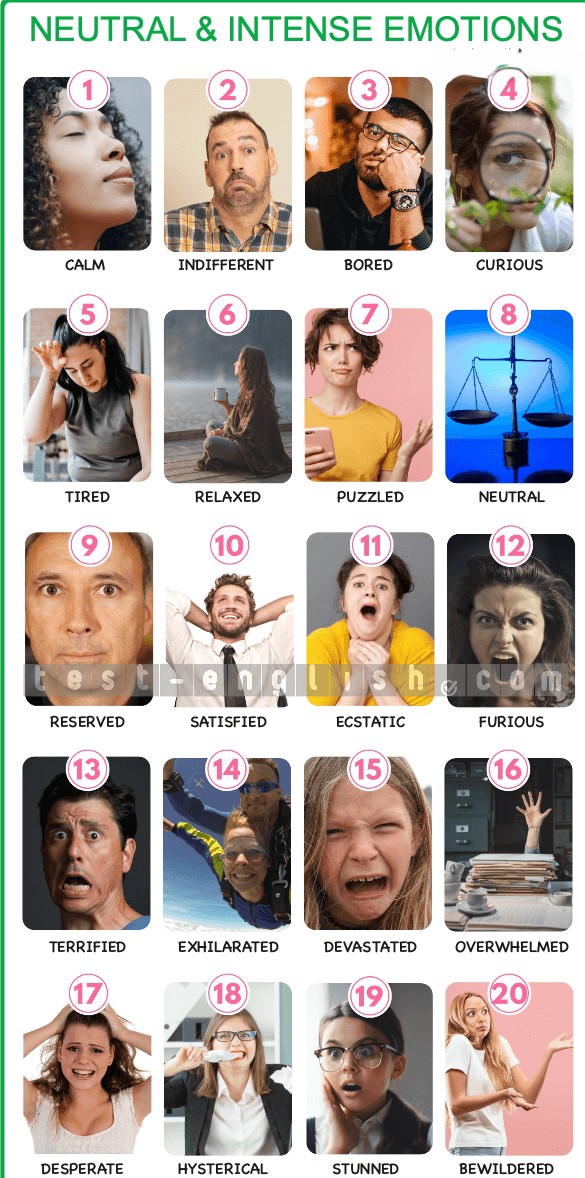
Neutral Emotions
Adjectives for mild, indifferent, or balanced emotional states.
Calm
Relaxed, and not worried about anything.
She took a deep breath and tried to stay calm during the stressful meeting.
Indifferent
Have no feelings about or interest in something.
He seemed indifferent to the news, as if it didn’t matter to him at all.
Bored
Uninterested in what is happening around you.
The long lecture left him feeling bored and uninterested.
Curious
Want to know more about something.
Her curious nature led her to explore new places whenever she had the chance.
Tired
Don’t have a lot of energy and may want to sleep.
After a hard workout at the gym, she was tired and ready to rest.
Relaxed
Feel free because nothing is worrying you.
The spa day left her feeling completely relaxed and rejuvenated.
Puzzled
Confused about something that is happening or has happened.
She furrowed her brow, puzzled by the mysterious message.
Neutral
Have no strong preferences or opinions about something.
She tried to remain neutral and not take sides in the argument.
Reserved
Keep your feelings to yourself.
He was reserved and didn’t often share his feelings or personal thoughts with others.
Satisfied
Pleased because you got what you desired.
He felt satisfied after completing the challenging report.
Intense Emotions
Powerful feelings—extreme joy, fear, anger, or shock.
Ecstatic
Incredibly happy, usually because something good has happened.
She was absolutely ecstatic when she received the news that she had been accepted into her dream university.
Furious
Extremely angry about something.
She was furious when she discovered that someone had accidentally deleted all of her important work files from the computer.
Terrified
Very scared; something is really frightening you.
He was terrified of heights, so climbing to the top of the tower was a major challenge.
Exhilarated
Thrilled and excited.
After her first experience jumping out of an airplane, she felt exhilarated and proud of her accomplishment.
Devastated
Extremely sad; something very upsetting has happened.
Hearing the news of her grandmother’s passing left her devastated and in tears.
Overwhelmed
Affected deeply, causing you to feel very emotional.
Juggling work, school, and family responsibilities, she often felt overwhelmed by the stress.
Desperate
Lost all hope, and are feeling very down.
With no money and nowhere to go, he felt desperate and reached out to a local shelter for help.
Hysterical
In a state of uncontrolled excitement, anger, or panic.
When the project deadline was suddenly moved up by a week without previous notice, she became hysterical.
Stunned
Too shocked to express any emotion, usually because of surprising news.
After receiving the award, she was too stunned to speak, her mouth hanging open in amazement.
Bewildered
Extremely confused, and unable to understand a situation.
Lost in the unfamiliar city, she looked around bewildered, trying to find her way back to the hotel.
Feelings & Emotions Vocabulary Summary
Key terms: joyful, anxious, calm, ecstatic, devastated, overwhelmed, bewildered, etc.