Vocabulary/ B1 Vocabulary lessons and / More daily routines – B1 English Vocabulary
Daily Routines Vocabulary
Learn essential expressions to describe everyday activities in English
About This Lesson
In this Intermediate Vocabulary Lesson about Daily Routines, you will learn a range of useful expressions to describe everyday activities in more detail. The pictures, definitions, and sentence examples below will help you understand and remember these important terms.
Daily Routine Actions (B1 Level)
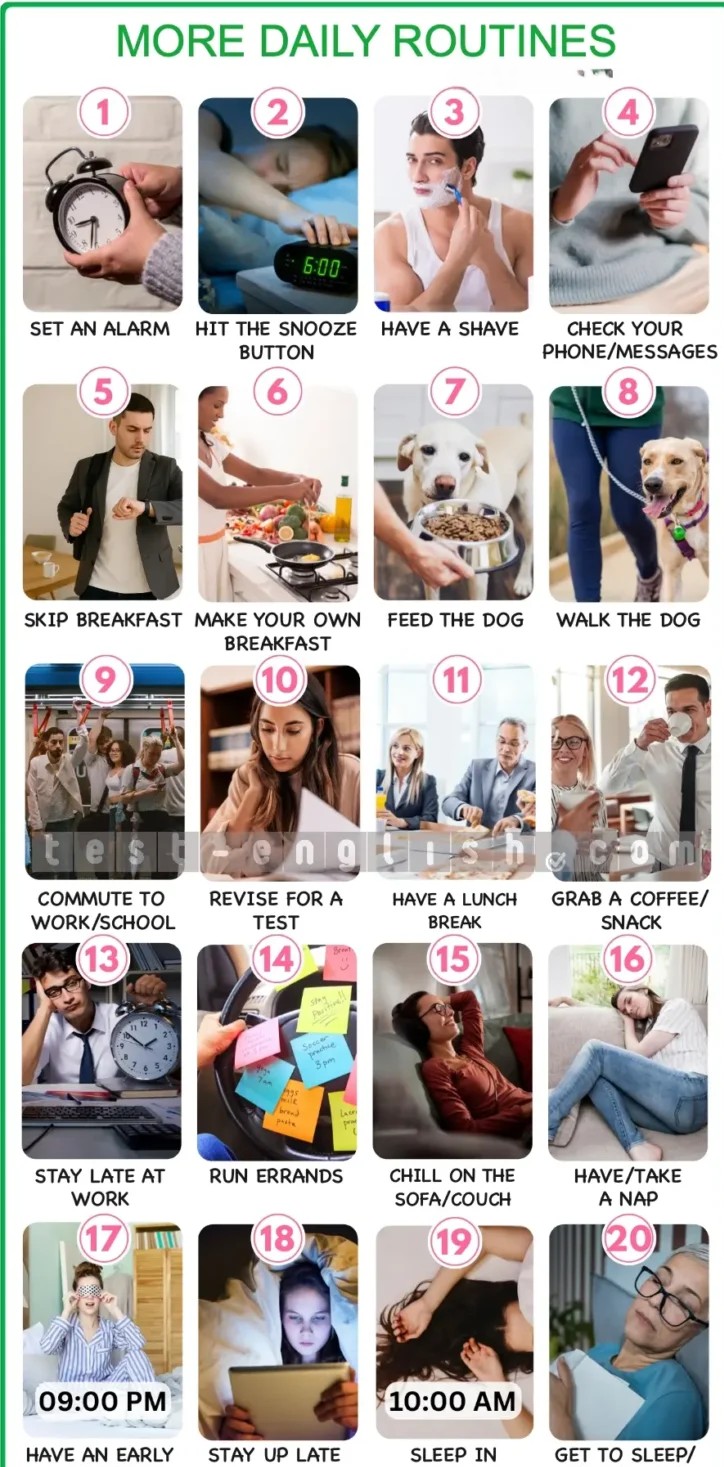
Vocabulary chart showing 20 daily routine actions: set an alarm, skip breakfast, walk the dog, commute, run errands, chill on the sofa, etc.
Daily Routine Vocabulary
Morning
set an alarm
You choose a time for your alarm clock to ring.
I always set an alarm for 7 a.m. on weekdays.
hit the snooze button
You press a button on your alarm clock to sleep for a few more minutes.
He hit the snooze button three times this morning.
have a shave
You use a razor to take the hair off your face.
I usually have a shave before breakfast.
check your phone / messages
You look at your phone to see if you have any notifications, texts, or emails.
She checked her phone as soon as she woke up.
skip breakfast
You don’t eat anything in the morning.
He skipped breakfast because he was late for school.
make your own meal
You prepare the meal yourself instead of buying it or having someone else make it.
I usually make my own lunch and take it to work.
feed the dog/cat
You give food to your pet.
She feeds the cat every morning before school.
walk the dog
You take your dog outside, usually on a lead.
I walk the dog in the park every morning.
During the day (work/school)
commute to work/school
You travel from your home to your workplace or school.
She commutes to work by train every day.
revise for a test
You study something again to prepare for an exam.
I usually revise for tests in the evening.
have a lunch break
You stop working or studying for a short time to eat lunch.
They always have a lunch break at 1 p.m.
grab a coffee/snack
You quickly get something small to eat or drink.
We grabbed a coffee before the meeting.
stay late at work
You don’t leave at your usual time and work extra hours.
He often stays late at work to finish projects.
run errands
You go out to do small jobs like shopping or picking something up.
I need to run some errands before dinner.
Evening & night
chill on the sofa
You relax and do something easy like watching TV or using your phone.
In the evening, I like to chill on the sofa and listen to music.
have/take a nap
You sleep for a short time during the day.
She usually takes a nap after lunch.
have an early night
You go to bed earlier than usual.
I’m really tired, so I’ll have an early night.
stay up late
You go to bed much later than usual.
We stayed up late watching a movie.
sleep in
You stay in bed later than usual in the morning.
I love to sleep in on weekends.
get to sleep / fall asleep
You start sleeping.
It was hard to get to sleep because of the noise outside.