Vocabulary/ B1 Vocabulary lessons and / Education – B1 English Vocabulary
Education Vocabulary
Learn verb phrases and key terms about education systems in English
About This Lesson
In this lesson, you will learn common verb phrases that we use to talk about education. You will also see the differences between the British and the American education systems and will learn words to talk about different types of schools.
Education Verb Phrases (B1 Level)
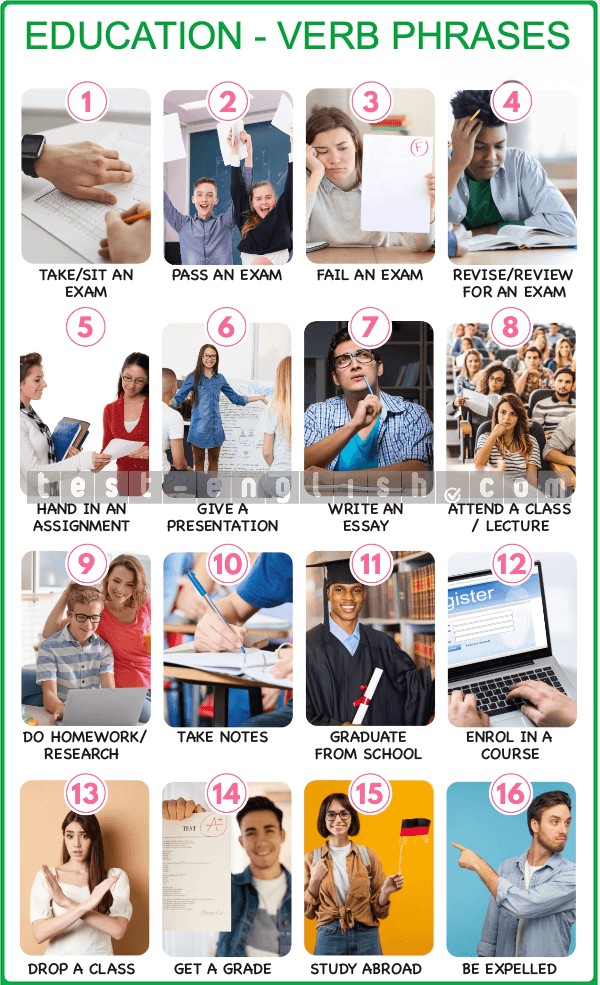
Vocabulary chart showing phrases like: take an exam, hand in an assignment, give a presentation, etc.
Verb Phrases About Education
There are many verb phrases which we use when talking about education. Here are some of the most common ones. Look at the pictures and read the definitions and sentence examples.
take / sit an exam
Attend an exam.
I always feel nervous before taking exams.
pass an exam
Obtain successful results in an exam.
I was pleased when I heard that I’d passed my exam.
fail an exam
Obtain unsuccessful results in an exam.
Mum was angry because I’d failed my exam.
revise / review / study for an exam
Prepare for an exam.
I have to revise for my exams this weekend.
hand in an assignment / essay
Give an assignment to a teacher or lecturer.
I handed in my assignment yesterday morning.
give a presentation
Give a talk delivering information to a class or group.
Tom gave a presentation on solar energy.
write an essay
Write a piece of writing on a particular subject as part of a course.
I wrote an essay on crime for English class.
attend a class / lecture
Go to and be present in a class/lecture.
Sam has attended all his classes this term.
do homework / research / a project
Carry out the action of homework, etc.
I usually do my homework when I get home.
take notes
Write down what the teacher is saying.
I always take notes when the teacher is talking.
graduate from school
Leave school having obtained a diploma.
After I graduate from school, I’ll look for a job.
enrol in a course
Sign up for a course.
I’ve enrolled in a business course which starts next week.
drop a class
Stop taking a class.
I decided to drop my history class as I wasn’t enjoying it.
get a grade
Receive a mark (A, B, C / 50%, 70%, etc.) for a test, essay, etc.
I was pleased when I got a good grade for my essay.
study abroad
Study in another country.
I would love to study abroad, preferably in an Asian country.
be expelled
Be asked to leave school as punishment for bad behaviour.
Sid was expelled after being caught cheating in his exams.
Education Systems and Schools
In most countries, students begin their education between the ages of three and four and continue learning until they are at least sixteen. During this time, they progress to different types of schools, and some even go on to pursue higher studies to increase their opportunities. There are, however, some differences between the British educational institutions and the American ones that can prove confusing for English learners.
There may be differences in the education system from one country to another in the UK or from one state to another in the US.
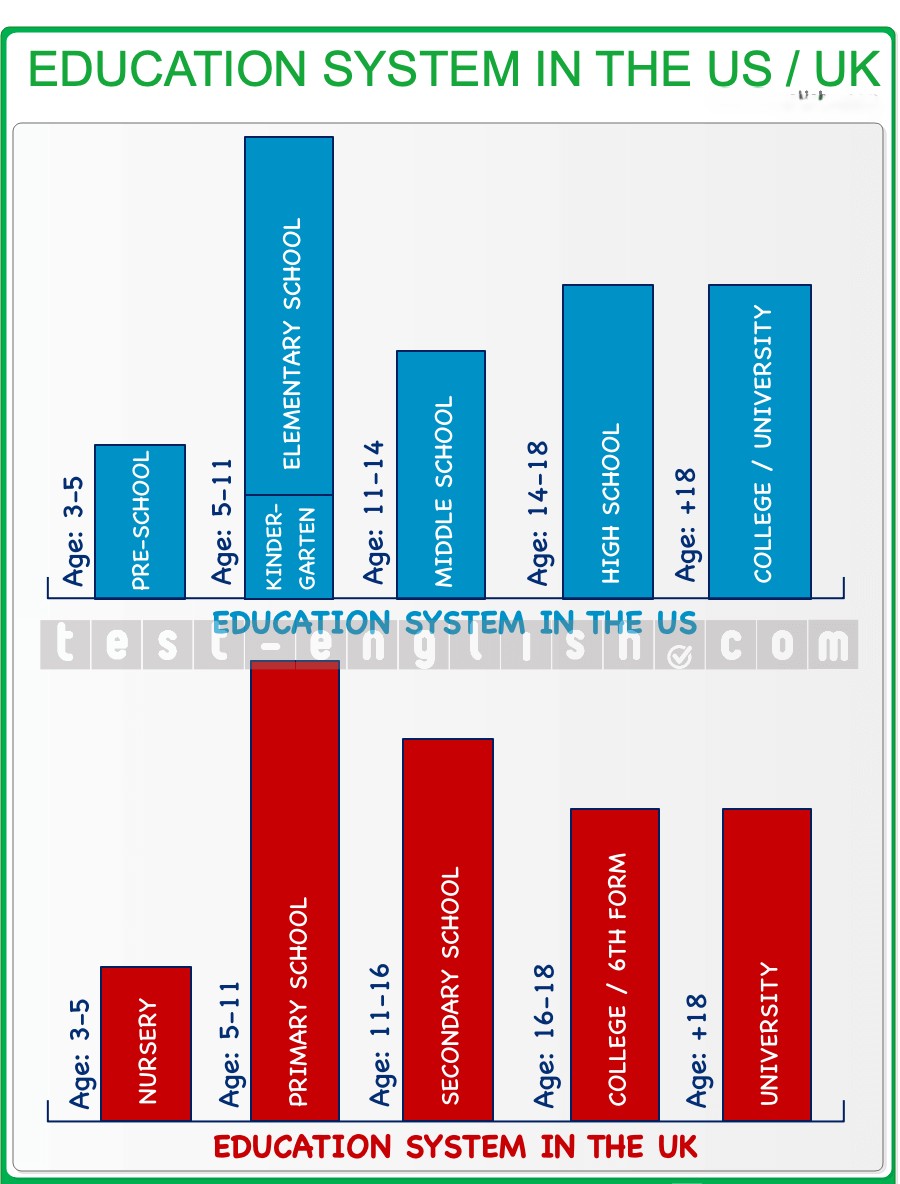
Nursery, which is called pre-school in the US, is where British children go between the ages of three and five. At this stage, children experience a taste of school life without any formal academic learning.
Between the ages of five and eleven, British children attend primary school. This is where their formal academic education begins. The American equivalent is elementary school. The first year of elementary school is called kindergarten. Children remain in primary or elementary school until they are eleven or twelve years old.
Following this, British children go to secondary school, where they study until the age of sixteen. In the United States, students attend middle school, also known as junior high school in some regions, from ages eleven to fourteen. After that, they begin high school, where they remain until they are seventeen or eighteen.
After secondary school, education is optional in the UK, and some British teens begin college (also called 6th form), where they study until they are eighteen. Some then go on to study at university, where their higher education begins. They usually remain there for three or four years and leave after obtaining a degree.
In the US, the word college is different than in the UK. It refers to a place where students go to pursue a higher education after finishing high school. For this reason, the words college and university are often used interchangeably in the United States.
| Stage | United Kingdom | United States | Notes |
|---|---|---|---|
| 1 | Nursery (ages 3–5) | Pre-school / Kindergarten (ages 3–5) | Informal early learning; no formal academics. |
| 2 | Primary school (ages 5–11) | Elementary school (ages 5–11/12) | Formal education begins. |
| 3 | Secondary school (ages 11–16) | Middle school (11–14) + High school (14–18) | Compulsory education continues. |
| 4 | College / 6th form (ages 16–18, optional) | High school continues until 18 | Pre-university studies (UK). |
| 5 | University (3–4 years for a degree) | College or University (4 years for a bachelor’s) | In the US, 'college' = higher education; in the UK, 'college' = pre-university. |
UK vs. US Education Systems
Infographic comparing nursery, primary, secondary, college, and university in both systems.