The body: parts and actions – B1 English Vocabulary
Vocabulary/ B1 Vocabulary lessons and / The body: parts and actions – B1 English Vocabulary
B1 Intermediate Level
The Body: Parts and Actions
Learn essential vocabulary for body parts and common actions
About This Lesson
In this B1 Intermediate Vocabulary Lesson about Body Parts and Actions, you will learn the names of different body parts and the actions associated with them. The definitions and sentence examples below will help you understand and remember the terms.
Parts of the Body (B1 Level)
Educational chart of human body parts, labelled with numbers 1 to 16, highlighting eyebrows, forehead, cheeks, heel, etc., for an English vocabulary lesson.
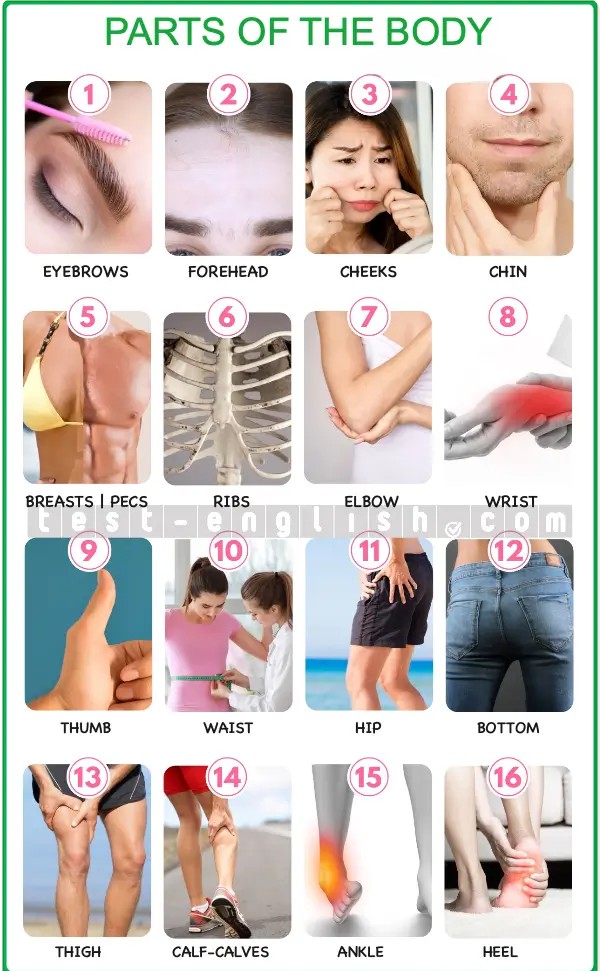
Parts of the Body
- Your 1 eyebrows are the two lines of hair above your eyes, and your 2 forehead is the top of your face, just above your eyebrows.
“Cara raised her eyebrows in surprise.”
“Lisa’s long hair covers her forehead.” - 3 Cheeks are symmetrical facial features on either side of your nose, while your 4 chin is the lower part of your face, just below the mouth.
“Peter’s cheeks were red from the cold.”
“A beard now covers Larry’s chin.” - 5 Breasts and pecs are terms often associated with the chest area. Breasts typically refer to the women’s mammary glands that can produce milk, and pecs, which is short for pectoral muscles, is a term more often used to refer to the men’s chest muscles.
“The baby was lying against its mother’s breast.”
“Tim’s pecs have grown since he started going to the gym.” - 6 Ribs are a series of bones on each side of your body, just below your chest.
“The boy was so thin that I could see his ribs.” - Your elbow and your wrist are both parts of your arm. Your 7 elbow is the joint that bends in the middle of your arm, while your 8 wrist is the narrow part that connects the arm to the hand. Your 9 thumb is the closest finger to your wrist and the widest finger on your hand.
“You shouldn’t put your elbows on the table when you’re eating.”
“Lucy wears a gold watch around her wrist.”
“The ring was so big that I could only wear it on my thumb.” - The hips, waist, and bottom make up the lower part of your torso. Your 10 waist is the narrow part around which you wear a belt, while your 11 hips are the symmetrical bones found on either side of the waist. Your 12 bottom is the soft part of the body on which you sit.
“Karen was wearing a leather belt around her waist.”
“My hips are quite wide, and I find it hard to find jeans that fit.”
“After sitting on the wet chair, Sam’s bottom was wet.” - Your thigh and your calf are parts of the leg. The 13 thigh is the soft top part of your leg, between the torso and the knee, while the 14 calf (plural calves) is the muscular part at the back of the leg, just below the knee. The 15 ankle is the joint that connects your leg with your foot, and your 16 heel is the bottom part of your foot, just below your ankle.
“Lara’s skirt was so short that it barely covered her thighs.”
“After exercising at the gym, my calf muscles were sore.”
“My ankles were cold, so I put on a longer pair of socks.”
“After wearing new shoes all day, Paula’s heels were very sore.”
Body Actions
Educational chart showcasing numbered human body actions 1 to 20, including breathe, sneeze, taste, smell, yawn, snore, etc., for an English vocabulary lesson.
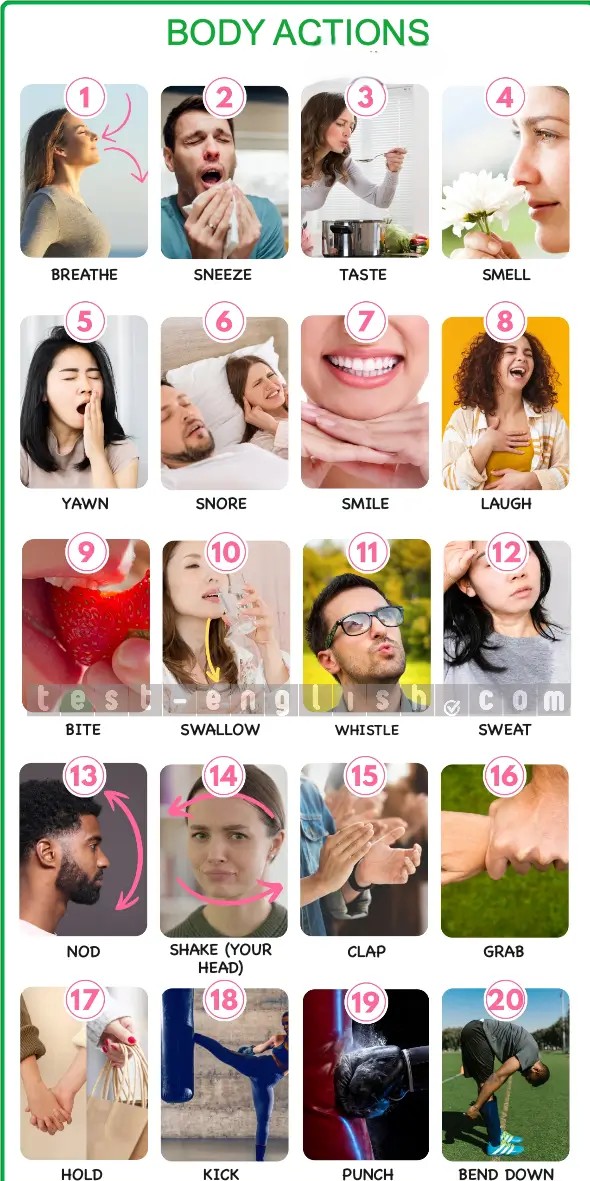
- When you 1 breathe, you take in air into your lungs and then expel it, and when you 2 sneeze, you expel air from your nostrils suddenly and often loudly.
“I went outside to breathe in some fresh air.”
“I had a bad cold, and I couldn’t stop sneezing.” - Taste and smell are both verbs related to the senses. When you 3 taste something, you put it in your mouth to perceive its flavour with your tongue, whereas when you 4 smell something, you perceive its scent through the nose.
“I tasted the soup and then decided to add more salt.”
“Lucy bent down to smell the roses.” - Yawning and snoring are both connected to sleep. When you 5 yawn, you open your mouth wide involuntarily because you are tired, and when you 6 snore, you make noise with your nose when you’re sleeping.
“It was obvious that Paul was tired because he couldn’t stop yawning.”
“Mary couldn’t sleep because her husband was snoring loudly.” - Smile and laugh are things we do when we are happy or amused. When you 7 smile, you turn up the corners of your mouth to show pleasure, and you 8 laugh when you find something funny.
“When his grandmother gave him the chocolate, Joe smiled and said thank you.”
“The film was really funny, and we couldn’t stop laughing.” - Bite, swallow, and whistle are all things you do with your mouth. When you 9 bite (bit, bitten) something, you use your teeth to cut into something, and when you 10 swallow, you make food pass down from your mouth into your throat. When you 11 whistle, you make a series of musical notes by forcing your breath out between your lips.
“I bit into the juicy apple.”
“The biscuit was dry and difficult to swallow.”
“I could hear Joe whistling as he washed his car.” - When you 12 sweat, a salty liquid comes through your skin, normally as a reaction to heat, and when you 13 nod, you move your head up and down, usually to show agreement. When you 14 shake (shook, shaken) your head, you move it from side to side to say ‘no’ or indicate disagreement, denial, or disapproval.
“Mike was sweating because he’d just finished working out.”
“Matt nodded his head in agreement.”
“When I asked Max if he wanted more cake, he shook his head and said, ‘No, thank you.’” - When you 15 clap, you put your hands together and make a smacking sound, and when you 16 grab something, you take it in your hand or pick it up suddenly or forcefully. When you 17 hold something, you carry or support it with your hand, often for an extended time.
“At the end of the performance, the audience clapped.”
“Jamie grabbed the toy out of his sister’s hand.”
“The lady was holding her baby in her arms.” - Kicking and punching are things we do either in sports or to show aggression. When you 18 kick, you strike someone or something with your foot, and when you 19 punch, you strike a person or thing with your fist.
“I kicked the football to Tony.”
“Mario punched Luis in the face.” - When you 20 bend (down), you move the upper part of your body downward and forward.
“Mary bent down to pick up her bag.”