Grammar / B1+ Grammar lessons and exercises / Would rather, would prefer: Expressing preference
Would Rather, Would Prefer: Expressing Preference
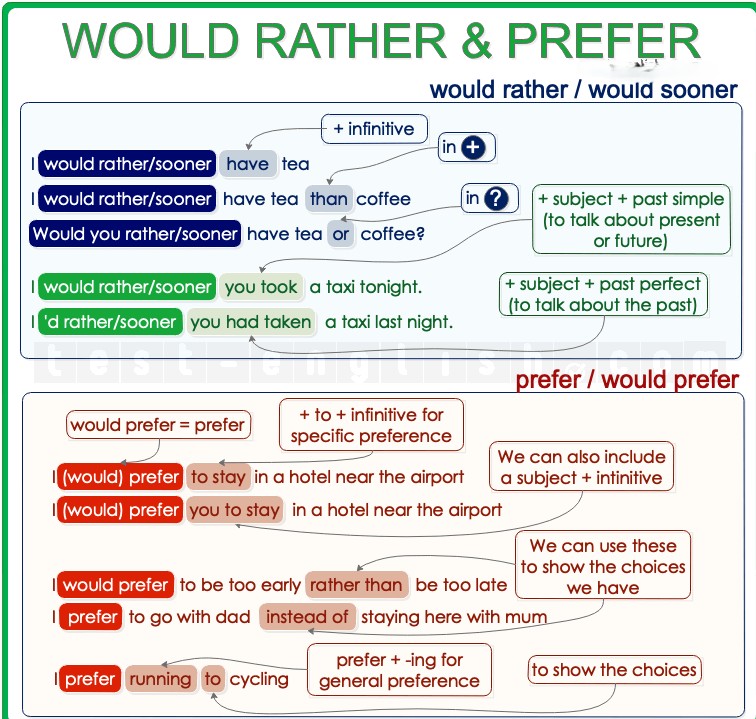
🔹Would rather / Would sooner
We use would rather or would sooner + bare infinitive (without to) to talk about a preference in a specific situation.
✅ I’d rather have tea, please.
✅ I’d sooner have tea than drink that coffee.
✅ Would you rather have tea or coffee?
To talk about someone else’s actions (present or future), use:
would rather/sooner + subject + past simple
✅ We’d rather she was/were with us now.
✅ She’d rather I picked her up after lunch.
✅ Would you rather we went by bus or by train?
🔹(Would) Prefer + to + infinitive
We use prefer or would prefer + to + infinitive to express a preference in a specific situation.
✅ I would prefer to stay in a hotel near the airport.
✅ Most clients prefer to have breakfast in their bedroom.
We can compare two options using rather than or instead of. Note: after rather than, use the bare infinitive.
✅ I would prefer to be too early rather than be too late.
✅ I prefer to go with Dad instead of staying here with Mum.
🔹Prefer + -ing verb (General Preference)
We use prefer + -ing to talk about general, long-term preferences.
✅ I love running, but he prefers cycling.
✅ She prefers reading to watching TV.
When comparing two activities with prefer ... to ..., both verbs take the -ing form because to is a preposition.
✅ He prefers walking to cycling.
✅ They prefer eating out to cooking at home.
📌 Key Rules:
🔹 Would rather + bare infinitive → specific preference.
🔹 Would rather + subject + past simple → preference about others’ actions.
🔹 Prefer/would prefer + to + infinitive → specific situation.
🔹 Prefer + -ing → general habit or long-term preference.
✨ Use rather than (bare infinitive) or instead of (-ing) for comparisons.