Grammar / B1+ Grammar lessons and exercises / Verbs of the senses: look, sound, feel, etc.
Verbs of the Senses – Grammar Chart
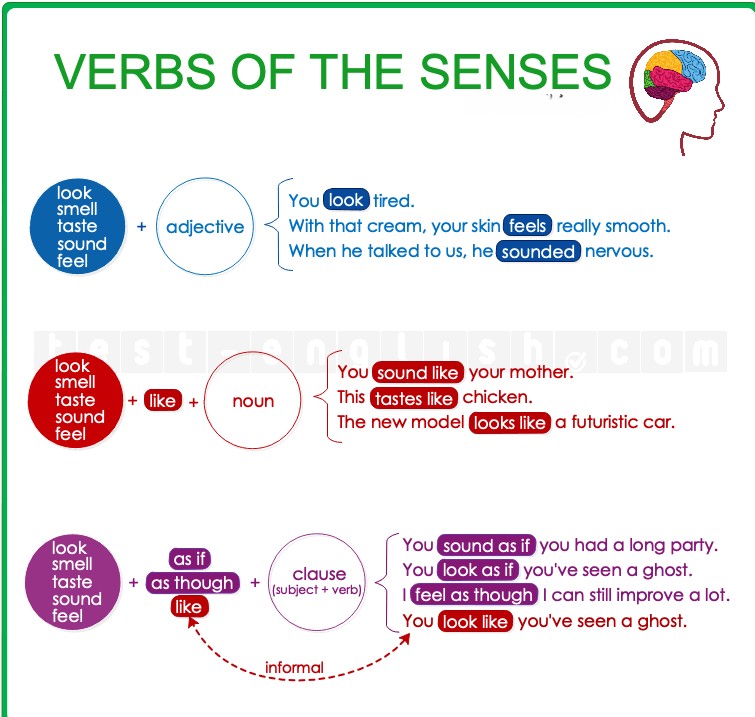
The verbs look, sound, feel, smell, and taste are verbs of the senses. They are usually stative (not used in continuous tenses) and can be followed by:
- ✅ an adjective
- ✅ like + noun
- ✅ as if / as though + clause (subject + verb)
🟦Verb + Adjective
Use a verb of the sense + adjective to describe how something appears, sounds, feels, etc.
✅ When you use that cream, your skin feels really smooth.
✅ When he talked to us, he sounded nervous.
✅ This soup tastes delicious.
✅ The room smells fresh.
✅ You look tired.
💡 These verbs are stative → avoid continuous forms:
✅ “It tastes sweet.” ❌ “It is tasting sweet.”
🟩Verb + like + Noun
Use like + noun to make comparisons.
✅ You sound like your mother.
✅ This tastes like chicken.
✅ It smells like rain.
✅ The fabric feels like silk.
✅ That cloud looks like an elephant.
🟪Verb + as if / as though + Clause
Use as if or as though before a full clause (subject + verb) to describe how something seems.
✅ You sound as if you had a long party last night.
✅ You look as though you’ve just seen a ghost.
✅ It smells as if something is burning.
✅ This cake tastes as though it’s homemade.
✅ The ground feels as if it’s vibrating.
💬 Informal note: In spoken English, many people also say “like + clause” (though traditionally less formal):
→ “You sound like you had a long party…”
🟨🔑 Quick Reference
look / sound / feel / smell / taste
- → + adjective: It smells nice.
- → + like + noun: It smells like coffee.
- → + as if / as though + clause: It smells as if coffee is brewing.
📌 Remember:
🔸 These verbs are usually stative → use simple tenses.
🔸 After like, use a noun or pronoun.
🔸 After as if / as though, use a full clause.
🔸 In informal speech, “like + clause” is common but avoid in formal writing.