Grammar / B1+ Grammar lessons and exercises / Reporting verbs: Admit doing, refuse to do, etc.
Reporting Verbs
🟦What Are Reporting Verbs?
Reporting verbs (e.g., promise, say, ask, admit, suggest, deny) are used to report what someone said, thought, or felt. We classify them into groups based on the grammatical structure that follows them.
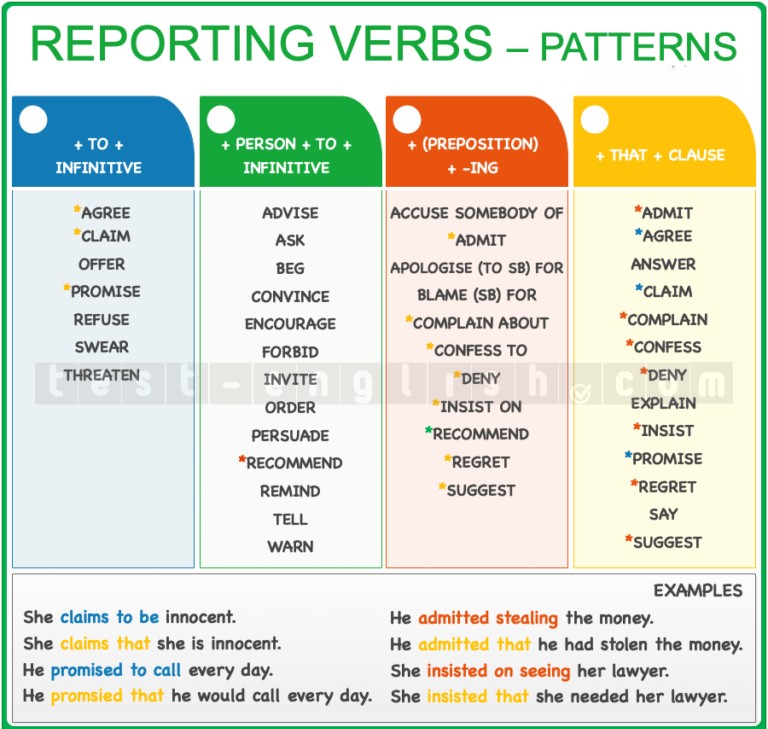
🟩Verb + to-infinitive
Common verbs: agree, decide, offer, promise, refuse, threaten
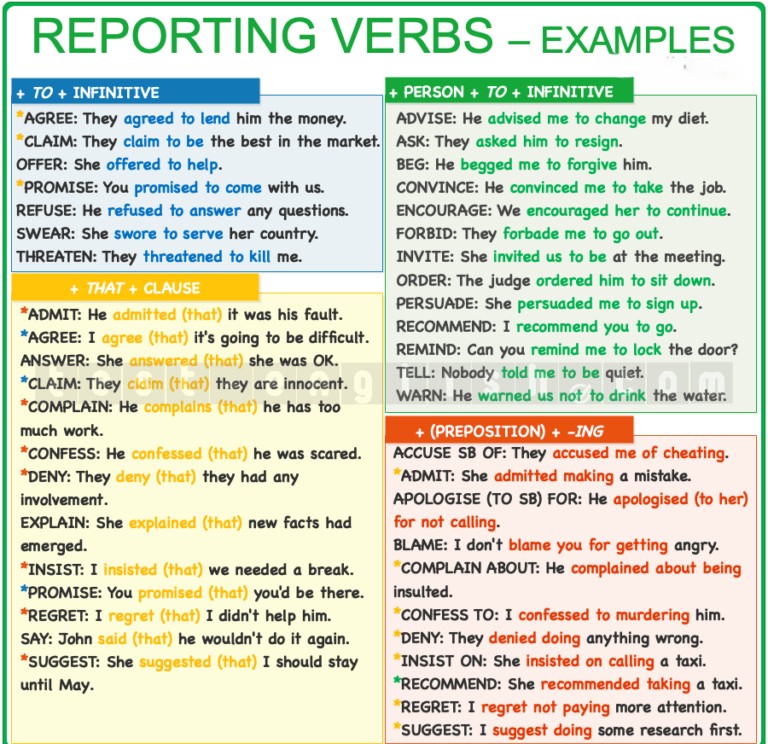
✅ She promised to help.
✅ He refused to answer.
✅ They agreed to meet at 6 p.m.
🟪Verb + person + to + infinitive
Common verbs: ask, tell, encourage, invite, warn, allow
✅ She asked me to wait.
✅ The coach told them to run faster.
✅ We invited her to join the team.
🟦Verb + (that) + clause
Common verbs: say, claim, admit, suggest, explain, mention, deny
✅ He said (that) he was busy.
✅ They admitted (that) they made a mistake.
✅ She suggested (that) we leave early.
🟨Verb + (preposition) + -ing
Common combinations:
• accuse of, apologise for, blame for
• insist on, object to, thank for
✅ He apologised for being late.
✅ They accused him of lying.
✅ She insisted on paying.
🟥The Perfect Gerund: regret doing vs. regret having done
We use the perfect gerund (having + past participle) to emphasize that an action was completed in the past.
✅ I regret being married. → (I am married now and regret it)
✅ I regret having been married. → (I was married in the past and regret it)
💡 Often, the time is clear from context, so both forms are acceptable with little difference in meaning:
✅ He admitted stealing the money.
✅ He admitted having stolen the money.
📌 Key Takeaways:
🔸 Reporting verbs follow fixed grammatical patterns — learn them by group.
🔸 The perfect gerund emphasizes a completed past action, but is often optional.