Grammar / B1+ Grammar lessons and exercises / Questions: Different types
Word Order in English Questions
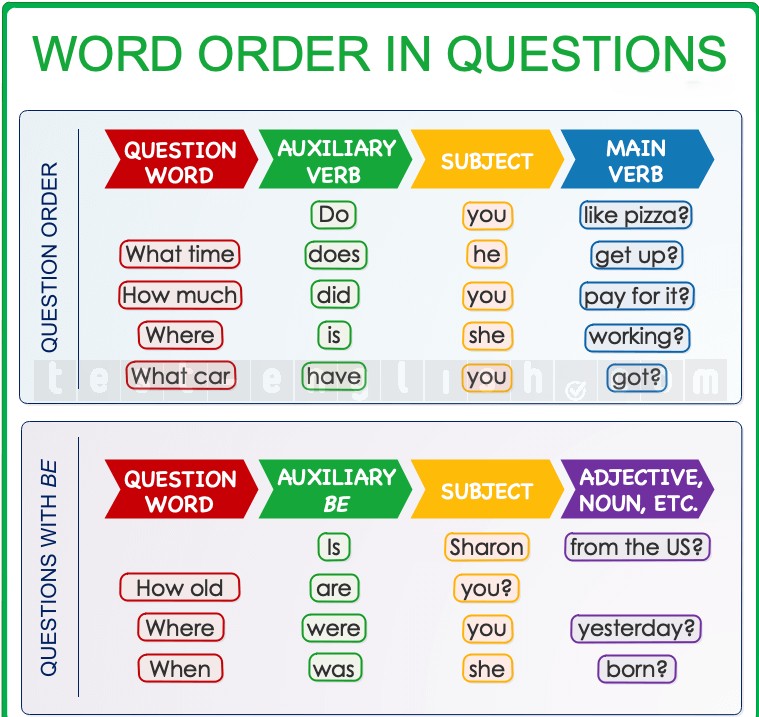
🟦Basic Question Word Order
To form a question, invert the subject and the auxiliary verb (e.g., be, have) or modal verb (e.g., can, could, should).
If there’s no auxiliary or modal, use do/does (present) or did (past).
✅ She is tired. → Is she tired?
✅ They can swim. → Can they swim?
✅ He likes coffee. → Does he like coffee?
🟩Prepositions at the End
In informal/spoken English, place the preposition at the end of the question.
In formal English, the preposition may come before the question word—but then use whom instead of who.
✅ What are you talking about?
✅ Who do you live with?
✅ Who did she talk to? (Informal)
✅ To whom did she talk? (Formal)
🟪Negative Questions
Use negative questions to seek confirmation, express surprise, or show annoyance.
✅ Don’t you have work to do?
✅ Haven’t you already been there?
✅ Didn’t you like the film? I thought it was amazing!
⚠️ Without contractions, place not after the subject:
✅ Did you not enjoy the trip?
✅ Has he not returned your calls yet?
🟦Subject Questions
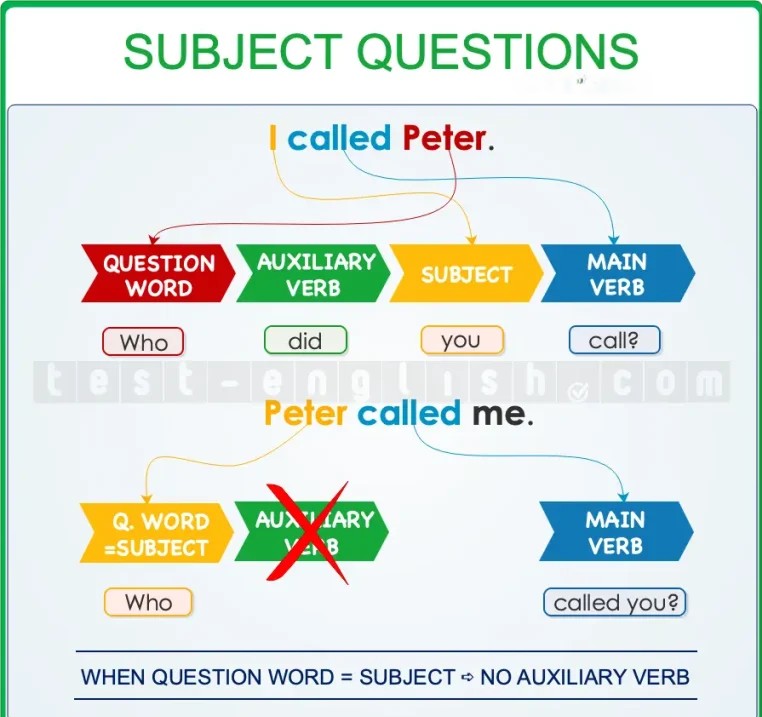
When the question word (who, what, which, how many/much) is the subject of the sentence, do not use do/does/did—and no inversion is needed.
✅ Who called you last night? (Who = subject)
✅ Which company won the contract?
✅ What scares you most?
✅ How many people went to class?
🔁 But with other tenses (that include auxiliaries), use normal question structure:
✅ Who is cooking dinner?
✅ Who has eaten all the cookies?
🟨Indirect (Embedded) Questions
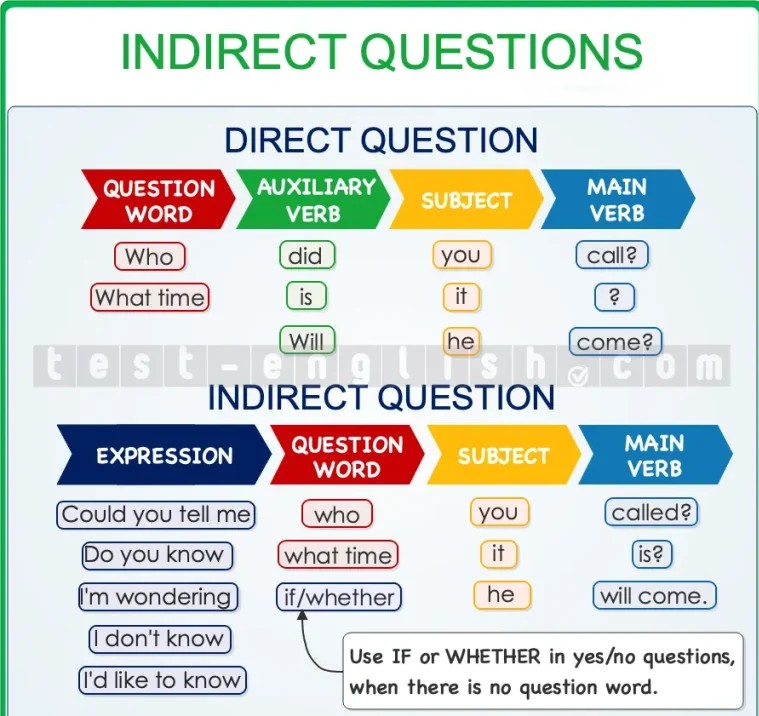
Use indirect questions to be more polite. Begin with phrases like:
Can/Could you tell me…? Do you know…? I wonder…? I’d like to know…?
✅ Structure
- Direct: What time is it?
Indirect: Could you tell me what time it is? - ❌ Do you know where can I find a bank?
✅ Do you know where I can find a bank?
✅ More Examples
- I don’t know what he is doing here.
- I wonder when he will find the truth.
- Do you know if/whether he’ll be here soon?
📌 Key Rules:
🔁 Invert subject + auxiliary/modal → Is she coming?
➕ No auxiliary? Add do/does/did → Does he know?
📎 Prepositions go at the end in informal speech → Who with?
❓ Subject questions = no do/does/did → Who broke it?
🗣️ Indirect questions = statement word order → Do you know where she lives?
🙋 Negative questions = confirmation or emotion → Don’t you agree?