Grammar / B1+ Grammar lessons and exercises / Indirect questions
Position of Adverbs
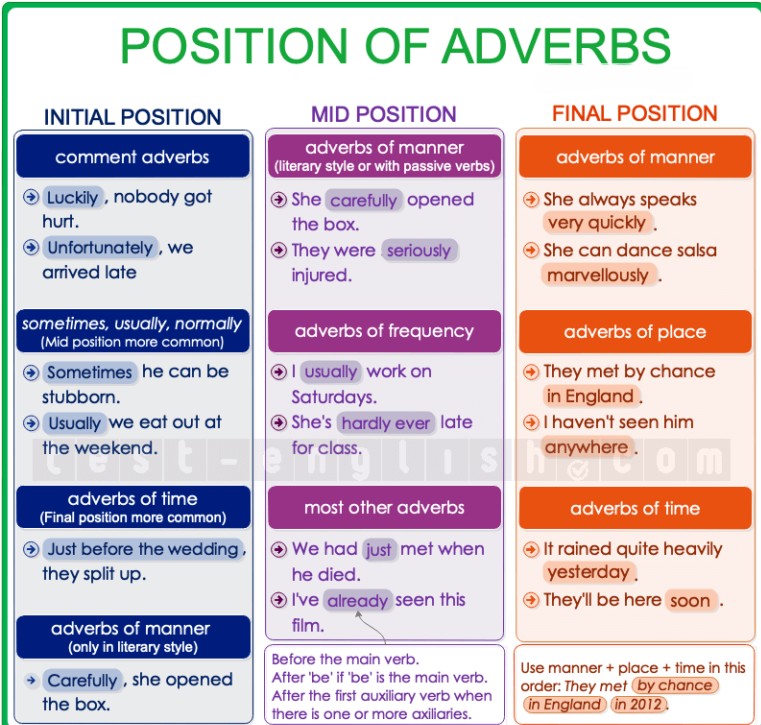
🟦Initial, Mid, and Final Position
Adverbs and adverb phrases can appear in three main positions in a sentence:
- Initial position: at the beginning of the sentence.
✅ Yesterday I went to the library.
✅ Sometimes I feel a bit lost. - Mid position: before the main verb (or after be, or after the first auxiliary).
✅ I often call him.
✅ They are often late.
✅ I have often been tempted... - Final position: at the end of the sentence.
✅ She arrived very late.
✅ We have to move quickly.
🟩Adverbs of Frequency
These describe how often something happens.
🔹 Mid position (most common):
✅ I usually work on Saturdays.
✅ She’s hardly ever late.
✅ You should always knock.
🔹 Initial position (only with sometimes, usually, normally):
✅ Sometimes, he can be very stubborn.
✅ Normally, we leave at 8.
🟪Adverbs of Manner
These describe how something happens.
🔹 Final position (most common):
✅ I don’t understand you when you speak quickly.
✅ She can dance salsa marvellously.
🔹 Mid position (literary or passive):
✅ He carefully took the flower...
✅ The driver was seriously injured.
❗ Well, badly, hard, fast cannot go in mid position.
🔹 Initial position (literary only):
✅ Carefully, she opened the box.
🟦Adverbs of Time & Comment Adverbs
Adverbs of Time
🔹 Final position (usual):
✅ They’ll be here soon.
✅ It rained a lot yesterday.
🔹 Initial position (for emphasis or structure):
✅ Last week, she arrived late every day.
✅ Two days after their wedding, they slipped up.
Comment Adverbs
(e.g. obviously, luckily, unfortunately, honestly)
🔹 Usually in initial position:
✅ Unfortunately, we arrived half an hour late.
✅ Ideally, we should leave at 10:00.
🟨Adverbs of Degree & Word Order Rules
- Almost, hardly, nearly, quite, rather, scarcely → usually mid position:
“We were nearly hit by a car.”
“I would rather stay here.” - Very, extremely, incredibly, absolutely → before the adjective/adverb they modify:
“We’re incredibly tired.”
“It’s absolutely impossible.” - Much, a lot, a bit → after the verb:
“Britons drink a lot.”
“He doesn’t talk much.” - A little → before adjective/adverb:
“I’m a little tired.” - 🔸 Order in final position: manner → place → time
“They met by chance in England in 1999.”
🔸 With verbs of movement: place → manner → time
“He goes to school by car every day.” - ❗ Never split verb and object:
❌ “I like a lot pizza.” → ✅ “I like pizza a lot.”
❌ “He speaks very well English.” → ✅ “He speaks English very well.”
📌 Quick Reference:
🔹 Initial: Yesterday, I left. / Unfortunately, it rained.
🔹 Mid: I always eat breakfast. / She is often late.
🔹 Final: He runs fast. / We met in Paris last year.
🔹 Order (final): manner → place → time (or place → manner → time with movement verbs).
🔹 Never separate verb and object: “I love pizza a lot” ✅