Grammar / B1+ Grammar lessons and exercises / The passive voice: All tenses
The Passive Voice – All Tenses
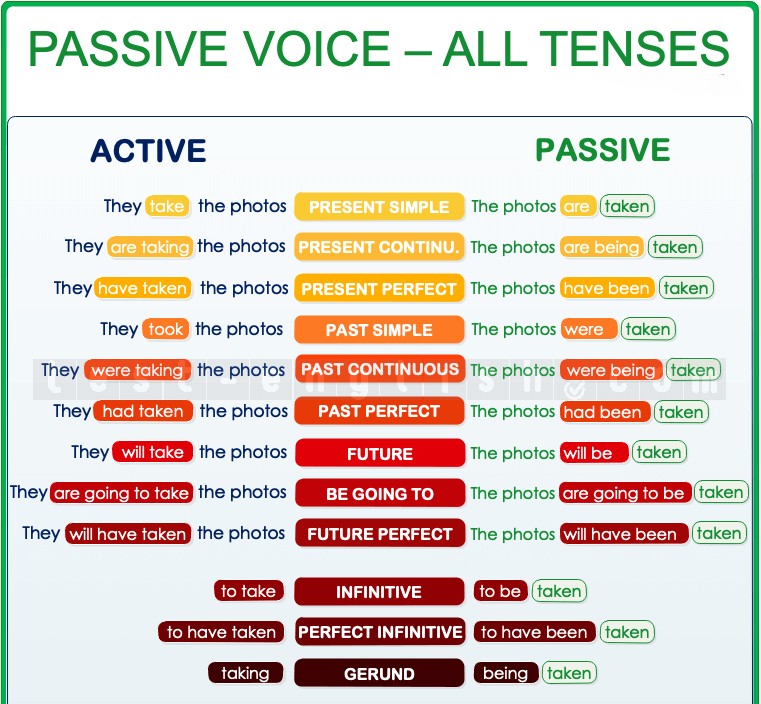
🟦What Is the Passive Voice?
In a passive sentence, the object of the active sentence becomes the subject. The focus is on the action or the receiver — not who performed it.
✅ Active: They take the photos in Africa.
✅ Passive: The photos are taken in Africa.
🔧 Structure: be (in correct tense) + past participle
🎯 The subject of a passive sentence is the receiver of the action.
🟩When Do We Use the Passive Voice?
- ✅ When we don’t know who did the action.
- ✅ When it’s obvious or unimportant who did it.
- ✅ When we want to focus on the action or object, not the doer.
✅ A bank was robbed yesterday. (We don’t know who.)
✅ He was arrested last night. (Obviously by police.)
✅ I have been told that you insulted my brother. (I won’t say who told me.)
✅ Jurassic Park was filmed by Spielberg in 1993. (Focus on the movie.)
🟪Passive Voice Across Tenses
The verb be changes to match the tense. The main verb is always in the past participle.
| Tense | Active | Passive |
|---|---|---|
| Simple Present | They take photos. | Photos are taken. |
| Simple Past | They took photos. | Photos were taken. |
| Present Continuous | They are taking photos. | Photos are being taken. |
| Past Continuous | They were taking photos. | Photos were being taken. |
| Present Perfect | They have taken photos. | Photos have been taken. |
| Past Perfect | They had taken photos. | Photos had been taken. |
| Future (will) | They will take photos. | Photos will be taken. |
| Modal (can, must, etc.) | They can take photos. | Photos can be taken. |
🟨🔑 Key Notes
- 🔸 Only transitive verbs (verbs with an object) can be passive.
- 🔸 The agent (doer) can be added with by, but often it’s omitted.
- 🔸 In informal English, passive with get is sometimes used: “He got fired.”
- 🔸 Avoid overusing the passive — it’s common in formal writing, news, and science.
📌 Remember:
🔸 Structure: subject + be (correct tense) + past participle
🔸 Use when the doer is unknown, unimportant, or obvious.
🔸 Always check: does the verb have an object? If not, no passive!
🔸 Common in academic, scientific, and journalistic writing.