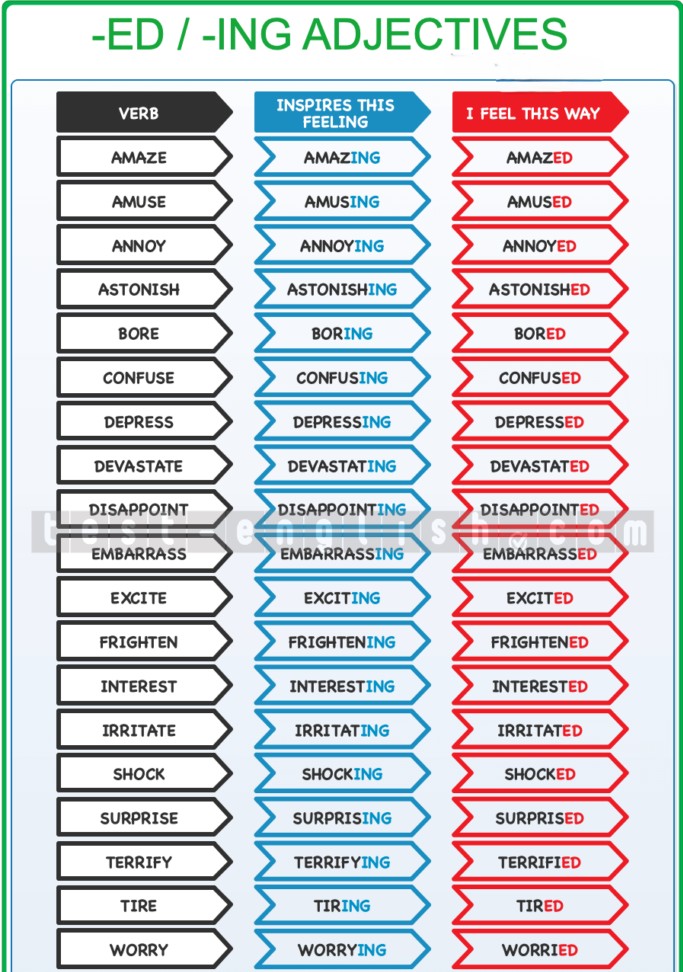
Grammar / B1+ Grammar lessons and exercises / Participles as adjectives: -ed/-ing adjectives
-ed / -ing Adjectives – Grammar Chart
🟦What Are -ed / -ing Adjectives?
Participial adjectives come from verbs and end in -ed or -ing. They describe feelings — but in two different ways:
✅ Walking up the stairs tires me. → I’m tired. (How I feel)
✅ The stairs are tiring. (What causes the feeling)
✅ You are boring me. → I’m bored.
🟩-ed Adjectives → How People Feel
Use -ed adjectives to describe **emotions or feelings** experienced by **people (or animals)**. Things cannot “feel” emotions, so we don’t use -ed adjectives for objects.
✅ We’re tired. Can we stop running?
✅ I’m bored. Let’s play cards.
✅ She was surprised to see him.
💡 Subject = person → use -ed
🟪-ing Adjectives → What Causes the Feeling
Use -ing adjectives to describe **things, situations, or people** that **cause** a feeling in others.
✅ Running is very tiring.
✅ This film is boring.
✅ Her visit was surprising.
💡 Subject = thing/situation → use -ing
🟨❗ Irregular Forms (Not -ing!)
Some participial adjectives don’t follow the regular -ing pattern. Watch out for these common irregular pairs:
✅ offended → offensive (NOT *offending*)
✅ stressed → stressful (NOT *stressing*)
✅ delighted → delightful
✅ impressed → impressive
✅ scared → scary
📌 Key Rules:
🔸 -ed = how **someone feels** (I’m bored)
🔸 -ing = what **causes the feeling** (The movie is boring)
🔸 People → -ed | Things/Situations → -ing
🔸 Watch for **irregular forms**: stressful, offensive, scary, etc.