Grammar / B1+ Grammar lessons and exercises / Needn’t, don’t need to, didn’t need to, needn’t have
Needn’t, don’t need to, didn’t need to, needn’t have
🟦Overview
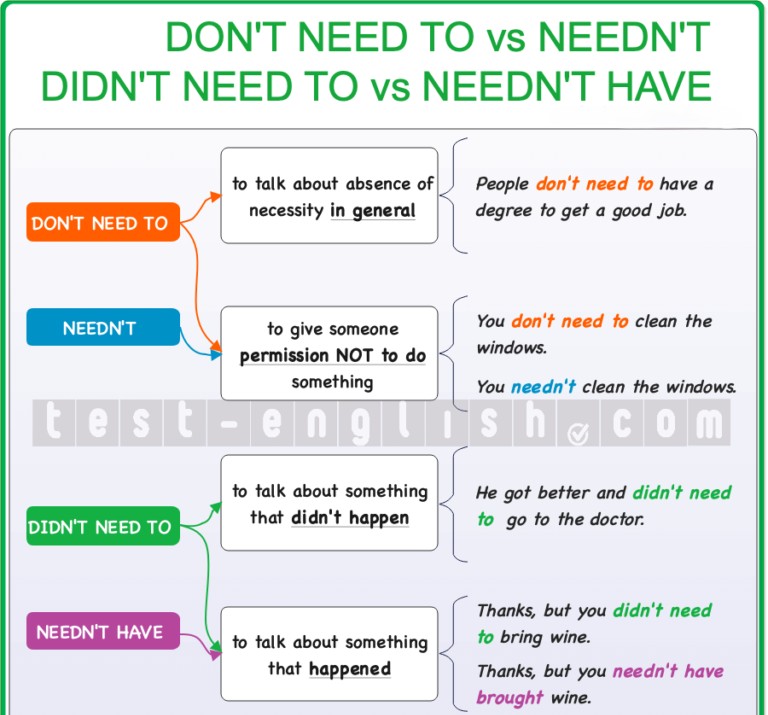
We use needn’t, don’t need to, didn’t need to, and needn’t have to express an absence of necessity. Although they all come from the verb need, they have different meanings, time references, and grammatical structures.
Need can act as:
• a main verb → don’t/doesn’t/didn’t need to
• a modal verb (mainly in British English) → needn’t, needn’t have
🟩Absence of Necessity in the Present
Both needn’t + base verb and don’t need to + base verb mean “it’s not necessary”.
✅ You needn’t mop the floor. I’ve already done it.
✅ You don’t need to mop the floor. I’ve already done it.
🔸 Needn’t is more formal and common in British English. Often used to give permission not to do something.
🔸 Don’t need to is more common in general statements and in American English.
✅ People don’t need to get a degree to find a good job. (general truth)
❌ People needn’t get a degree… (less natural for general statements)
🟪Absence of Necessity in the Past
The key difference lies in whether the unnecessary action was done or was not done.
1. The action WAS done (but it wasn’t necessary)
✅ You needn’t have brought dessert. (= You brought it, but it wasn’t needed.)
✅ You didn’t need to bring dessert. (also acceptable, especially in US English)
2. The action WAS NOT done (and it wasn’t necessary)
✅ He got better, so I didn’t need to call the doctor. (= I didn’t call.)
❌ He got better, so I needn’t have called the doctor. (WRONG — implies you did call!)
🟦Quick Reference: When to Use Which?
| Form | Structure | Meaning | Example |
|---|---|---|---|
| don’t need to | don’t/doesn’t + need to + base verb | No necessity (present/future); action usually not done | You don’t need to come tomorrow. |
| needn’t | needn’t + base verb | No necessity (present/future); often permission (UK) | You needn’t wait. |
| didn’t need to | didn’t + need to + base verb | No necessity in past; action not done | I didn’t need to cook. We ate out. |
| needn’t have | needn’t have + past participle | Action was done but was unnecessary | You needn’t have cooked. We ordered pizza! |
🟨British vs American English
British English uses need as a modal verb more frequently.
🇬🇧 British English
✅ You needn’t go.
✅ She needn’t have worried.
🇺🇸 American English
✅ You don’t need to go.
✅ She didn’t need to worry.
(Rarely uses needn’t)
📌 Key Takeaways:
🔸 Needn’t = modal (UK), present/future permission.
🔸 Don’t need to = main verb, general or specific absence of necessity.
🔸 Didn’t need to = past, action not done.
🔸 Needn’t have + past participle = past, action was done but unnecessary.
🌍 Needn’t is rare in American English—use don’t/doesn’t/didn’t need to.