Grammar / B1+ Grammar lessons and exercises / Have something done
Have Something Done – Causative Structure
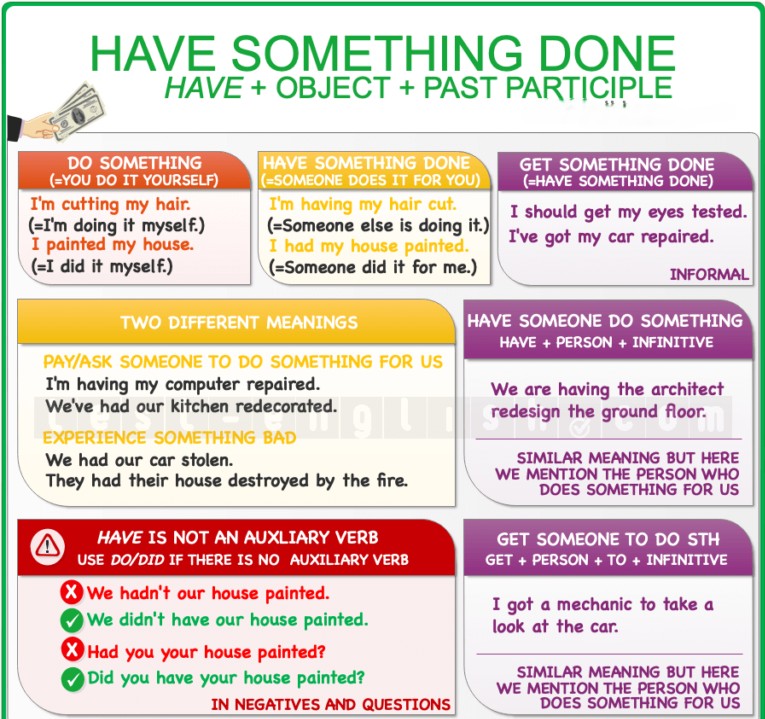
🟦Someone Does Something for Us
We use have + object + past participle to say that someone else does something for us — usually because we pay, ask, or persuade them.
✅ We clean the house every Friday. → (we do it ourselves)
✅ We have the house cleaned every Friday. → (a cleaner does it)
💡 Have is **not an auxiliary verb** here. Use do/does/did in questions and negatives:
❌ We usually haven’t the house painted.
✅ We don’t usually have the house painted.
✅ Did you have your house painted? It looks great!
🟩Works in Any Tense
The causative structure can be used in all verb tenses:
✅ I’m going to have my hair cut tomorrow. (future)
✅ She’s having her house redecorated. (present continuous)
✅ I’ve had the oil in my car changed. (present perfect)
✅ She had her hair cut yesterday. (past simple)
🟪Unwanted or Negative Events
We also use have/get something done to describe bad things that happen to us (passive meaning).
✅ He had his wallet stolen in Piccadilly.
(= His wallet was stolen)
✅ They had their house destroyed by the fire.
🟦Get Something Done (Informal)
In informal English, get + object + past participle has the same meaning as have something done.
✅ I need to get my eyes tested.
✅ They got their home rebuilt after the earthquake.
✅ She got her legs burned in the fire. (negative event)
🟨Have Someone Do Something
When you mention **who** does the action, use:
have + person + bare infinitive
✅ We are having the architect redesign the ground floor.
✅ Susanne had her brother prune all the trees.
💡 Compare: We had the ground floor redesigned (focus on action) vs. We had the architect redesign it (focus on person).
🟥Get Someone to Do Something
Use get + someone + to + infinitive when you **persuade, ask, or convince** someone to do something.
✅ I got a mechanic to take a look at the car.
✅ Tom’s boss got him to go to a conference in Germany.
💡 Get someone to do often implies effort or persuasion; have someone do is more neutral.
📌 Key Rules:
🔸 Have/get + object + past participle = someone does something for you (or to you)
🔸 Use do/does/did for questions & negatives (not “have” as auxiliary)
🔸 Works in all tenses: present, past, future, perfect
🔸 Have someone do vs. Get someone to do → mention the person
🔸 Also used for unwanted events: “He had his phone stolen.”