Grammar / B1+ Grammar lessons and exercises / Gerund or infinitive: Verb patterns
When to Use Gerund or Infinitive
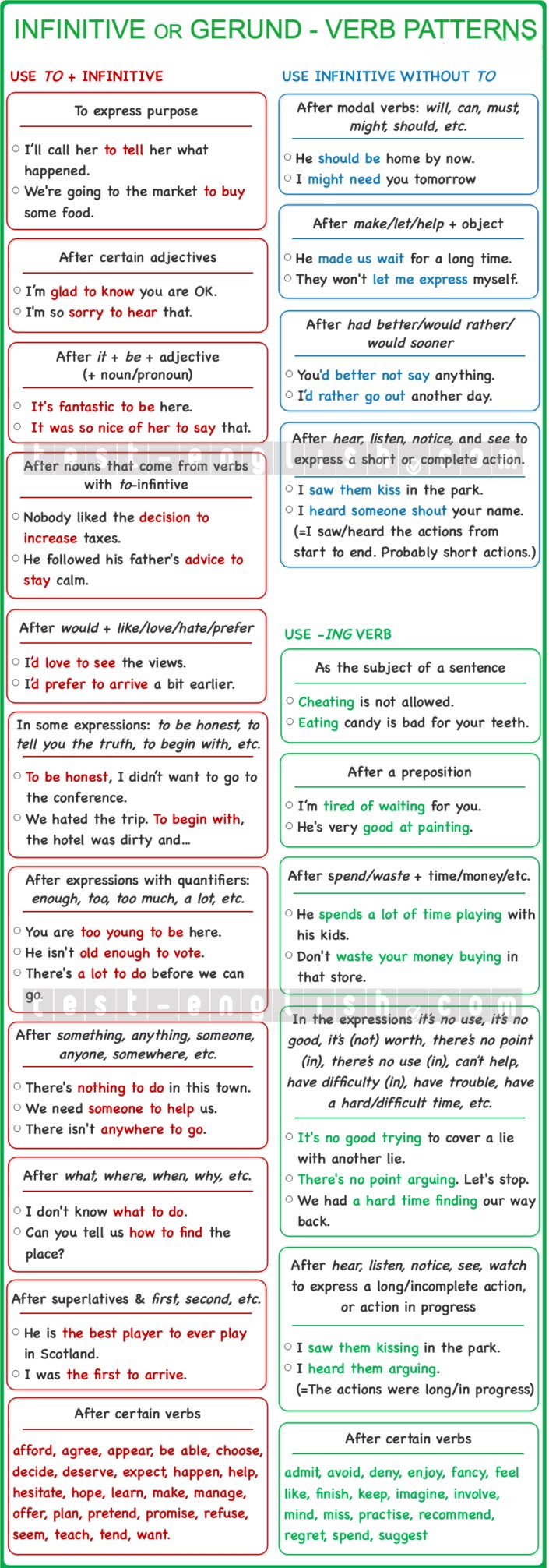
Many English verbs are followed by either a gerund (-ing) or an infinitive (to + base verb). Sometimes the choice changes the meaning. Below are key patterns and verbs where this distinction matters.
Verbs That Take Gerund or Infinitive with a Change of Meaning
🔹Forget
Forget to do = didn’t remember to do something (it wasn’t done).
✅ I think I forgot to lock the door when we left.
✅ Don’t forget to call me when you finish.
Forget doing = don’t remember a past event (used mostly in negative or with “never”).
✅ I’ll never forget walking on that amazing beach for the first time.
🔹Remember
Remember to do = you recall something you need to do → then you do it.
✅ He didn’t remember to turn off the heating after class.
✅ Will you please remember to close the windows if you leave?
Remember doing = recall a past memory.
✅ I remember eating on this same chair the day I graduated.
✅ I remember mentioning the issue to Elisabeth last week.
🔹Try
Try to do = make an effort to achieve something (may or may not succeed).
✅ Could you please try to be a bit less rude?
✅ I’ll try to convince him, but I’m not sure that’s going to change anything.
Try doing = experiment with a new method to solve a problem.
✅ A: “I need to sleep, but I can’t.”
B: “Why don’t you try drinking a glass of hot milk?”
✅ I can’t contact Jane. I’ve tried calling her home number and also on her mobile, but nothing.
🔹Stop
Stop to do = pause one activity in order to start another.
✅ We had been driving for hours, so we had to stop to eat something and go to the toilet.
Stop doing = quit or finish an ongoing action.
✅ Could you stop biting your nails?
✅ I need to stop smoking once and for all.
🔹Need
Need to do = it’s necessary for someone to do something (active).
✅ I need to see you immediately.
Something needs doing = passive meaning ( = needs to be done).
✅ Your car needs cleaning. (= Your car needs to be cleaned.)