Grammar / B1+ Grammar lessons and exercises / When I do vs When I have done: Future time clauses
When I do vs When I have done
🟦Future Time Clauses: The Basics
In English, we often use time words like when, as soon as, until, once, before, after, or while to talk about the future. These are called future time clauses.
🔹 The main clause uses a future tense (e.g., will).
🔹 The time clause uses a present tense — never a future form!
✅ When I’m 70, I’ll retire.
❌ When I will be 70, I’ll retire.
✅ We’ll call you once we’ve arrived.
❌ We’ll call you once we will arrive.
🟩When I do vs When I have done
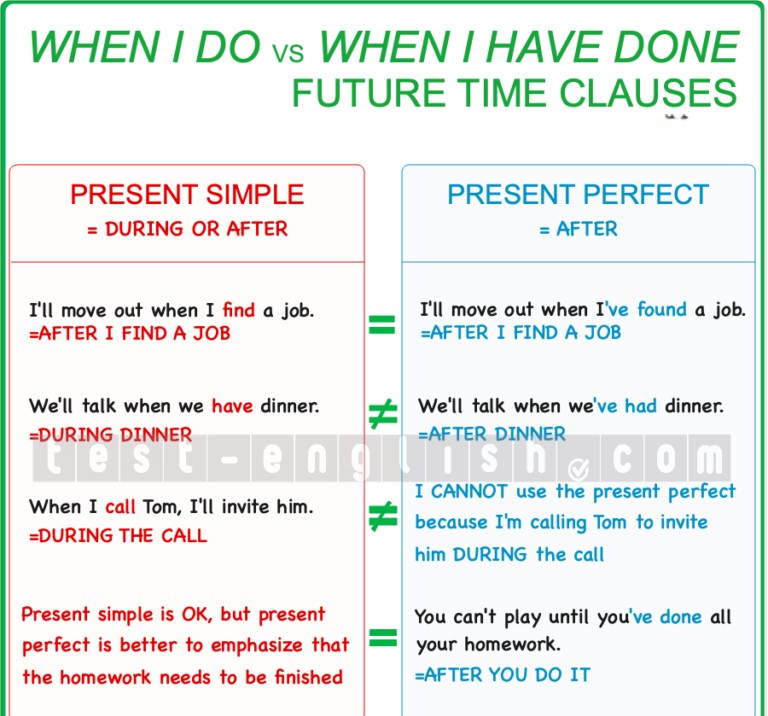
Both the present simple and present perfect can be used in future time clauses — but the choice affects meaning.
✅ I’ll move out when I find a job.
✅ I’ll move out when I’ve found a job.
→ In many cases, both mean the same: after the job is found.
However, sometimes the difference is crucial:
🔸 When we have dinner, we can discuss this.
(= During dinner)
🔸 When we’ve had dinner, we can discuss this.
(= After dinner is finished)
🟪Use Present Perfect to Stress Completion
When the action in the time clause must be fully completed before the main event happens, the present perfect is clearer and more natural.
✅ You’ll have dessert when you’ve eaten all your peas.
✅ I won’t let you play outside until you’ve done your homework.
✅ You’ll get a pay rise once you’ve worked here for three months.
🟦Avoiding Confusion
Some sentences with the present simple can be ambiguous. Use the present perfect (or rephrase) for clarity.
❓ I’ll call you when I have a shower.
→ Does this mean during or after? Unclear!
✅ I’ll call you when I’ve had a shower. (after)
✅ I’ll call you after I have a shower.
🟨Simultaneous Actions → Present Simple Only
When two actions happen at the same time, use the present simple. The present perfect is not possible.
✅ When I go to France, I’ll eat snails.
❌ When I’ve gone to France, I’ll eat snails.
✅ When I call Jack, I’ll invite him.
❌ When I’ve called Jack, I’ll invite him. (implies after, which changes meaning)
📌 Key Rules:
⏱️ In future time clauses (when, after, until, once, etc.), never use future tense.
✅ Use present simple for simultaneous or general future actions.
✅ Use present perfect to emphasize that something is completed before the main event.
🔍 When in doubt about timing, present perfect = after; present simple = during or general.
🚫 Don’t use present perfect for actions that happen at the same time.