Grammar / B1+ Grammar lessons and exercises / Pretty, rather, quite, fairly: Adverbs of degree
Pretty, Rather, Quite, Fairly
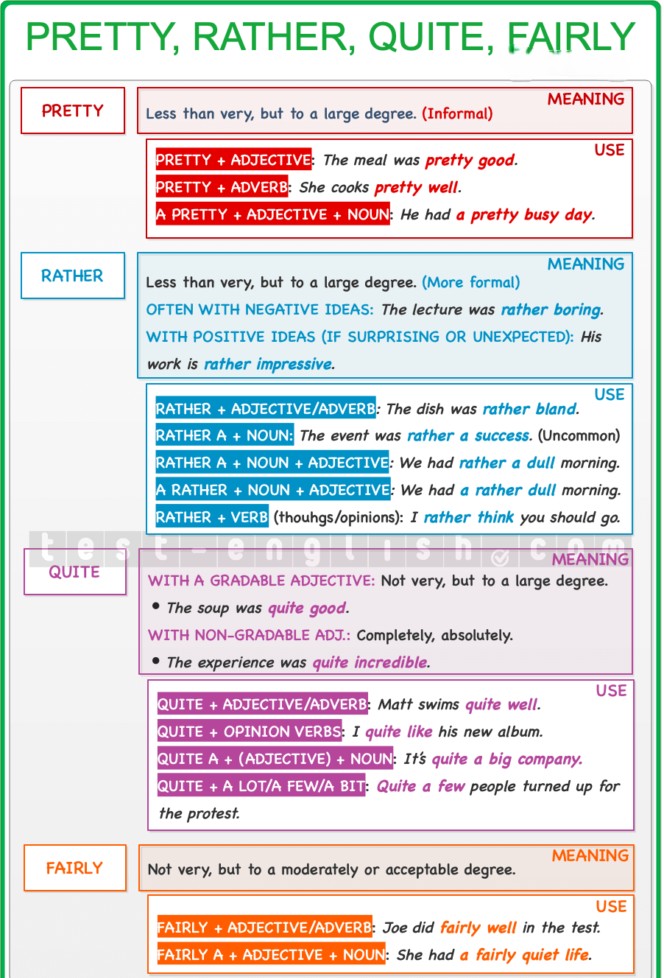
📥 Download full-size image from Pinterest
🟦What Are These Adverbs of Degree?
Pretty, rather, quite, and fairly are adverbs of degree used to modify the intensity of adjectives, adverbs, verbs, or nouns. Though similar, each has distinct nuances, formality levels, and grammatical rules.
✅ The meal was pretty good.
✅ The lecture was rather boring.
✅ I’m quite sure that’s correct.
✅ We live fairly close to each other.
🟩Pretty
Meaning: “Less than very, but to a large degree.”
Usage: Informal only. Used only before adjectives and adverbs. Rarely used in negative contexts.
✅ The meal was pretty good.
✅ She cooks pretty well.
🔹 With adjective + noun: always use an article (a or the).
✅ We had a pretty busy day.
✅ He’s a pretty good driver.
🟪Rather
Meaning: Similar to pretty, but more formal.
Usage: Versatile—can intensify negative or (surprisingly) positive ideas.
✅ The dish was rather bland.
✅ His work is rather impressive.
🔹 With noun phrases: article can come before or after rather (more formal with article after).
✅ The event was rather a success.
✅ We’ve had a rather dull morning.
🔹 Can precede verbs (especially in British English).
✅ I rather think you should apologise.
🟦Quite
Meaning depends on what follows:
- 🔸 Before gradable adjectives/adverbs → “fairly” or “to a large degree” (but not “very”).
- 🔸 Before non-gradable (extreme) adjectives → “completely” or “absolutely”.
✅ The soup was quite good. (gradable)
✅ I’m quite sure that’s correct. (non-gradable)
✅ The experience was quite incredible.
🔹 Can intensify opinion verbs and quantifiers.
✅ I quite like his new album.
✅ Quite a few people came.
✅ It’s quite a lot warmer in Italy.
🔹 With noun phrases: always use an article after quite.
✅ The launch was quite a success.
✅ It’s quite a big company.
🟨Fairly
Meaning: “Not very, but to a moderate or acceptable degree.”
Usage: The weakest of the four in intensity. Used before adjectives and adverbs.
✅ We live fairly close to one another.
✅ Joe did fairly well in the test.
🔹 With adjective + noun: article comes before fairly.
✅ It is a fairly common surname.
✅ She had a fairly quiet life.
📌 Quick Comparison:
🔥 Strongest: quite (with non-gradable) → “completely”
💬 Formal: rather | Informal: pretty
🌡️ Weakest: fairly → “moderately”
📚 All modify adjectives/adverbs; only rather and quite work with verbs/nouns.
🇬🇧 Rather + verb is more common in British English.