Grammar / B1+ Grammar lessons and exercises / Already, still, yet: What’s the difference?
Still, Yet, Already: What’s the difference?
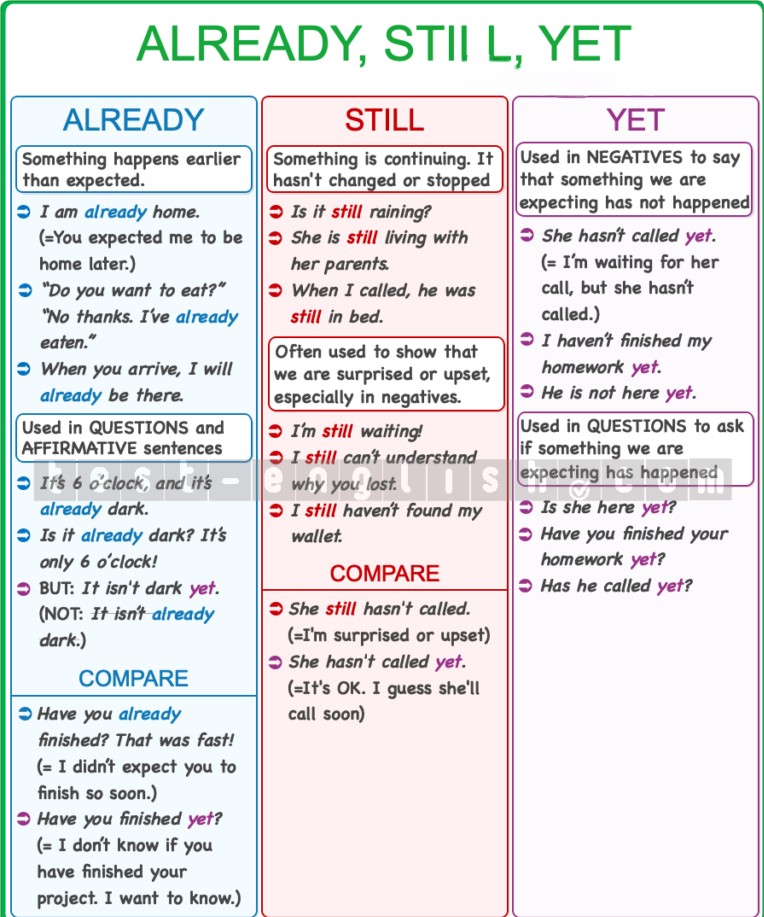
🟦Overview
Already, still, and yet are adverbs used with the present perfect (and sometimes past simple) to talk about time, expectations, and ongoing situations—but they have very different meanings and positions.
🟩Already
We use already when something happens earlier than expected or sooner than something else.
✅ I am already home. (= You expected me later.)
✅ “Do you want to eat?” — “No thanks. I’ve already eaten.”
✅ When you arrive, I will already be there.
Position: Usually in mid-position (after auxiliary verbs, before main verbs). In informal speech, it can go at the end.
✅ He already has a license.
✅ I have already finished.
✅ Have you already left? (question)
✅ He has a license already. (informal)
🟪Yet
We use yet in negative sentences and questions to say that something expected has not happened (but may happen soon).
✅ She hasn’t called yet.
✅ I haven’t done my homework yet.
✅ Has he arrived yet?
Position: Almost always at the end of the sentence.
🟦Still
We use still to say that a situation continues—it hasn’t changed or stopped. Often expresses surprise or impatience.
✅ He is still in the shower.
✅ I still haven’t found my wallet.
✅ Are you still working?
Position: Mid-position—before the main verb, after "be", or after the first auxiliary/modal.
✅ She still lives here.
✅ I am still tired.
✅ I still can’t understand it.
✅ She still hasn’t replied.
🟨Still vs Yet in Negative Sentences
Both can be used in negatives, but still often shows surprise or impatience, while yet is more neutral.
✅ She hasn’t called yet. (= I’m waiting.)
✅ She still hasn’t called! (= I’m annoyed/surprised!)
✅ He hasn’t graduated yet.
✅ He still hasn’t graduated. (= It’s taking too long!)
🟥British vs American English
There’s a key difference in verb tense preference:
🇬🇧 British English
Prefers present perfect:
“I’ve already eaten.”
“Have you finished yet?”
🇺🇸 American English
Often uses past simple:
“I already ate.”
“Did you finish yet?”
📌 Quick Summary:
🔸 Already = happened sooner than expected → mid-position or end (affirmative/questions).
🔸 Yet = not happened (but expected) → end of sentence (negatives/questions).
🔸 Still = situation continues → mid-position (often shows surprise in negatives).
🔸 Still + negative = more emotional than yet.
🌍 UK: present perfect | US: past simple (with already/yet).