Grammar / B1+ Grammar lessons and exercises / Adjectives without noun
Adjectives Without Nouns
🟦Well-Known Groups of People
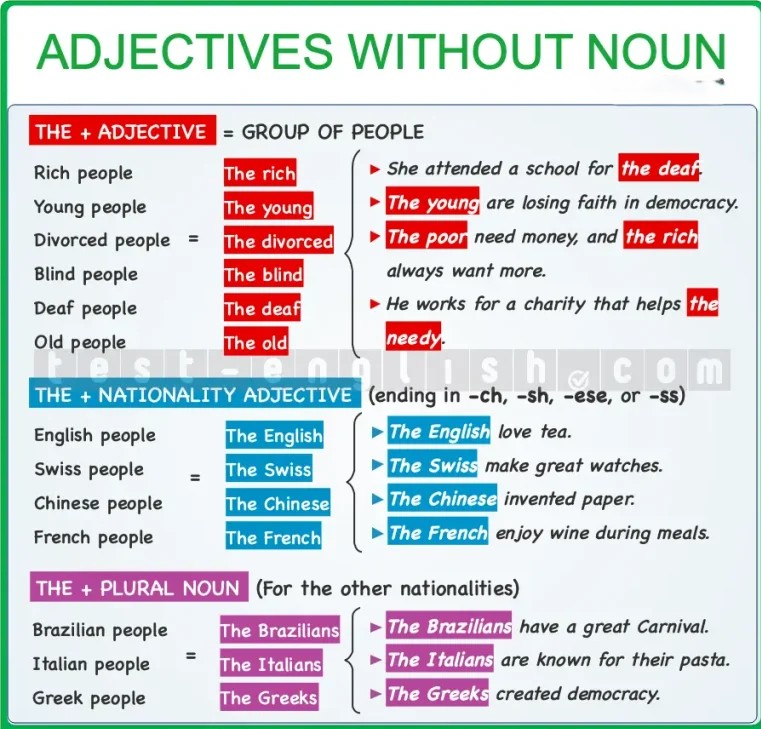
We can use the + adjective (without a noun) to refer to certain groups of people in general. This is a common and formal way to talk about people who share a characteristic.
✅ The government is going to provide more help for the mentally ill.
✅ The new taxation system doesn’t help the poor.
✅ The rich vote Republican in the US.
✅ They have organised a marathon to support the blind.
✅ The jobless are losing hope of finding a good job.
✅ This tradition has existed for centuries to keep the memory of the dead.
✅ Their organisation raises money to help the handicapped.
Other common examples: the deaf, the young, the disabled, the old, the needy, the divorced, the illiterate, etc.
But with adjectives used as nouns for people, the + adjective is required.
You can also say: rich people, blind people, young people — without the.
🟩Nationalities Ending in -ch, -sh, -ese, -ss
For nationalities ending in -ch, -sh, -ese, or -ss, we use the + adjective to refer to all people of that nationality.
✅ The English like their privacy. (= English people)
✅ The Swiss are voting on emigration again.
✅ The Chinese are unhappy about the new system.
✅ The Japanese value harmony in communication.
✅ The Portuguese celebrate this festival every June.
🟪The + Plural Noun (Other Nationalities)
Most other nationalities are used as nouns. To refer to all people of that nationality, use the + plural noun.
✅ The Belgians are known for their excellent chocolate.
✅ The Brazilians were shocked after their national team’s defeat.
✅ The demonstrators were shouting, “Greece belongs to the Greeks.”
✅ The Moroccans welcomed us with mint tea.
🟦Singular Reference: Special Nationalities
For nationalities ending in -ch, -sh, -ese, -ss, you cannot use the adjective alone as a singular noun. Instead, use -man / -woman or a special noun.
✅ an Englishman / an Englishwoman (NOT “an English”)
✅ a Frenchman / a Frenchwoman
✅ an Irishman / an Irishwoman
However, some nationalities have special singular nouns:
✅ a Spaniard (NOT “a Spanishman”)
✅ a Dane (NOT “a Danishwoman”)
✅ a Finn, a Scot, a Pole, a Swede, a Turk
When a special noun exists, you can refer to the whole group in two ways:
- ‣ The + adjective: the Spanish, the Polish, the Swedish
- ‣ The + plural noun: the Spaniards, the Poles, the Swedes
🟨Regular Nationalities (Singular)
For most other nationalities, the singular noun is the same as the adjective.
✅ a Belgian, a Moroccan, a Canadian, an Australian
📌 Key Rules:
👥 The + adjective = group of people (e.g., the poor, the elderly).
🌍 Nationalities in -ch, -sh, -ese, -ss → the English, the Japanese.
🌐 Other nationalities → the + plural noun (e.g., the Germans, the Italians).
👤 Singular: use -man/-woman or special nouns (e.g., a Scot, a Finn).
🔄 Two forms possible when special nouns exist: the Spanish OR the Spaniards.