Grammar / B1+ Grammar lessons and exercises / Adjective order
Adjective Order in English
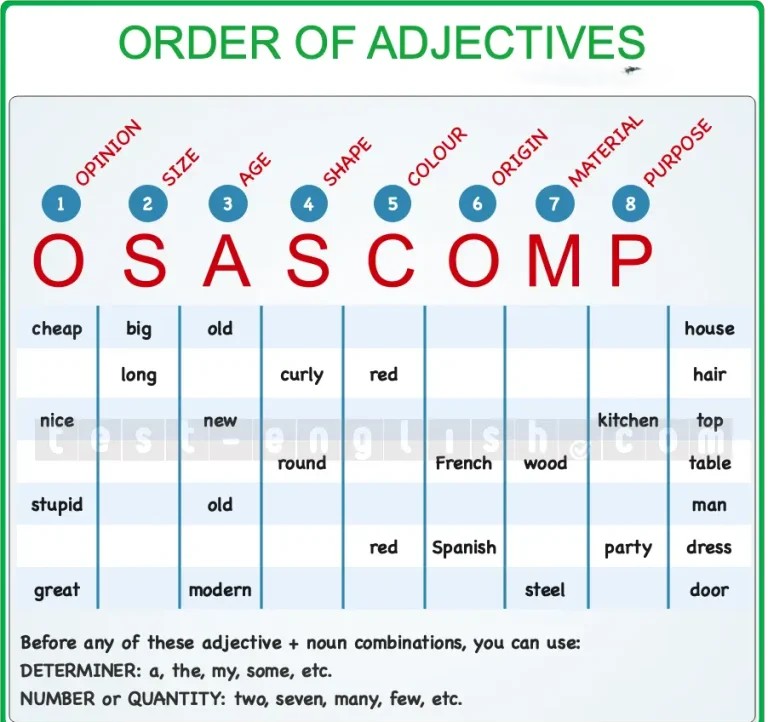
Native speakers often learn how to order adjectives intuitively through years of exposure and practice rather than through formal study. They develop a natural sense of what ‘sounds right’ without necessarily knowing the rules that govern these choices. However, for students of English as a second language, mastering the order of adjectives can be quite challenging. As you can see in the grammar chart above, there’s a handy mnemonic (OSASCOMP) that can help you remember the usual sequence. Fortunately, it’s rare that you’ll need to use many adjectives together, and when you do, the context of the sentence often guides the correct placement, making communication clear and effective even if the order varies slightly.
🟦Opinion vs. Fact Adjectives
Opinion adjectives express what the speaker thinks of something (e.g., nice, handsome, brilliant).
Fact adjectives give objective information (e.g., age, size, colour, material).
When using two or more adjectives together, opinion adjectives usually come before fact adjectives.
✅ They live in an amazing modern attic.
✅ She’s a beautiful young woman.
🟩The OSASCOMP Rule
When using multiple fact adjectives, they follow this standard order:
- Opinion: wonderful, terrible, lovely
- Size: small, huge, tiny
- Age: ancient, new, young
- Shape: round, square, oblong
- Colour: green, bright, pale
- Origin: Victorian, American, Turkish
- Material: wooden, metallic, cotton
- Purpose: racing, sleeping, cooking
💡 Mnemonic: Opinion – Size – Age – Shape – Colour – Origin – Material – Purpose → OSASCOMP
🟪Determiners Come First
Before any adjective-noun combination, we use one or more determiners, such as:
Articles: a, an, the
Possessives: my, your, her, their
Demonstratives: this, that, these, those
Numbers: one, ten, fifty
Quantifiers: some, any, many, few, several
Example: My (determiner) + beautiful (opinion) + small (size) + old (age) + round (shape) + red (colour) + Italian (origin) + wooden (material) + serving (purpose) + tray (noun)
📌 Key Rules:
👂 Native speakers rely on intuition; learners use OSASCOMP.
💬 Opinion adjectives come before fact adjectives.
🔢 Fact adjectives follow strict order: O-S-A-S-C-O-M-P.
🧷 Always start with a determiner (a, the, my, this, etc.).
🌐 Real usage is flexible—but OSASCOMP ensures clarity and correctness.