Grammar / A2 Grammar lessons and exercises / verbs-with-two-objects
Verbs with Two Objects: Double Object Verbs
📌 Direct and Indirect Objects
The direct object answers “what?” or “who?”
✅ I bought a nice sweater. → What? A sweater.
✅ I saw Peter and Sarah. → Who? Peter and Sarah.
The indirect object answers “to whom?” or “for whom?”
✅ I sent my friends a picture of the house. → To whom? My friends.
✅ I cooked my wife breakfast. → For whom? My wife.
🔄 Verbs with Two Objects
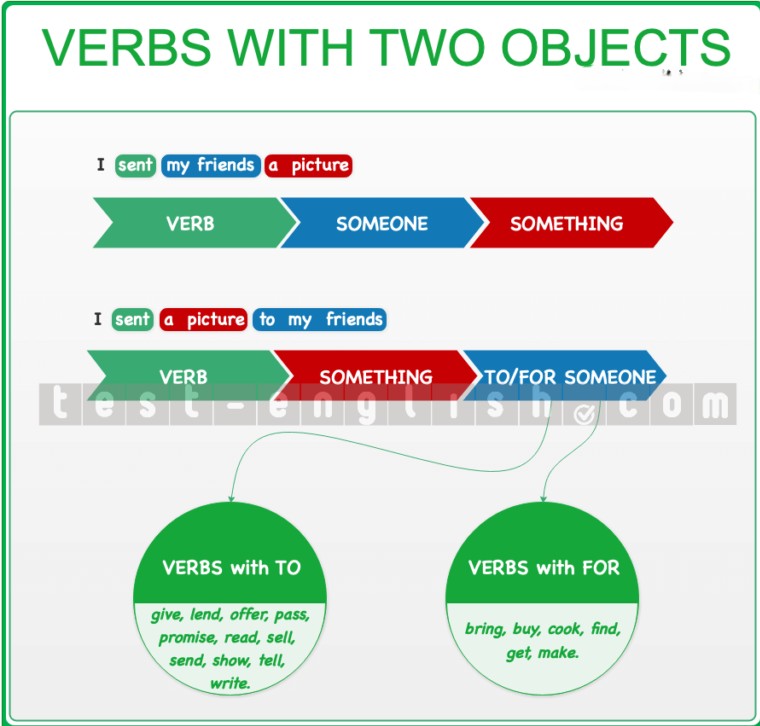
Some verbs can take two objects: an indirect object (person) and a direct object (thing).
Common double-object verbs:
bring, buy, cook, find, get, give, lend, make, offer, pass, promise, read, sell, send, show, tell, write
There are two possible structures:
- ✅ I sent my friends a picture. → verb + IO + DO
- ✅ I sent a picture to my friends. → verb + DO + to/for + IO
💡 If the indirect object is a pronoun (me, you, him, her, etc.), we usually place it next to the verb:
✅ I sent them a picture. (NOT: I sent a picture to them — though grammatically correct, less common)
🔹 To or For?
When using the structure verb + direct object + preposition, choose to or for based on the verb.
❗ When using IO next to verb → NO “to” or “for”
✅ Use “to” or “for” in: verb + DO + to/for + IO
✅ I sent a postcard to Alex.
✅ She bought a present for her friend.
🔸 Verbs with “to + indirect object”
These verbs typically use “to” before the indirect object in the DO + prep + IO structure:
give, lend, offer, pass, promise, read, sell, send, show, tell, write
✅ You should give an apology to Tom.
✅ She showed the letter to all her friends.
🔸 Verbs with “for + indirect object”
These verbs typically use “for” before the indirect object:
bring, buy, cook, find, get, make
✅ Can you bring some food for the dog?
✅ I’ll cook a nice dinner for you.
💡 Quick Summary
- Two Structures: verb + IO + DO OR verb + DO + to/for + IO
- Use pronouns next to verb: “I gave her a book” (✔️ not “I gave a book to her” — though both correct, first is more natural)
- “To” verbs: give, send, show, tell, write, lend, offer, read, sell, pass, promise
- “For” verbs: buy, cook, make, get, find, bring
- Never use “to/for” when IO is placed directly after verb: “I sent Alex a letter” ✔️ — NOT “I sent to Alex a letter” ❌