Grammar / A2 Grammar lessons and exercises/ Too, too much, too many, enough
Too, Too Much, Too Many, Enough
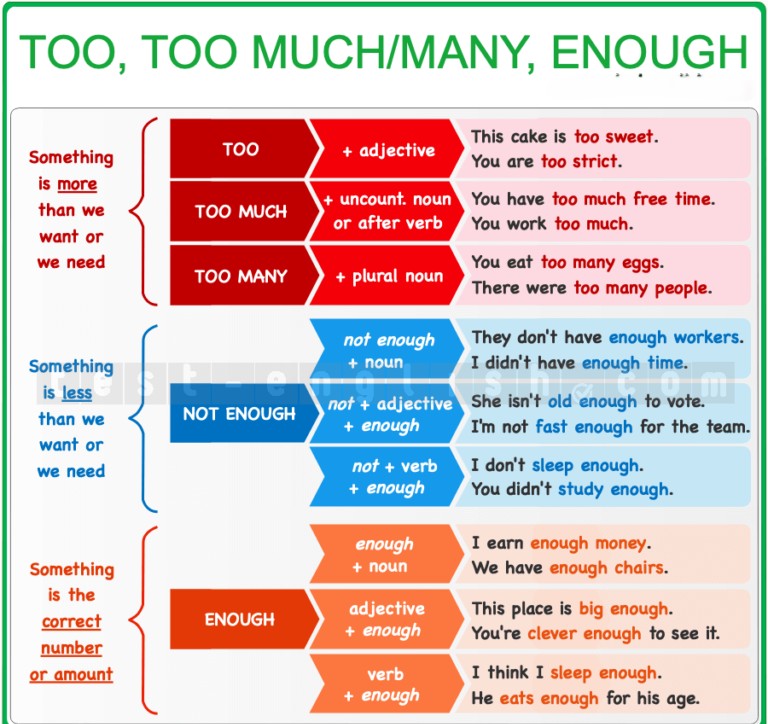
🟦 Too
We use too before an adjective or adverb to mean ‘more than we need’ or ‘more than is necessary’.
✅ You are too young to enter this club.
✅ We arrived too late.
🟩 Too much
We use too much before an uncountable noun to mean ‘more than we need’.
✅ The doctor said I drink too much coffee.
✅ I hate this city. There’s too much traffic.
🔹 Also used after a verb:
✅ You can’t take the car. You’ve drunk too much.
✅ He talks too much.
🟪 Too many
We use too many before a plural countable noun to mean ‘more than we need’.
✅ I didn’t enjoy the concert. There were too many people.
✅ They lost because they made too many mistakes.
🟧 Enough
We use enough before a noun to say something is the correct amount.
✅ I have saved enough money to go to Rome.
✅ Do you have enough butter to cook?
🔹 In negative sentences: (not) enough + noun → less than needed
✅ We don’t have enough money to travel.
✅ I don’t have enough time to finish my homework.
🟥 Enough (after adjective/adverb)
We use adjective/adverb + enough to mean ‘sufficiently’.
✅ This bed is big enough for the four of us.
✅ I think she spoke clearly enough. Everybody understood.
🔹 Negative form: (not) adjective/adverb + enough
✅ You aren’t old enough to enter this club.
✅ You aren’t going fast enough. We’re going to be late.
🔹 Also used after verbs:
✅ I didn’t study enough, and I failed the exam.
✅ I think you don’t sleep enough. You should sleep 7–8 hours.
🟪 Too / Enough + to-infinitive
These structures often combine with to + infinitive to show result or consequence.
✅ I was too tired to go clubbing.
✅ She makes enough money to sustain her family.
⚠️ Common Mistakes to Avoid
❌ Don’t use an adjective after “too much”:
I’m too much tired to study now. → ✅ I’m too tired to study now.
❌ Don’t confuse “too” with “very”:
Too = excessive (negative)
Very = intense (neutral/positive)
- ✅ I think she is too beautiful — it’s overwhelming.
- ✅ I think she is very beautiful — I admire her.