Grammar / A2 Grammar lessons and exercises / Subject questions, questions with preposition
Subject questions and object questions
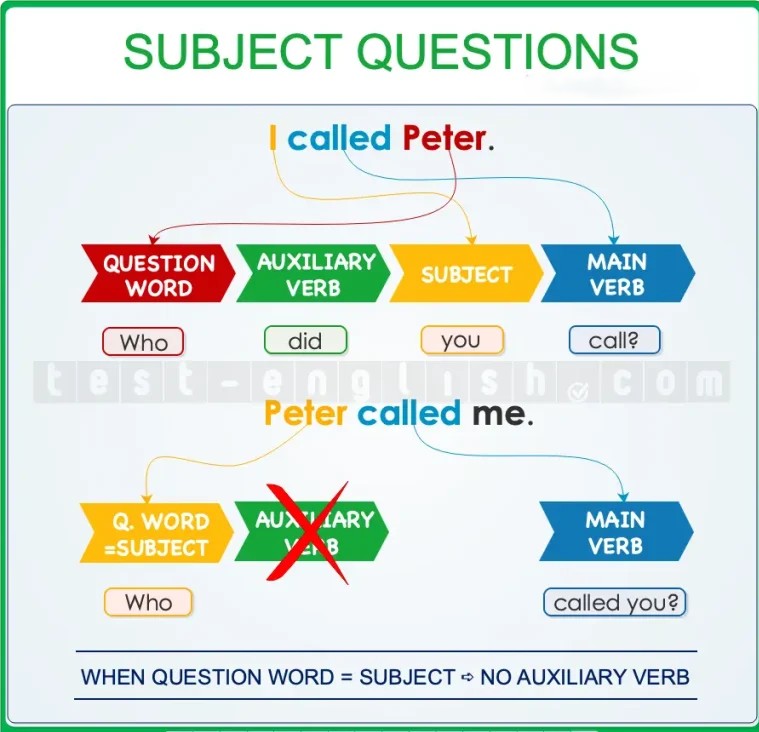
Subject Questions (Present & Past Simple)
In the present and past simple tenses, we do not use an auxiliary verb (do/does or did) after the question word if the question word (who, what, etc.) is the subject of the sentence.
Who did win the match? → Who won the match?
What did happen last night? → What happened last night?
How many people did go to the party? → How many people went to the party?
This rule applies specifically to the present and past simple tenses. For other tenses (present continuous, present perfect, etc), where the auxiliary verb is part of the verb form, we include the auxiliary verbs in subject questions.
- Who is cooking dinner tonight?
- Who has eaten all the cookies?
Object Questions
When we are asking about the object (after the verb), we use the normal order of the English question: auxiliary verb + subject. These types of questions are called object questions.
Jack called Teresa. (Teresa = object)
Jack called Teresa. (Jack = subject)
Who did Jack call? (Who = object)
Who called Teresa? (Who = subject)
Questions with Preposition
In informal or spoken English, when a question word needs a preposition, the preposition goes at the end of the question (after the verb or after verb + object if there is an object). We don’t use the preposition at the beginning.
- I played tennis with John. ⇒ Who did you play tennis with?
- I work for a multinational company ⇒ What company do you work for?
- We usually talk about sports. ⇒ What do you usually talk about?